Advertisements
Advertisements
Question
|
A watermelon vendor arranged the watermelons similar to shown in the adjoining picture:
|
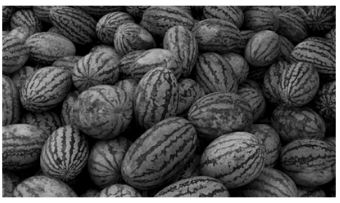
Based on the above information, answer the following questions:
(i) Find the value of ‘d’. [1]
(ii) How many watermelons will be there in the 15th row from the bottom? [1]
(iii) (a) Find the total number of watermelons from bottom to top. [2]
OR
(iii) (b) If the number of watermelons in the nth row from top is equal to number of watermelons in the nth row from bottom, find the value of n. [2]
Advertisements
Solution
This forms an Arithmetic Progression.
Bottom row (first term) a = 101
Top row (Last term) l = 1
Number of rows (n) = 21
Common difference = d.
(i) l = a + (n – 1)d
1 = 101 + (21 – 1)d
⇒ `d = (-100)/20`
d = –5
(ii) an = a + (n – 1)d
a15 = 101 + (15 – 1)(–5)
a15 = 101 + 14(–5)
a15 = 101 – 70
a15 = 31
There will be 31 watermelons in the 15th row from the bottom.
(iii) (a) `S_n = n/2 (a + l)`
`S_21 = 21/2 (101 + 1)`
= `21/2 (102)`
= 21 × 51
= 1071
∴ The total number of watermelons from bottom to top is 1071.
OR
(iii) (b) Sequence from bottom to top is an AP.
101, 96, 91, ... 1
nth row from bottom
an = 101 + (n – 1)(–5)
= 101 – 5(n – 1)
nth row from top
If there are 21 rows total, then nth row from top = (21 – n + 1) = (22 – n)th term from bottom
a22–n = 101 – 5((22 – n) – 1)
= 101 – 5(21 – n)
101 – 5(n – 1) = 101 – 5(21 – n)
106 – 5n = –4 + 5n
106 + 4 = 5n + 5n
110 = 10n
n = 11
