English

A vessel is in the form of a hollow hemisphere mounted by a hollow cylinder. The diameter of the hemisphere is 14 cm and the total height of the vessel is 13 cm. Find the inner surface area of the - Mathematics

Advertisements
Advertisements

Question

A vessel is in the form of a hollow hemisphere mounted by a hollow cylinder. The diameter of the hemisphere is 14 cm and the total height of the vessel is 13 cm. Find the inner surface area of the vessel. [Use `pi = 22/7`]

Sum
Advertisements

Solution
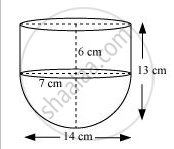
It can be observed that the radius (r) of the cylindrical part and the hemispherical part is the same (i.e., 7 cm).

Height of hemispherical part = Radius = 7 cm

Height of cylindrical part (h) = 13 − 7 = 6 cm

Inner surface area of the vessel = CSA of cylindrical part + CSA of hemispherical part

= 2πrh + 2πr2

Inner surface are of vessel = `2 xx 22/7 xx 7 xx 6+2 xx 22/7 xx 7 xx 7`

= 44 (6 + 7)

= `44xx13`

= 572 cm2

shaalaa.com
  Is there an error in this question or solution?
Chapter 14: Surface Areas and Volumes - Exercise 14.2 [Page 61]

APPEARS IN

RD Sharma Mathematics [English] Class 10
Chapter 14 Surface Areas and Volumes
Exercise 14.2 | Q 17 | Page 61
NCERT Mathematics [English] Class 10
Chapter 12 Surface Areas and Volumes
EXERCISE 12.1 | Q 2. | Page 166

RELATED QUESTIONS

Due to sudden floods, some welfare associations jointly requested the government to get 100 tents fixed immediately and offered to contribute 50% of the cost. If the lower part of each tent is of the form of a cylinder of diameter 4.2 m and height 4 m with the conical upper part of same diameter but of height 2.8 m, and the canvas to be used costs Rs. 100 per sq. m, find the amount, the associations will have to pay. What values are shown by these associations? [Use π=22/7]


A right circular cone of radius 3 cm, has a curved surface area of 47.1 cm2. Find the volume of the cone. (use π 3.14).


A wooden article was made by scooping out a hemisphere from each end of a solid cylinder, as shown in given figure. If the height of the cylinder is 10 cm, and its base is of radius 3.5 cm, find the total surface area of the article.

 [Use `pi = 22/7`]


Find the area of the shaded region in Fig. 3, where arcs drawn with centres A, B, C and D intersect in pairs at mid-points P, Q, R and S of the sides AB, BC, CD and DA respectively of a square ABCD of side 12 cm. [Use π = 3.14]


The diameters of the lower and upper ends of a bucket in the form of a frustum of a cone are 10 cm and 30 cm respectively. If its height is 24 cm, find:

1) The area of the metal sheet used to make the bucket.

2) Why we should avoid the bucket made by ordinary plastic? [Use π = 3.14]


A toy is in the shape of a right circular cylinder with a hemisphere on one end and a cone on the other. The radius and height of the cylindrical part are 5 cm and 13 cm respectively.The radii of the hemispherical and conical parts are the same as that of the cylindrical part.Find the surface area of the toy if the total height of the toy is 30 cm.


The perimeters of the ends of a frustum of a right circular cone are 44 cm and 33 cm. If the height of the frustum be 16 cm, find its volume, the slant surface and the total surface.


If the radii of circular ends of a bucket 24cm high are 5cm and 15cm. find surface area of
bucket?


A solid cuboid of iron with dimensions 53 cm ⨯ 40 cm ⨯ 15 cm is melted and recast into a cylindrical pipe. The outer and inner diameters of pipe are 8 cm and 7 cm respectively. Find the length of pipe.


Three solid spheres of radii 3, 4 and 5 cm respectively are melted and converted into a single solid sphere. Find the radius of this sphere.


From a solid cube of side 7 cm , a conical cavity of height 7 cm and radius 3 cm is hollowed out . Find the volume of the remaining solid.


A spherical ball of radius 3 cm is melted and recast into three spherical balls. The radii of two of these balls are 1.5 cm and 2 cm. Find the radius of the third ball.


How many lead shots each 3 mm in diameter can be made from a cuboid of dimensions 9 cm × 11 cm × 12 cm ?


Three metallic cubes whose edges are 3 cm, 4 cm and 5 cm, are melted and recast into a single large cube. Find the edge of the new cube formed.


Match the following columns:

Column I Column II
(a) The radii of the circular ends of
a bucket, in the form of the frustum of a cone of height 30 cm, are 20 cm
and 10 cm respectively. The
capacity of the bucket is ........cm3.
(p) 2418π
(b) The radii of the circular ends
 of a conical bucket of height
15 cm are 20 and 12 cm
respectively. The slant height
of the bucket is ........ cm.
(q) 22000
(c) The radii of the circular ends of
a solid frustum of a cone are 33 cm
and 27 cm and its slant height is
10 cm. The total surface area of
the bucket is .........cm2.
(r) 12
(d) Three solid metallic spheres of
radii 3 cm, 4 cm and 5 cm are
melted to form a single solid
sphere. The diameter of the
resulting sphere is ........ cm.
(s) 17

A container opened at the top and made up of a metal sheet, is in the form of a frustum of a cone of height 16 cm with radii of its lower and upper ends as 8 cm and 20 cm respectively. Find the cost of milk which can completely fill the container, at the rate of ₹ 50 per litre. Also find the cost of metal sheet used to make the container, if it costs ₹ 10 per 100 cm2. (Take π = 3⋅14)


Eight solid sphere of same size are made by melting a solid metallic cylinder of base diameter 6 cm and height 32 cm. The diameter of each sphere is ______.


A plumbline (sahul) is the combination of (see figure) ______.


Khurja is a city in the Indian state of Uttar Pradesh famous for the pottery. Khurja pottery is traditional Indian pottery work which has attracted Indians as well as foreigners with a variety of tea sets, crockery and ceramic tile works. A huge portion of the ceramics used in the country is supplied by Khurja and is also referred as "The Ceramic Town".

One of the private schools of Bulandshahr organised an Educational Tour for class 10 students to Khurja. Students were very excited about the trip. Following are the few pottery objects of Khurja.

Students found the shapes of the objects very interesting and they could easily relate them with mathematical shapes viz sphere, hemisphere, cylinder etc.

Maths teacher who was accompanying the students asked the following questions:

  1. The internal radius of hemispherical bowl (filled completely with water) in I is 9 cm and the radius and height of the cylindrical jar in II are 1.5 cm and 4 cm respectively. If the hemispherical bowl is to be emptied in cylindrical jars, then how many cylindrical jars are required?
  2. If in the cylindrical jar full of water, a conical funnel of the same height and same diameter is immersed, then how much water will flow out of the jar?

Share
Notifications

Englishहिंदीमराठी


      Forgot password?
Use app×