Advertisements
Advertisements
Question
A turn of radius 20 m is banked for the vehicles going at a speed of 36 km/h. If the coefficient of static friction between the road and the tyre is 0.4, what are the possible speeds of a vehicle so that it neither slips down nor skids up?
Advertisements
Solution
Given:
Speed of vehicles = v = 36 km/hr = 10 m/s
Radius = r = 20 m
Coefficient of static friction = μ = 0.4
Let the road be banked with an angle \[\theta\]
We have :
\[\theta = \tan^{- 1} \frac{\text{v}^2}{\text{rg}}\]
\[ = \tan^{- 1} \frac{100}{20 \times 10}\]
\[ = \tan^{- 1} \left( \frac{1}{2} \right)\]
\[ \Rightarrow \text{tan } \theta = 0 . 5\]
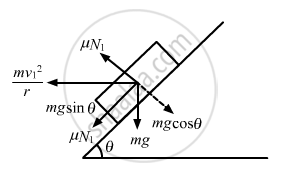
When the car travels at the maximum speed, it slips upward and μN1 acts downward.
Therefore we have :
\[\text{ N}_1 - \text{mg}\cos\theta - \frac{\text{mv}_1^2}{r}\sin\theta = 0 . . . \left( \text{i} \right)\]
\[\mu \text{N}_1 + \text{mg }\sin\theta - \frac{\text{mv}_1^2}{r}\cos\theta = 0 . . . \left(\text{ ii} \right)\]
On solving the above equations, we get :
\[\text{v}_1 = \sqrt{\text{rg}\frac{\mu + \tan\theta}{1 - \mu\tan\theta}}\]
\[ = \sqrt{20 \times 10 \times \frac{0 . 9}{0 . 8}}\]
\[ = 15 \text{ m/s = 54 km/hr }\]
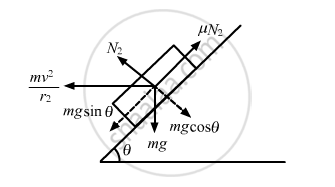
Similarly, for the other case, it can be proved that :
\[\text{v}_2 = \sqrt{\text{rg}\frac{\text{tan}\theta - \mu}{\sqrt{1 - \mu \text{ tan }\theta}}}\]
\[ = \sqrt{20 \times 10 \times \frac{0 . 1}{1 . 2}}\]
\[ = 4 . 08 \text{ m/s = 14 . 7 km/hr}\]
Thus, the possible speeds are between 14.7 km/hr and 54 km/hr so that the car neither slips down nor skids up.
APPEARS IN
RELATED QUESTIONS
A stone of mass 0.25 kg tied to the end of a string is whirled round in a circle of radius 1.5 m with a speed of 40 rev/min in a horizontal plane. What is the tension in the string? What is the maximum speed with which the stone can be whirled around if the string can withstand a maximum tension of 200 N?
A disc revolves with a speed of `33 1/3` rev/min, and has a radius of 15 cm. Two coins are placed at 4 cm and 14 cm away from the centre of the record. If the co-efficient of friction between the coins and the record is 0.15, which of the coins will revolve with the record?
A 70 kg man stands in contact against the inner wall of a hollow cylindrical drum of radius 3 m rotating about its vertical axis with 200 rev/min. The coefficient of friction between the wall and his clothing is 0.15. What is the minimum rotational speed of the cylinder to enable the man to remain stuck to the wall (without falling) when the floor is suddenly removed?
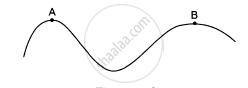
A car moves at a constant speed on a road as shown in figure. The normal force by the road on the car NA and NB when it is at the points A and B respectively.
A motorcycle is going on an overbridge of radius R. The driver maintains a constant speed. As the motorcycle is ascending on the overbridge, the normal force on it
If the earth stop rotating, the apparent value of g on its surface will
Let θ denote the angular displacement of a simple pendulum oscillating in a vertical plane. If the mass of the bob is m, the tension is the string is mg cos θ
An object follows a curved path. The following quantities may remain constant during the motion
(a) speed
(b) velocity
(c) acceleration
(d) magnitude of acceleration.
Suppose the amplitude of a simple pendulum having a bob of mass m is θ0. Find the tension in the string when the bob is at its extreme position.
A hemispherical bowl of radius R is rotated about its axis of symmetry which is kept vertical. A small block is kept in the bowl at a position where the radius makes an angle θ with the vertical. The block rotates with the bowl without any slipping. The friction coefficient between the block and the bowl surface is μ. Find the range of the angular speed for which the block will not slip.
When seen from below, the blades of a ceiling fan are seen to be revolving anticlockwise and their speed is decreasing. Select the correct statement about the directions of its angular velocity and angular acceleration.
In non-uniform circular motion, the ratio of tangential to radial acceleration is (r = radius, a = angular acceleration and v = linear velocity)
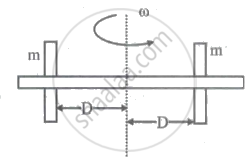
Two identical masses are connected to a horizontal thin (massless) rod as shown in the figure. When their distance from the pivot is D, a torque τ produces an angular acceleration of α1. The masses are now repositioned so that they are 2D from the pivot. The same torque produces an angular acceleration α2 which is given by ______
A rigid body is rotating with angular velocity 'ω' about an axis of rotation. Let 'v' be the linear velocity of particle which is at perpendicular distance 'r' from the axis of rotation. Then the relation 'v = rω' implies that ______.
If a cyclist doubles his speed while negotiating a curve, how does the tendency to overturn vary?
A particle performs uniform circular motion in a horizontal plane. The radius of the circle is 10 cm. If the centripetal force F is kept constant but the angular velocity is halved, the new radius of the path will be ______.
In negotiating curve on a flat road, a cyclist leans inwards by an angle e with the vertical in order to ______.
A body is moving along a circular track of radius 100 m with velocity 20 m/s. Its tangential acceleration is 3 m/s2 then its resultant accelaration will be ______.
A racing car travels on a track (without banking) ABCDEFA (Figure). ABC is a circular arc of radius 2 R. CD and FA are straight paths of length R and DEF is a circular arc of radius R = 100 m. The co-efficient of friction on the road is µ = 0.1. The maximum speed of the car is 50 ms–1. Find the minimum time for completing one round.
A particle at rest starts moving with constant angular acceleration ‘α’ in circular path. At what time the magnitude of centripetal acceleration is half the tangential acceleration?
