Advertisements
Advertisements
Question
Read the following paragraph and answer the questions that follow.
|
A student sets up the circuit as shown in the figure to find the value of unknown resistance X and records a set of readings of the voltmeter and the ammeter by using the rheostat.
|
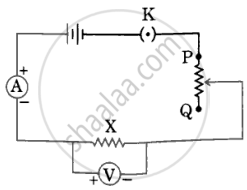
i. If resistor X were made of manganin and readings for V and I are taken without switching off the circuit, the graph between V and I will be as:


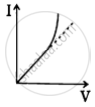
ii. Error in the value of X obtained from different sets of voltmeter and ammeter readings, is ______.
- due to error in voltmeter reading only.
- due to error in ammeter reading only.
- equal to the sum of error in voltmeter reading and error in ammeter reading.
- equal to error in voltmeter reading divided by the error in ammeter reading.
iii. If the movable end of rheostat is moved towards P, then ______.
- reading in ammeter decreases and reading in voltmeter increases.
- readings in both voltmeter and ammeter increase.
- reading in ammeter increases and reading in voltmeter decreases.
- readings in both voltmeter and ammeter decrease.
iv. a. Suppose the unknown resistance X is replaced by a wire made of the same metal. This wire consists of three parts of the same length L but has radii r, `r/3` and `r/2` as shown in the figure.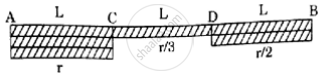
For a particular setting of the rheostat, let v1, v2 and v3 be the value of drift velocities in parts AC, CD and DB. Then:
- v1 > v2 > v3
- v2 > v3 > v1
- v3 > v2 > v1
- v1 = v2 = v3
OR
b. Consider the same wire, as shown in figure in question (iv)(a) connected in place of X. For a particular setting of rheostat, let E1, E2 and E3 be the value of electric fields in part AC, CD and DB. Then:
- E1 = E2 = E3
- E3 > E2 > E1
- E2 > E3 > E1
- E1 > E2 > E3
Advertisements
Solution
i.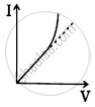
Explanation:
Even if the circuit is not turned off, manganin’s resistance (R) stays constant because of its very low temperature coefficient of resistance (i.e., even if there is small heating due to the Joule effect).
Because R is constant, the ratio `V/I` remains constant.
A constant ratio results in a linear graph (straight line) passing through the origin in the V-I plane.
∴ The graph will be a straight line passing through the origin.
ii. Error in the value of X obtained from different sets of voltmeter and ammeter readings, is equal to the sum of error in voltmeter reading and error in ammeter reading.
Explanation:
Both the voltage V, as determined by the voltmeter, and the current I, as determined by the ammeter, determine the computed value of X. Any inaccuracy (systematic or random error) in either instrument will contribute to the total error in X. Based to the rules of error propagation, the total error in the result is the sum of the fractional or percentage errors of the divided numbers. The total error is the sum of the errors in both measurements.
iii. If the movable end of rheostat is moved towards P, then readings in both voltmeter and ammeter increase.
Explanation:
In the given circuit, moving the slider towards P decreases the effective length of the rheostat wire included in the circuit.
Since Resistance R ∝ Length, the rheostat resistance `R_"rheostat"` decreases.
As Rtotal decreases, the current I in the circuit increases `(I = E/R_"total")`. Thus, the ammeter reading increases.
The voltmeter is connected across the fixed resistor X. The potential drop across it is V = IX. Since I has increased and X is constant, the potential drop V also increases. Thus, the voltmeter reading increases. Thus, readings in both the voltmeter and the ammeter increase.
iv. a. v2 > v3 > v1
Explanation:
The three parts of the wire are connected in series, so the same current I flows through each part.
The material is the same, so the number density of free electrons (n) is the same.
Thus, vd ∝ `1/A prop 1/R^2`
Let’s calculate the ratios:
Part AC: R1 = r ⇒ v1 ∝ `1/r^2`
Part CD: R2 = `r/3` ⇒ v2 ∝ `1/((r//3)^2) = 9/r^2`
Part DB: R3 = `r/2` ⇒ v3 ∝ `1/((r//2)^2) = 4/r^2`
Comparing the values: v2 = 9v1 and v3 = 4v1.
Therefore, v2 > v3 > v1.
OR
b. E2 > E3 > E1
Explanation:
Since the wires are in series, the current I is constant throughout.
The material is the same, so the resistivity ρ is constant.
Thus, E ∝ `1/A prop 1/R^2`.
For part AC: E1 ∝ `1/r^2`
For part CD: E2 ∝ `1/((r//3)^2) = 9/r^2`
For part DB: E3 ∝ `1/((r//2)^2) = 4/r^2`
Comparing the magnitudes: E2 > E3 > E1.
