Advertisements
Advertisements
Question
|
A small town is analyzing the pattern of a new street light installation. The lights are set up in such a way that the intensity of light at any point x metres from the start of the street can be modelled by f(x) = ex sin x, where x is in metres. |
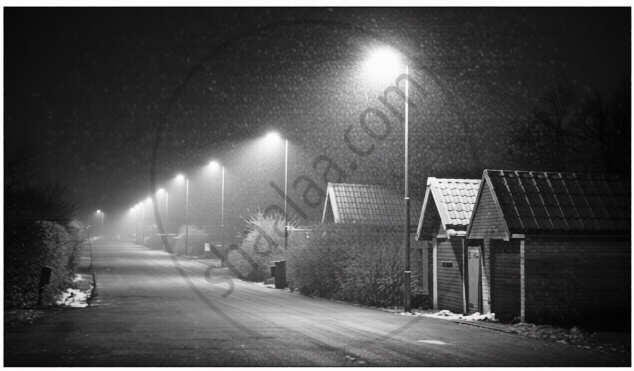
Based on the above, answer the following:
- Find the intervals on which the f(x) is increasing or decreasing, x ∈ [0, π]? [2]
- Verify, whether each critical point when x ∈ [0, π] is a point of local maximum or local minimum or a point of inflexion. [2]
Advertisements
Solution
(i) f(x) = ex sin x
f'(x) = ex cos x + ex sin x
⇒ ex (cos x + sin x)
f'(x) = 0
⇒ ex (cos x + sin x) = 0
ex ≠ 0
cos x = −sin x
x = `(3pi)/4 "in" [0, pi]`
∴ Inverval `[0, (3pi)/4), ((3pi)/4, pi]`
f' = `((2pi)/3)`
= `e^(2pi//3)(cos (2pi)/3 + sin (2pi)/3) ...[∵ x = (2pi)/3]`
= `e^(2pi//3)((-1)/2 + sqrt3/2) > 0`
Hence, f(x) is increasing on `[0, (3pi)/4)` and decreasing on `((3pi)/4, pi]`
(ii) f"(x) = ex (cos x + sin x) + ex (−sin x + cos x)
= 2ex cos x
`f"''"((3pi)/4) = 2e^(3pi//4) xx (-1)/sqrt2`
= `(-2e^(3pi//4))/sqrt2 < 0`
Hence, the point x = `(3pi)/4` is a local maximum.
