Advertisements
Advertisements
Question
A radioactive nucleus `""_"Z"^"A"` X first emits a beta particle and then an alpha particle to give the resulting nucleus `""_"Q"^"P"` Y What will be the values of P and Q in terms of A and Z?
Advertisements
Solution
Initially element is represented by zXA
β particle is represented by -1e° after emitting a β particle atomic number of element would increase by 1 unit and mass number of element would remain unchanged.
So after emitting a β particle zXA would become z+1XA
a particle is rep resented by 2He4 this means it contains 2 protons and 2 neutrons so mass of a particle is 4 unit. Thus after emitting a particle mass number of element would decrease by 4 unit and atomic number of element would decrease by 2.
So after emitting a particle zXA would become z+1-2XA-4 = z-1XA-4.
The daughter nucleus is represented by QYP.
QyP = z-1XA-4.
P= A-4.
Q= Z-1.
APPEARS IN
RELATED QUESTIONS
What are isobars?
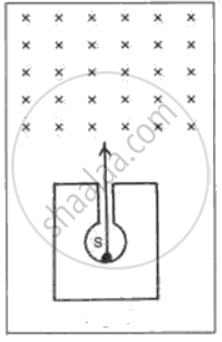
In following fig. shows a mixed source S of alpha and beta particles in a thick lead container. The particles pass through a magnetic field in a direction perpendicular to the plane of paper (inwards as shown by x). State and show in the diagram how the particles get affected.
A nucleus of an element X which has the symbol `""_84^202` X emits an alpha particle and then a beta particle. The final nucleus is `""_"b"^"a"` Y Find a and b.
What happens to the position of an element in the periodic table when it emits an alpha particle
State three safety precautions that you would take while handling the radioactive substances.
State two characteristics of the substance used as thermionic emitter.
Justify with reason, whether the following nuclear reactions are allowed or not.
\[\ce{^A_Z X -> ^A_{Z - 2}X + ^4_{2}He}\]
Two radioactive nuclei are represented by xAp and yAq and when p and q are mass numbers and x, y are the atomic number. How can the products be represented, i .e., what are the new values of p, q. x and y after the emission of an α-particle and a β-particle from A and B respectively.
Two radioactive sources A and B of half lives of 1 hour and 2 hours, respectively, initially contain the same number of radioactive atoms. At the end of two hours, their rates of disintegration are in the ratio of ______.
The mean lives of a radioactive substance are 1620 and 405 years for β-emission and β-emission respectively. The time after which three fourth of a sample will decay if it is decaying both by β-emission and β-emission simultaneously will be ______ years.
(Take ln 2 = 0.693)
