Advertisements
Advertisements
Question
A parallel beam of light is travelling obliquely from an optically rarer medium to an optically denser medium.
- Draw a labelled diagram showing incident and refracted wavefronts. Mark angle of incidence as ‘i’ and angle of refraction as ‘r’.
- Use Huygen’s wave theory to prove Snell’s law.
Advertisements
Solution
i.
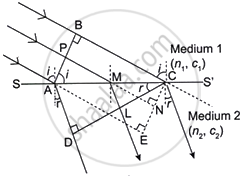
ii. Let SS' stand for the surface that divides media 1 and 2, which have refractive indices of n1 and n2, respectively. Let c1 and c2 represent the light velocities in the two mediums. Since the second medium has a higher optical density than the first, c1 > c2.
APB represents the incident wavefront. When the disturbance at B reaches C, the secondary wavelets from A have traversed a distance AD = c2t, where t represents the time necessary for the waves to cover the distance BC. Consequently, BC = c1t and AD = c2t. A sphere is drawn with center A and radius AD (= c2t), and a tangent CD is constructed from point C to the sphere. Consequently, CD denotes the refracted plane wavefront. To demonstrate that CD is the shared wavefront, it suffices to establish that at the time the disturbance propagates from B to C or A to D, the disturbance at P arrives at L. We create a sphere with M as the center, such that CD serves as the tangent to the sphere.
From the similar triangles ACD and MCL,
`(AD)/(ML) = (AC)/(MC)` ...(i)
Similarly, from a similar triangle ACE and MCN,
`(AE)/(MN) = (AC)/(MC)` ...(ii)
From (i) and (ii),
`(AD)/(ML) = (AE)/(MN)`
or `(AE)/(AD) = (MN)/(ML)`
∵ AE = BC = c1t and AD = c2t
We can write,
`(AE)/(AD) = (c_1t)/(c_2t) = (MN)/(ML)`
or `(BC)/(AD) = (MN)/(ML) = c_1/c_2` ...(iii)
Therefore, if AD represents the radius of the secondary wavefront for point A, then ML denotes the radius of the secondary wavefront for point M. Let i and r denote the angles of incidence and refraction, respectively.
From triangles ABC and ACD,
`(sin i)/(sin r) = (BC//AC)/(AD//AC) = (BC)/(AD) = (c_1t)/(c_2t) = c_1/c_2` = 1n2
1n2 is a constant known as the refractive index of the second medium relative to the first medium. This confirms Snell's law of refraction.
