Advertisements
Advertisements
Question
A mass m = 50 g is dropped on a vertical spring of spring constant 500 N m−1 from a height h = 10 cm as shown in figure. The mass sticks to the spring and executes simple harmonic oscillations after that. A concave mirror of focal length 12 cm facing the mass is fixed with its principal axis coinciding with the line of motion of the mass, its pole being at a distance of 30 cm from the free end of the spring. Find the length in which the image of the mass oscillates.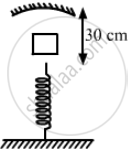
Advertisements
Solution
Given,
Mass = 50 g
Spring constant, k = 500 Nm−1
Height from where the mass is dropped on the spring, h = 10 cm
Focal length of concave mirror, f = 12 cm
Distance between the pole and the free end of the spring is 30 cm.
As per the question, when the mass is released it will stick to the spring and execute SHM.
At equilibrium position, weight of the mass is equal to force applied by the spring.
∴ mg = kx
where g is acceleration due to gravity
`⇒ X = mg / k `
`= 50 xx 10^-3 xx 10 / 500`
`= 10^-3m = 0.1 cm`
Therefore, the mean position of the SHM is (30 + 0.1 = 30.1) cm away from the pole of the mirror.
From the work energy principle,
final kinetic energy − initial kinetic energy = work done
⇒ 0 − 0 = mg(h + δ) − `1/2 Kδ^2`
Where δ is the maximum compression of the spring.
mg(h + δ) = `1/2Kδ^2`
⇒ `50 xx 10^-3 xx 10 ( 0.1 + δ ) = 1/2 500δ^2`
`δ = 0.015 m = 1.5 cm 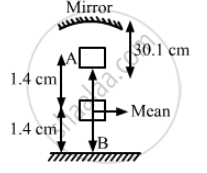
From the above figure,
Position of point B, (30 + 1.5) = 31.5 cm from the pole of the mirror
Therefore, amplitude of vibration of SHM, (31.5 − 30.1) = 1.4 cm
Position of point A from the pole of the mirror, (30.1 − 30.1) = 28.7 cm
For point A,
Object distance (ua) = − 31.5
f = − 12 cm
By using the lens formula:
` 1/(va) - 1/(ua) = 1/f`
`⇒ 1/(vb) = 1/f + 1/(ub)`
`= 1/(-12) + 1/(-28.7)`
`= vb = -20.62 cm`
Hence, the image of the mass oscillates in length (20.62 − 19.38) = 1.24 cm
