Advertisements
Advertisements
Question
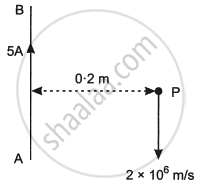
A long straight wire AB carries a current of 5 A. P is a proton travelling with a velocity of 2 × 10⁶ m/s, parallel to the wire, 0.2 m from it and in a direction opposite to the current, as shown in Figure below. Calculate the force which magnetic field of the current carrying conductor AB exerts on the proton.
Advertisements
Solution
The magnetic field due to the current-carrying wire is perpendicular to the plane of the paper, in a downward direction.
i.e., `vec B = -(mu_0 I)/(2 pi d) vec k`
Force `vec F = q vec v xx vec B`
= `e(- v vec j) xx (-(mu_0 I)/(2 pi d) vec k)`
= `(mu_0 ev I)/(2 pi d) vec i`
Given that d = 0.2 m, ν = 2 × 10⁶ m/s, I = 5 A
∴ F = `(mu_0 e xx 2 xx 10^6 xx 5 xx 10^5)/(2 pi xx 0.2) vec i`
= `(2 xx 10^-7 xx 1.6 xx 10^-19 xx 2 xx 10^6 xx 5 xx 10^5)/0.2`
= 16 × 10−19 N
