Advertisements
Advertisements
Question
A line is parallel to one side of triangle which intersects remaining two sides in two distinct points then that line divides sides in same proportion.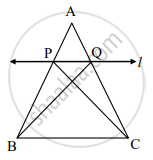
Given: In ΔABC line l || side BC and line l intersect side AB in P and side AC in Q.
To prove: `(AP)/(PB) = (AQ)/(QC)`
Construction: Draw CP and BQ
Proof: ΔAPQ and ΔPQB have equal height.
`(A(ΔAPQ))/(A(ΔPQB")) = (square)/(PB)` ...(i) [areas in proportion of base]
`(A(ΔAPQ))/(A(ΔPQC)) = (square)/(QC)` ...(ii) [areas in proportion of base]
ΔPQC and ΔPQB have `square` is common base.
Seg PQ || Seg BC, hence height of ΔAPQ and ΔPQB.
A(ΔPQC) = A(Δ`square`) ......(iii)
`(A(ΔAPQ))/(A(ΔPQB)) = (A(Δsquare))/(A(Δsquare))` ...[(i), (ii), and (iii)]
`(AP)/(PB) = (AQ)/(QC)` ...[(i) and (ii)]
Advertisements
Solution
Given: In ΔABC line l || side BC and line l intersect side AB in P and side AC in Q.
To prove: `(AP)/(PB) = (AQ)/(QC)`
Construction: Draw CP and BQ
Proof: ΔAPQ and ΔPQB have equal height.
`(A(ΔAPQ))/(A(ΔPQB))` = \[\frac{{\boxed{AP}}}{{{PB}}}\] ...(i) [areas in proportion of base]
`(A(ΔAPQ))/(A(ΔPQC))` = \[\frac{{\boxed{AQ}}}{{{QC}}}\] ...(ii) [areas in proportion of base]
ΔPQC and ΔPQB have \[\boxed{\text{PQ}}\] is common base.
Seg PQ || Seg BC, hence height of ΔAPQ and ΔPQB.
A(ΔPQC) = A(Δ\[\boxed{\text{PQB}}\]) ...(iii) [Areas of two triangles having equal base and height are equal]
`(A(ΔAPQ))/(A(ΔPQB))` = \[\frac{A(Δ{\boxed{APQ}})}{{A(Δ{\boxed{PQC}}})}\] ...[(i), (ii), and (iii)]
`(AP)/(PB) = (AQ)/(QC)` ...[(i) and (ii)]
