Advertisements
Advertisements
Question
A galvanometer of resistance G is converted into a voltmeter to measure upto V volts by connecting a resistance R1 in series with the coil. If a resistance R2 is connected in series with it, then it can measures upto V/2 volts. Find the resistance, in terms of R1 and R2, required to be connected to convert it into a voltmeter that can read upto 2 V. Also find the resistance G of the galvanometer in terms of R1 and R2
Advertisements
Solution
A high resistance that is connected in series with the galvanometer to convert it into voltmeter. The value of the resistance is given by `R=V/I_g-G`
Here,
V = Potential difference across the terminals of the voltmeter
Ig = Current through the galvanometer
G = Resistance of the galvanometer
When resistance R1 is connected in series with the galvanometer,
`R_1=V/I_g-G`
When resistance R2 is connected in series with the galvanometer,
`R_2=V/(2I_g)-G" .....(ii)"`
From (i) and (i), we get
`V/(2I_g)=R_1-R_2 " and "G=R_1-2R_2`
The resistance R3 required to convert the given galvanometer into voltmeter of range 0 to 2V is given by
`R_3=(2V)/I_g-G`
⇒R3=4(R1−R2)−(2R1−R2)=3R1−2R2
G in terms of R1 and R2 is given by
G=R1−2R2
APPEARS IN
RELATED QUESTIONS
Two moving coil meters, M1 and M2 have the following particulars:
R1 = 10 Ω, N1 = 30,
A1 = 3.6 × 10⁻³ m2, B1 = 0.25 T
R2 = 14 Ω, N2 = 42,
A2 = 1.8 × 10⁻³ m2, B2 = 0.50 T
(The spring constants are identical for the two meters.)
Determine the ratio of
- current sensitivity and
- voltage sensitivity of M2 and M1.
Why does a galvanometer when connected in series with a capacitor show a momentary deflection, when it is being charged or discharged?
How does this observation lead to modifying the Ampere's circuital law?
Hence write the generalised expression of Ampere's law.
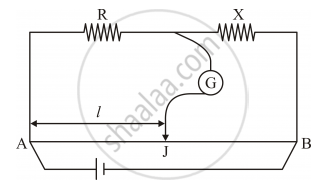
In the meter bridge experiment, balance point was observed at J with AJ = l.
(i) The values of R and X were doubled and then interchanged. What would be the new position of balance point?
(ii) If the galvanometer and battery are interchanged at the balance position, how will the alance point get affected?
State the principle of the working of a moving coil galvanometer, giving its labeled diagram ?
Outline the necessary steps to convert a galvanometer of resistance RG into an ammeter of a given range ?
The conversion of a moving coil galvanometer into a voltmeter is done by ______.
A galvanometer shows full-scale deflection for current Ig. A resistance R1 is required to convert it into a voltmeter of range (0 - V) and a resistance R2 to convert it into a voltmeter of range (0 - 2V). Find the resistance of the galvanometer.
A galvanometer of resistance 100 Ω gives a full-scale deflection for a potential difference of 200 mV.
- What must be the resistance connected to convert the galvanometer into an ammeter of the range 0-200 mA?
- Determine resistance of the ammeter.
Current sensitivity of a galvanometer is defined as the:
In a suspended-coil galvanometer, the phosphor-bronze strip serves to:
