English

A Fluid that Occupies the Larger Cavity of the Eye Ball Behind the Lens is - Biology

Advertisements
Advertisements

Question

A fluid that occupies the larger cavity of the eye ball behind the lens is
___________.

Advertisements

Solution

A fluid that occupies the larger cavity of the eye ball behind the lens is vitreous humour.

shaalaa.com
  Is there an error in this question or solution?
2014-2015 (March) Science Paper 3

RELATED QUESTIONS

find odd one from following: Malleus, iris, Stapes, Incus.


Differentiate between the Rods and Cones of Retina (Type of pigment) 


Give technical terms for The nerve which transmits impulses from the ear to the brain


Sclerotic layer or choroid layer.(Which one forms the Iris ?)


The figure below is the sectional view of a part of the skull showing a sense organ:

What are the parts labeled 'm', 'i' and 's'? What do these parts constitute collectively?


Differentiate between:

The middle ear and Inner ear.


Given below is the diagram of the human ear. Study the same and answer the questions that follow:

(i) Give the biological term for the part labeled ‘A’ and state its function.
(ii) Name the part labeled ‘B’ and state its function.
(iii) Name the part labeled ‘C’ and state its function.
(iv) Give the function of ear wax.


The part of the ear that turns pressure variations into electrical signals is ______.


Categorise the following parts under (i) external, (ii) middle and (iii) internal ear.

Ear drum, hammer, pinna, cochlea, anvil, stirrup, eustachian tube, tympanum, oval window, semi-circular canals.


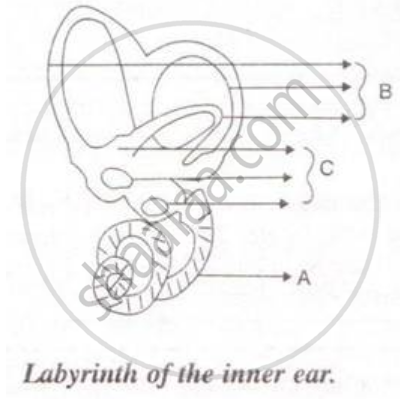
  1. Draw a neat and well labelled diagram of the membranous labyrinth found in the inner ear.
  2. Based on the diagram drawn above in (i), give a suitable term for each of the following descriptions:
    1. The structure responsible for hearing.
    2. The sensory cells that help in hearing.
    3. The membrane-covered opening that connects the middle ear to inner ear.
    4. The nerves that carry impulses from the ear to the brain.
    5. The tube which equalises the air pressure on either side of the ear drum.

Share
Notifications

Englishहिंदीमराठी


      Forgot password?
Use app×