English

A firm manufacturing two types of electrical items A and B, can make a profit of ₹ 20 per unit of A and ₹ 30 per unit of B. Both A and B make use of two essential components a motor and a transformer. - Mathematics and Statistics

Advertisements
Advertisements

Question

A firm manufacturing two types of electrical items A and B, can make a profit of ₹ 20 per unit of A and ₹ 30 per unit of B. Both A and B make use of two essential components a motor and a transformer. Each unit of A requires 3 motors and 2 transformers and each units of B requires 2 motors and 4 transformers. The total supply of components per month is restricted to 210 motors and 300 transformers. How many units of A and B should be manufactured per month to maximize profit? How much is the maximum profit?

Graph
Sum
Advertisements

Solution

Let the firm manufactures x units of item A and y units of item B.

Firm can make profit of ₹ 20 per unit of A and ₹ 30 per unit of B.

Hence, the total profit is z = ₹ (20x + 30y)

This is the objective function which is to be maximized. The constraints are as per the following table:

  Item A (x) Item A (y) Total supply
Motor 3 2 210
Transformer 2 4 300

From the table, the constraints are

3x + 2y ≤ 210, 2x + 4y ≤ 300

Since, number of items cannot be negative, x ≥ 0, y ≥ 0.

Hence, the mathematical formulation of given LPP is :

Maximize z = 20x + 30y, subject to

3x + 2y ≤ 210, 2x + 4y ≤ 300, x ≥ 0, y ≥ 0

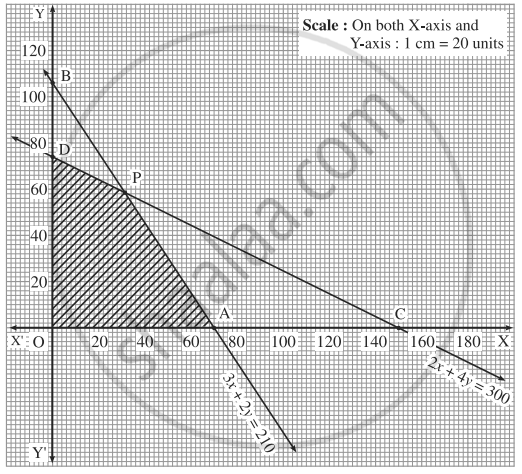
We draw the lines AB and CD whose equations are

3x + 2y = 210 and 2x + 4y = 300 respectively.

Line Equation Points on the X-axis Points on the Y-axis Sign Region
AB 3x + 2y = 210 A(70, 0) B(0, 105) origin side of line AB
CD 2x + 4y = 300 C(150, 0) D(0, 75) origin side of line CD

The feasible region is OAPDO which is shaded in the graph.
The vertices of the feasible region are O (0, 0), A (70, 0), P and D (0, 75).
P is the point of intersection of the lines

2x + 4y = 300      ....(1)

and 3x + 2y = 210       ....(2)

Multiplying equation (2) by 2, we get

6x + 4y = 420 

Subtracting equation (1) from this equation, we get

∴ 4x = 120 

∴ x = 30

Substituting x = 30 in (1), we get

2(30) + 4y = 300

∴ 4y = 240

∴ y = 60

∴ P is (30, 60)

The values of the objective function z = 20x + 30y at these vertices are

z(O) = 20(0) + 30(0) = 0 + 0 = 0

z(A) = 20(70) + 30(0) = 1400 + 0 = 1400

z(P) = 20(30) + 30(60) = 600 + 1800 = 2400

z(D) = 20(0) + 30(75) = 0 + 2250 = 2250

∴ z has the maximum value 2400 when x = 30 and y = 60

Hence, the firm should manufactured 30 units of item A and 60 units of item B to get the maximum profit of  ₹ 2400 frim

shaalaa.com
Linear Programming Problem (L.P.P.)
  Is there an error in this question or solution?
Chapter 7: Linear Programming - Miscellaneous exercise 7 [Page 245]

APPEARS IN

Balbharati Mathematics and Statistics 1 (Arts and Science) [English] Standard 12 Maharashtra State Board
Chapter 7 Linear Programming
Miscellaneous exercise 7 | Q 14) | Page 245

RELATED QUESTIONS

A doctor has prescribed two different units of foods A and B to form a weekly diet for a sick person. The minimum requirements of fats, carbohydrates and proteins are 18, 28, 14 units respectively. One unit of food A has 4 units of fat, 14 units of carbohydrates and 8 units of protein. One unit of food B has 6 units of fat, 12 units of carbohydrates and 8 units of protein. The price of food A is ₹ 4.5 per unit and that of food B is ₹ 3.5 per unit. Form the LPP, so that the sick person’s diet meets the requirements at a minimum cost.


If John drives a car at a speed of 60 km/hour, he has to spend ₹ 5 per km on petrol. If he drives at a faster speed of 90 km/hour, the cost of petrol increases ₹ 8 per km. He has ₹ 600 to spend on petrol and wishes to travel the maximum distance within an hour. Formulate the above problem as L.P.P.


Solve the following L.P.P. by graphical method:

Minimize: z = 8x + 10y

Subject to: 2x + y ≥ 7, 2x + 3y ≥ 15, y ≥ 2, x ≥ 0, y ≥ 0.


Minimize z = 6x + 21y, subject to x + 2y ≥ 3, x + 4y ≥ 4, 3x + y ≥ 3, x ≥ 0, y ≥ 0.


Select the appropriate alternatives for each of the following question:

The value of objective function is maximum under linear constraints


Objective function of LPP is ______.


The maximum value of z = 10x + 6y subject to the constraints 3x + y ≤ 12, 2x + 5y ≤ 34, x, ≥ 0, y ≥ 0 is ______.


Of all the points of the feasible region, the optimal value of z obtained at the point lies ______.


The corner points of the feasible solution given by the inequation x + y ≤ 4, 2x + y ≤ 7, x ≥ 0, y ≥ 0 are ______.


If the corner points of the feasible solution are (0, 10), (2, 2) and (4, 0), then the point of minimum z = 3x + 2y is ______.


The half-plane represented by 4x + 3y >14 contains the point ______.


Solve the following LPP:

Maximize z = 6x + 10y subject to 3x + 5y ≤ 10, 5x + 3y ≤ 15, x ≥ 0, y ≥ 0.


Solve the following LPP:

Maximize z = 2x + 3y subject to x - y ≥ 3, x ≥ 0, y ≥ 0.


Solve each of the following inequations graphically using XY-plane:

y ≤ - 3.5


Sketch the graph of the following inequation in XOY co-ordinate system:

|x + 5| ≤ y


Solve the following LPP:

Maximize z = 4x1 + 3x2 subject to
3x1 + x2 ≤ 15, 3x1 + 4x2 ≤ 24, x1 ≥ 0, x2 ≥ 0. 


Solve the following LPP:

Minimize z = 4x + 2y

Subject to 3x + y ≥ 27, x + y ≥ 21, x + 2y ≥ 30, x ≥ 0, y ≥ 0


A manufacturing firm produces two types of gadgets A and B, which are first processed in the foundry and then sent to machine shop for finishing. The number of man hours of labour required in each shop for production of A and B and the number of man hours available for the firm are as follows:

Gadgets Foundry  Machine Shop
A 10 5
B 6 4
Time available (hours) 60 35

Profit on the sale of A is ₹ 30 and B is ₹ 20 per unit. Formulate the L.P.P. to have maximum profit.


A company manufactures two types of chemicals A and B. Each chemical requires two types of raw material P and Q. The table below shows number of units of P and Q required to manufacture one unit of A and one unit of B.

Raw Material \Chemical A B Availability
p 3 2 120
Q 2 5 160

The company gets profits of ₹ 350 and ₹ 400 by selling one unit of A and one unit of B respectively. Formulate the problem as L.P.P. to maximize the profit.


Choose the correct alternative :

The corner points of the feasible region are (0, 0), (2, 0), `(12/7, 3/7)` and (0,1) then the point of maximum z = 7x + y


The optimal value of the objective function is attained at the ______ points of the feasible region.


State whether the following is True or False :

Saina wants to invest at most ₹ 24000 in bonds and fixed deposits. Mathematically this constraints is written as x + y ≤ 24000 where x is investment in bond and y is in fixed deposits.


Which value of x is in the solution set of inequality − 2X + Y ≥ 17


Maximize z = 5x + 2y subject to 3x + 5y ≤ 15, 5x + 2y ≤ 10, x ≥ 0, y ≥ 0


Maximize z = 7x + 11y subject to 3x + 5y ≤ 26, 5x + 3y ≤ 30, x ≥ 0, y ≥ 0


Choose the correct alternative:

The feasible region is


Choose the correct alternative:

Z = 9x + 13y subjected to constraints 2x + 3y ≤ 18, 2x + y ≤ 10, 0 ≤ x, y was found to be maximum at the point


State whether the following statement is True or False:

Objective function of LPP is a relation between the decision variables


State whether the following statement is True or False:

LPP is related to efficient use of limited resources


Constraints are always in the form of ______ or ______.


The constraint that in a particular XII class, number of boys (y) are less than number of girls (x) is given by ______


A company produces two types of pens A and B. Pen A is of superior quality and pen B is of lower quality. Profits on pens A and B are ₹ 5 and ₹ 3 per pen respectively. Raw materials required for each pen A is twice as that of pen B. The supply of raw material is sufficient only for 1000 pens per day. Pen A requires a special clip and only 400 such clips are available per day. For pen B, only 700 clips are available per day. Formulate this problem as a linear programming problem.


A company produces two types of products say type A and B. Profits on the two types of product are ₹ 30/- and ₹ 40/- per kg respectively. The data on resources required and availability of resources are given below.

  Requirements Capacity available per month
Product A Product B
Raw material (kgs) 60 120 12000
Machining hours/piece 8 5 600
Assembling (man hours) 3 4 500

Formulate this problem as a linear programming problem to maximize the profit.


Solve the following linear programming problems by graphical method.

Minimize Z = 20x1 + 40x2 subject to the constraints 36x1 + 6x2 ≥ 108; 3x1 + 12x2 ≥ 36; 20x1 + 10x2 ≥ 100 and x1, x2 ≥ 0.


A solution which maximizes or minimizes the given LPP is called


A firm manufactures pills in two sizes A and B. Size A contains 2 mgs of aspirin, 5 mgs of bicarbonate and 1 mg of codeine. Size B contains 1 mg. of aspirin, 8 mgs. of bicarbonate and 6 mgs. of codeine. It is found by users that it requires at least 12 mgs. of aspirin, 74 mgs. of bicarbonate and 24 mgs. of codeine for providing immediate relief. It is required to determine the least number of pills a patient should take to get immediate relief. Formulate the problem as a standard LLP.


Which of the following can be considered as the objective function of a linear programming problem?


The minimum value of z = 5x + 13y subject to constraints 2x + 3y ≤ 18, x + y ≥ 10, x ≥ 0, y ≥ 2 is ______ 


The set of feasible solutions of LPP is a ______.


Shamli wants to invest ₹ 50, 000 in saving certificates and PPF. She wants to invest atleast ₹ 15,000 in saving certificates and at least ₹ 20,000 in PPF. The rate of interest on saving certificates is 8% p.a. and that on PPF is 9% p.a. Formulation of the above problem as LPP to determine maximum yearly income, is ______.


Solve the following LPP by graphical method:

Maximize: z = 3x + 5y Subject to:  x + 4y ≤ 24, 3x + y ≤ 21, x + y ≤ 9, x ≥ 0, y ≥ 0


Two kinds of foods A and B are being considered to form a weekly diet. The minimum weekly requirements of fats, Carbohydrates and proteins are 12, 16 and 15 units respectively. One kg of food A has 2, 8 and 5 units respectively of these ingredients and one kg of food B has 6, 2 and 3 units respectively. The price of food A is Rs. 4 per kg and that of food B is Rs. 3 per kg. Formulate the L.P.P. and find the minimum cost.


Share
Notifications

Englishहिंदीमराठी


      Forgot password?
Use app×