Advertisements
Advertisements
Question
A fair die is rolled. If face 1 turns up, a ball is drawn from Bag A. If face 2 or 3 turns up, a ball is drawn from Bag B. If face 4 or 5 or 6 turns up, a ball is drawn from Bag C. Bag A contains 3 red and 2 white balls, Bag B contains 3 red and 4 white balls and Bag C contains 4 red and 5 white balls. The die is rolled, a Bag is picked up and a ball is drawn. If the drawn ball is red; what is the probability that it is drawn from Bag B?
Advertisements
Solution
Let E1, E2, E3 be the events that a die is thrown and getting 1, 2 or 3 and 4 or 5 or 6 respectively.
`"P"("E"_1) = 1/6 , "P"("E"_2) = 2/6 , "P"("E"_3) = 3/6`
Let A be the event that drawn ball is red
`"P"("A"//"E"_1) = 3/5 , "P"("A"//"E"_2) = 3/7 , "P"("A"//"E"_3) = 4/9`
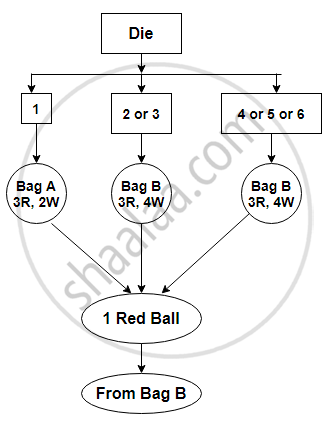
Required probability i.e. drawn ball is red from bag B is :
`"P"("E"_2//"A") = ("P"("E"_2) xx "P"("A"//"E"_2))/("P"("E"_1) xx "P"("A"//"E"_1) + "P"("E"_2) xx "P"("A"//"E"_2) + "P"("E"_3)xx "P"("A"//"E"_3))`
`= (2/6 xx 3/7)/(1/6 xx 3/5 + 2/6 xx 3/7 + 3/6 xx 4/9)`
`= (1/7)/(1/10 + 1/7 + 2/9)`
`= 1/7 xx (7 xx 9 xx 10)/293 = 90/293`
