Advertisements
Advertisements
Question
A Dolphin jumps and takes a path given by the equation h(t) = `1/2 (-7t^2 + 3t + 2)`, (t ≥ 0), where h(t) is the height of the Dolphin at any point in time.
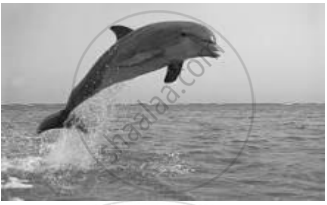
- Is the function differentiable for t ≥ 0? Justify.
- Find the instantaneous rate of change of height at t = `1/14`.
- h(t) is increasing in `(-∞, 3/14)`. Is this true or false? Justify.
- Find the time at which the Dolphin will attain the maximum height. Also find the maximum height.
Advertisements
Solution
a. The given function is h(t) = `1/2 (-7t^2 + 3t + 2)`
This is a polynomial function.
Since all polynomial functions are continuous and differentiable everywhere on R, therefore, for its restricted domain t ≥ 0, it is certainly differentiable.
Yes, h(t) is differentiable for all t ≥ 0.
b. Given, t = `1/14`
h(t) = `1/2 (-7t^2 + 3t + 2)`
Differentiating w.r.t ‘t’ we get,
`(dh)/(dt) = 1/2 (-14t + 3)`
`(dh)/(dt) = -7t + 3/2`
`[(dh)/(dt)]_(t = 1/14) = -7(1/14) + 3/2`
= `-1/2 + 3/2`
= 1 unit.
c. `(dh)/(dt) = -7t + 3/2`
`(dh)/(dt) > 0`
`-7t + 3/2 > 0`
`-7t > -3/2`
`t < 3/14`
Since the domain is t ≥ 0, the interval of increase is `(0, 3/14)`.
The statement h(t) is increasing in `(-∞, 3/14)` is false, because the function is defined only for t ≥ 0.
False; h(t) is increasing only on `(0, 3/14)`.
d. Setting `(dh)/(dt)` = 0, for stationary point, we get
`-7t + 3/2 = 0`
`7t = 3/2`
`t = 3/14`
Now, `(d^2h)/(dt^2) = d/dt (-7t + 3/2)`
= −7 < 0
Since the second derivative is negative.
h(t) has a local maximum at t = `3/14`
Put the t value in the given function:
`h(3/14) = 1/2 (-7(3/14)^2 + 3(3/14) + 2)`
`h(3/14) = 1/2 (-7(9/196) + 3 (3/14) + 2)`
`h(3/14) = 1/2 (-63/196) + 9/14 + 2`
`h(3/14) = 1/2 (-9/28 + 9/14 + 2)`
`h(3/14) = 1/2 (-9/28 + 18/28 + 56/28)`
`h(3/14) = 1/2 (-9 + 18 + 56)/28`
`h(3/14) = 1/2 xx 65/28`
`h(3/14) = 65/56`
`h(3/14)` = 1.161
