Advertisements
Advertisements
Question
A circle of maximum possible size is cut from a square sheet of board. Subsequently, a square of maximum possible size is cut from the resultant circle. What will be the area of the final square?
Options
`3/4` of original square.
`1/2` of original square.
`1/4` of original square.
`2/3` of original square.
Advertisements
Solution
`bb(1/2 "of original square")`.
Explanation:
Let a be the side of a square sheet.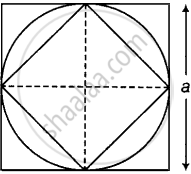
Then, area of bigger square sheet = a2 ...(i)
Now, we make the circle of maximum possible size from it.
Then, the radius of circle = `a/2` ...(ii)
So, its diameter (d) = `2 * a/2 = a`
Now, any square in a circle of maximum size will have the length of diagonal equal to the diameter of circle.
i.e Diagonal of square made inside the circle = a
So, the side of this square = `a/sqrt(2)` ...[∵ Diagonal = side `sqrt(2)`]
∴ Area of this square = `a^2/2` ...(iii)
From equations (i) and (iii),
Area of final square is `1/2` of original square.
