Advertisements
Advertisements
Question
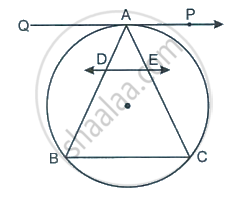
A circle circumscribes a ΔABC, DE is parallel to the tangent AP at A and intersects AB and AC in D and E respectively. Prove that:
- ΔАВС ~ ΔAED
- AC × AE = AB × AD
Theorem
Advertisements
Solution
Given:
A circle circumscribes ΔABC. DE is parallel to the tangent AP at A and intersects AB and AC in D and E, respectively.
To prove:
(i) ΔABC ~ ΔAED
Since DE ∥ AP,
∠ADE = ∠EAP (corresponding)
By the alternate segment theorem,
∠EAP = ∠ACB
∠ADE = ∠ACB
Since DE ∥ AP,
∠AED = ∠EAP (corresponding angles).
By the alternate segment theorem
∠EAP = ∠ABC.
Hence, ∠AED = ∠ABC.
Thus, by the AA similarity criterion,
ΔABC ∼ ΔAED
(ii) AC × AE = AB × AD
From the similarity of triangles, corresponding sides are proportional:
`(AB)/(AD) = (AC)/(AE)`
Cross multiply to get:
AC × AE = AB × AD
shaalaa.com
Is there an error in this question or solution?
