Advertisements
Advertisements
Question
A body is in translational equilibrium under the action of coplanar forces. If the torque of these forces is zero about a point, is it necessary that it will also be zero about any other point?
Advertisements
Solution
Yes , if the torque due to forces in translation equillibrium is zero about a point, it will be zero about other point in the plane.
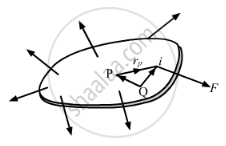
Let us consider a planner lamina of some mass, acted upon by forces \[\overrightarrow{F_1}, \overrightarrow{F_2}, . . . \overrightarrow{F_i},\] etc.
Let a force \[\overrightarrow{F_i}\] act on a \[i^{th}\] particle and torque due to \[\overrightarrow{F_i}\] be zero at a point Q.
Since the body is in translation equillibrium, we have
\[\Sigma \overrightarrow{F_i} = 0 .............(1)\]
Again, torque about P is zero . Therefore, we have
\[\Sigma\left( \overrightarrow{r_{pi}} \times \overrightarrow{F_i} \right) = 0 ..............(2)\]
Now, torque about point Q will be
\[\Sigma \overrightarrow{r}_{Qi} \times \overrightarrow{F_i} \]
\[ = \Sigma\left( \overrightarrow{r}_{QP} + \overrightarrow{r}_{Pi} \right) \times \overrightarrow{F_i} ............\left[\text{From fig.} \right]\]
\[ = \Sigma\left( \overrightarrow{r}_{QP} \times \vec{F_i} + \overrightarrow{r_{Pi}} \times \overrightarrow{F_i} \right)\]
\[ = \Sigma \overrightarrow{r_{QP}} \times \overrightarrow{F_i} + \Sigma \overrightarrow{r_{Pi}} \times \overrightarrow{F_i} \]
\[ = \overrightarrow{r_{QP}} \times \Sigma \overrightarrow{F_i} + 0 ..........\left[\text{From (2)} \right]\]
\[ = \overrightarrow{r_{QP}} \times 0 .........\left[\text{From (1)} \right]\]
\[ = 0\]
Thus, \[\overrightarrow{F}\] is zero about any other point Q.
APPEARS IN
RELATED QUESTIONS
Find the components along the x, y, z axes of the angular momentum l of a particle, whose position vector is r with components x, y, z and momentum is p with components px, py and 'p_z`. Show that if the particle moves only in the x-y plane the angular momentum has only a z-component.
Two particles, each of mass m and speed v, travel in opposite directions along parallel lines separated by a distance d. Show that the angular momentum vector of the two particle system is the same whatever be the point about which the angular momentum is taken.
The torque of a force \[\overrightarrow F \] about a point is defined as \[\overrightarrow\Gamma = \overrightarrow r \times \overrightarrow F.\] Suppose \[\overrightarrow r, \overrightarrow F\] and \[\overrightarrow \Gamma\] are all nonzero. Is \[r \times \overrightarrow\Gamma || \overrightarrow F\] always true? Is it ever true?
A heavy particle of mass m falls freely near the earth's surface. What is the torque acting on this particle about a point 50 cm east to the line of motion? Does this torque produce any angular acceleration in the particle?
A rectangular brick is kept on a table with a part of its length projecting out. It remains at rest if the length projected is slightly less than half the total length but it falls down if the length projected is slightly more than half the total length. Give reason.
Equal torques act on the disc A and B of the previous problem, initially both being at rest. At a later instant, the linear speeds of a point on the rim of A and another point on the rim of B are \[\nu_A\] and \[\nu_B\] respectively. We have
A particle is moving with a constant velocity along a line parallel to the positive X-axis. The magnitude of its angular momentum with respect to the origin is, ______
Two discs of the same moment of inertia rotating about their regular axis passing through centre and perpendicular to the plane of the disc with angular velocities ω1 and ω2. They are brought in to contact face to face coinciding with the axis of rotation. The expression for loss of energy during this process is, ______
The ratio of the acceleration for a solid sphere (mass m and radius R) rolling down an incline of angle θ without slipping and slipping down the incline without rolling is, ______
What are the conditions in which force can not produce torque?
State conservation of angular momentum.
A particle of mass 5 units is moving with a uniform speed of v = `3sqrt 2` units in the XOY plane along the line y = x + 4. Find the magnitude of angular momentum
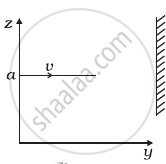
A particle of mass m is moving in yz-plane with a uniform velocity v with its trajectory running parallel to + ve y-axis and intersecting z-axis at z = a (Figure). The change in its angular momentum about the origin as it bounces elastically from a wall at y = constant is ______.
The net external torque on a system of particles about an axis is zero. Which of the following are compatible with it?
- The forces may be acting radially from a point on the axis.
- The forces may be acting on the axis of rotation.
- The forces may be acting parallel to the axis of rotation.
- The torque caused by some forces may be equal and opposite to that caused by other forces.
A solid sphere is rotating in free space. If the radius of the sphere is increased while keeping the mass the same, which one of the following will not be affected?
