Advertisements
Advertisements
Question
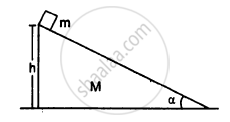
A block of mass m is placed on a triangular block of mass M which in turn is placed on a horizontal surface as shown in figure. Assuming frictionless surfaces find the velocity of the triangular block when the smaller block reaches the bottom end.
Advertisements
Solution
According to the question, the surface is frictionless. Thus, the block m will slide down the inclined plane of mass M.
Acceleration, a1 = g sin α (Relative to the inclined plane)
The horizontal component of acceleration a1 is given by ax = g sin α cos α, for which the block M accelerates towards left.
Let the left acceleration be a2.
By the concept of centre of mass, we can say that the external force is zero in the horizontal direction.
\[m a_x = (M + m) a_2\]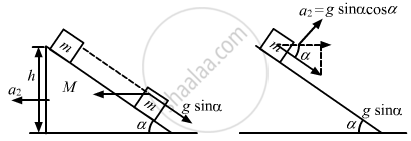
Absolute (resultant) acceleration of m on the plane M, along the direction of the incline will be = \[a = g \sin \alpha - a_2 \cos \alpha\]
Let the time taken by the block m to reach the bottom end be t.
Now,
\[s = ut + \left( \frac{1}{2} \right)a t^2 \]
\[ \Rightarrow \frac{h}{\sin \alpha} = \left( \frac{1}{2} \right)a t^2 \]
\[ \Rightarrow t = \sqrt{\frac{2h}{a \sin \alpha}}\]
Thus, the velocity of the bigger block after time t will be,
\[v_m = u = a_2 t\]
\[ = \frac{mg \sin \alpha \cos \alpha}{M + m} \sqrt{\frac{2h}{a \sin \alpha}} = \left[ \frac{2 m^2 g^2 h \sin^2 \alpha \cos^2 \alpha}{(M + m )^2 a \sin \alpha} \right]^{1/2}\]
Subtracting the value of a from equation (2), we get:
\[v_M = \left[ \frac{2 m^2 g^2 h \sin^2 \alpha}{(M + m )^2 \sin \alpha} \times \frac{\cos^2 \alpha}{g \sin \alpha} \frac{(M + m)}{(M + m \sin^2 \alpha)} \right]\]
