Advertisements
Advertisements
Question
A beam of α, β and γ rays is travelling through a certain region in space.
- Arrange them in ascending order of ionising power.
- Which of the above will pass undeviated if subjected to an electric field?
- With respect to your answer to part (b) above, what will be the change in the nucleus of an atom after such a ray is emitted.
Advertisements
Solution
- γ < β < α
- γ rays pass undeviated if subjected to an electric field.
- The nucleus of the atom has no change in the mass number and atomic number during γ emission. So, the γ rays take no mass and no electrical charge from the nucleus.
APPEARS IN
RELATED QUESTIONS
A radioactive source emits three types of radiations.
Name the three radiations.
A radioactive source emits three types of radiations.
Name the radiations which are deflected by the electric field.
The diagram in figure shows a radioactive source S placed in a thick lead walled container. The radiations given out are allowed to pass through a magnetic field. The magnetic field (shown as ×) acts perpendicular to the plane of paper inwards. Arrows shows the paths of the radiation A, B and C.
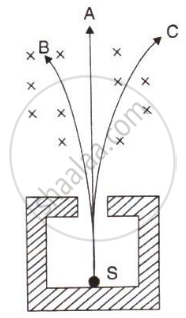
- Name the radiations labelled A, B and C.
- Explain clearly how you used the diagram to arrive at the answer in part (a).
In following Figure shows a mixed source R of alpha and beta particles in a thick lead walled container. The particles pass through a magnetic field in a direction perpendicular to the plane of paper inwards as shown by ×.
- Show in the diagram how the particles get affected.
- Name the law used in part (a).
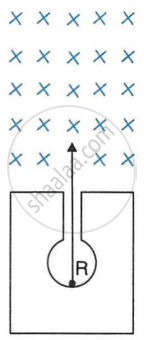
[Hint: Alpha particles will deflect to the left while beta particles to the right]
What is the composition of α, β and γ radiations?
Arrange the α, β, and γ radiation in ascending order of their biological damage. Give reason.
Compare the penetrating powers of α, β and γ-radiations.
Compare the ionising powers of α, β and γ radiations.
The figure shows a radioactive source S placed in a thick-walled lead container. The radiations given off pass through a magnetic field acting in direction perpendicular to the plane of paper inwards as shown by X. Copy the diagram and show the path of radiations. Explain why the source is kept in a thick-walled lead container.
Which of the following radiations suffer maximum deflection in a magnetic field?
