Viraf J. Dalal solutions for सिंप्लिफाइड केमिस्ट्री [इंग्रजी] इयत्ता १० आयसीएसई chapter 1 - Periodic Table – Periodic Properties and Variations of Properties [Latest edition]
Online Mock Tests
Chapters
▶ 1: Periodic Table – Periodic Properties and Variations of Properties
2: Chemical Bonding
Chapter 3. A: Acids, Bases and Salts
Chapter 3. B: Analytical Chemistry Use of Ammonium and Sodium Hydroxide
Mole Concept & Stoichiometry
Chapter 4. A: Gay Lussac’s Law-Avogadro’s Law-Mole concept
Chapter 4. B: Percentage Composition – Empirical and Molecular formula Calculations Based on Chemical Equations
Chapter 5: Electrolysis
Chapter 6: Metallurgy
Study of Compounds
Chapter 7. A: Hydrogen Chloride
Chapter 7. B: Ammonia
Chapter 7. C: Nitric Acid
Chapter 7. D: Sulphuric Acid
Chapter 8: Organic Chemistry
Chapter 9: Practical Chemistry
Chapter 10: Additional Charts
Advertisements
Advertisements
Solutions for Chapter 1: Periodic Table – Periodic Properties and Variations of Properties
Below listed, you can find solutions for Chapter 1 of CISCE Viraf J. Dalal for सिंप्लिफाइड केमिस्ट्री [इंग्रजी] इयत्ता १० आयसीएसई.
Advertisements
Viraf J. Dalal solutions for सिंप्लिफाइड केमिस्ट्री [इंग्रजी] इयत्ता १० आयसीएसई 1 Periodic Table – Periodic Properties and Variations of Properties 1. PREVIOUS QUESTIONS [Pages 16 - 17]
The energy required to remove - an electron from a neutral isolated gaseous atom & convert it into a positively charged gaseous ion is called ______.
electron affinity
ionisation potential
electronegativity
Match the atomic number 2, 4, 8, 15 and 19 with each of the following:
- A solid non-metal belonging to the third period.
- A metal of valency 1.
- A gaseous element with valency 2.
- An element belonging to Group 2.
- A rare gas.
Arrange the following as per the instruction given in the brackets:
He, Ar, Ne (Increasing order of the number of electron shells)
Give one word or a phrase:
The energy released when an electron is added to a neutral gaseous isolated atom to form a negatively charged ion.
Give reason for the following:
Inert gases do not form ion.
Give a reason for the following:
Ionisation potential increases across a period, from left to right.
In Period 3 of the Periodic Table, element B is placed to the left of element A. On the basis of this information, choose the correct word from the option to complete the following statement:
The element B would have ______ metallic character than A.
lower
higher
In Period 3 of the Periodic Table, element B is placed to the left of element A. On the basis of this information, choose the correct word from the option to complete the following statement:
The element A would probably have ______ electron affinity than B.
lesser
higher
In Period 3 of the Periodic Table, element B is placed to the left of element A. On the basis of this information, choose the correct word from the option to complete the following statement:
The element A would have ______ atomic size than B.
greater
smaller
The most electronegative element from the following elements is:
Magnesium
Chlorine
Aluminium
Sulphur
In Period 3, the most metallic element is ______.
sodium
magnesium
aluminium
Give the appropriate term defined by the statement given below:
The tendency of an atom to attract electrons towards itself when combined in a covalent compound.
Arrange the following:
Li, K, Na, H [In the decreasing order of their ionization potential]
Arrange the following according to the instruction given in the bracket:
F, B, N, O (In the increasing order of electron affinity).
Study the extract of the Periodic Table given below and answer the questions that follow. Give the alphabet corresponding to the element in question.
DO NOT repeat an element.
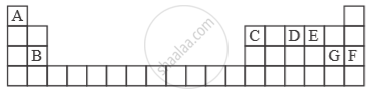
- Which element forms electrovalent compound with G?
- The ion of which element will migrate towards the cathode during electrolysis?
- Which non-metallic element has the valency of 2?
- Which is an inert gas?
The element with highest ionisation potential is ______.
Hydrogen
Caesium
Radon
Helium
Give the appropriate term defined by the statement given below:
The tendency of an atom to attract electrons towards itself when combined in a covalent compound.
The following table represents the elements and atomic number. With reference to this, answer the following using only the alphabets given in the table.
| Element | Atomic number |
| P | 13 |
| Q | 7 |
| R | 10 |
- Which element combines with hydrogen to form a basic gas?
- Which element has an electron affinity zero?
- Name the element which forms an ionic compound with chlorine.
Name the following element.
An alkaline earth metal present in group 2 and period 3.
Select the correct answer – in each case:
In the periodic table, elements of period 3 are arranged in increasing order of ionisation energy as:
Mg, Si, S, Ar
B, Cl, Ar, N
Si, Ar, Cl, Mg
Mg, S, Si, Ar
B, N, Cl, Ar
Ar, Si, S, Mg
The tendency of an atom to attract shared pair of - electrons to itself when forming a chemical bond is known as ______.
Electron affinity
Electronegativity
lonization potential
Nuclear charge
Elements A & B have - electronic configuration: 8 & 13 respectively. The chemical formula formed between A & B will be:
AB
B3A3
A2B3
B2A3
Alkaline earth metals have the same ______.
ionisation energy
number of valence electrons
metallic property
number of shells
The table shows the electronic configuration of four elements.
| Element | Electronic configuration |
| W | 2, 6 |
| X | 2, 8 |
| Y | 2, 8, 1 |
| Z | 2, 8, 7 |
Which pair of atoms will form a covalent compound?
two atoms of W
two atoms of X
an atom of W and an atom of X
an atom of Y and an atom of Z
Element with an atomic number 19 will ______.
Accept an electron & get oxidized.
Accept an electron & get reduced.
Lose an electron & get oxidized.
Lose an electron & get reduced.
Element with low ionization potential likely to be ______.
Metal
Metalloid
Non-metal
Inert gas
The non-metallic properties of elements from left to right in a periodic table ______.
Increases
Decreases
Remains same
First increases & then decreases
The electronic arrangements of six atoms, A to F is shown below.
A: 2, 5 B: 2 C: 2, 6 D: 2, 8, 6 E: 2, 8, 8 F: 2, 8, 3
Select the following:
The atoms from the same group of the periodic table:
D & E
C & D
E & F
C & E
The electronic arrangements of six atoms, A to F is shown below.
A: 2, 5 B: 2 C: 2, 6 D: 2, 8, 6 E: 2, 8, 8 F: 2, 8, 3
Select the following:
Two noble gases:
A & B
E & F
B & E
D & E
The electronic arrangements of six atoms, A to F is shown below.
A: 2, 5 B: 2 C: 2, 6 D: 2, 8, 6 E: 2, 8, 8 F: 2, 8, 3
Select the following:
The atom which is the most electronegative:
A
B
C
F
The electronic arrangements of six atoms, A to F is shown below.
A: 2, 5 B: 2 C: 2, 6 D: 2, 8, 6 E: 2, 8, 8 F: 2, 8, 3
Select the following:
The atom which has the highest ionization potential:
A
B
E
F
An element in period 3 whose electron affinity is zero.
Neon
Sulphur
Sodium
Argon
An element with the largest atomic radius among the following is:
Carbon
Nitrogen
Lithium
Beryllium
Give one word or phrase for the following:
The amount of energy released when an atom in the gaseous state accepts an electron to form an anion.
Arrange the following as per the instruction given in the bracket:
N, Be, O, C (increasing order of non-metallic character)
Arrange the following as per the instruction given in the bracket:
P, Si, F, Be (decreasing order of valence electrons)
Give reason for the following:
Ionisation potential decreases down a group.
In the 2nd period Neon has maximum Ionization Potential because ______.
It has unstable electronic configuration.
It easily accepts electrons.
It easily loses electrons.
The outer most shell is completely filled.
Electron Affinity is maximum in ______.
Mg
Ar
Li
Br
State the term for the following:
The tendency of an atom to pull a shared pair of electrons towards itself in a compound.
Give reason for the following:
Inert gases do not form ion.
Arrange the following as per the instruction given in the bracket:
Carbon, Fluorine, Beryllium (decreasing order of atomic size).
Arrange the following as per the instruction given in the bracket:
Potassium, Lithium, Sodium (increasing order of ionization potential).
Identify the following:
An element in Period 1 which can be placed in both Group 1 and Group 17 of the Periodic Table.
Identify the following:
The element having electronic configuration 2, 8, 6.
The following table shows the electronic configuration of the atoms A, B, C and D.
| Element | A | B | C | D |
| Electronic configuration | 2, 8, 8, 2 | 2, 6 | 2, 8, 7 | 2, 4 |
- Write the formula of the compound formed between:
- A and B
- D and C
- Which of the above elements will exhibit catenation?
Assertion (A): The tendency of losing electrons increases down the Group.
Reason (R): The most reactive metal is placed at the top of Group 1.
Both (A) and (R) are true, and (R) is the correct explanation of (A).
Both (A) and (R) are true, and (R) is not the correct explanation of (A).
(A) is true but (R) is false.
(A) is false but (R) is true.
X, Y & Z are three metallic atoms in successive order belonging to the same group such that atomic radii of ‘X’ is the smallest. Which of the three atoms is the best reducing agent?
X
Y
Z
All three have the same reducing power.
State the term for the following:
The tendency of an atom to attract the shared pair of electrons towards itself when combined in a compound.
The atomic number of two atoms ‘X’ and ‘Y’ are 14 and 8 respectively. State:
- the period to which ‘X’ belongs.
- the formula of the compound formed between ‘X’ and ‘Y’.
(Do not identify X and Y)
Study the table given below. Use only the letters given in the table to answer the questions. Do not identify the elements.
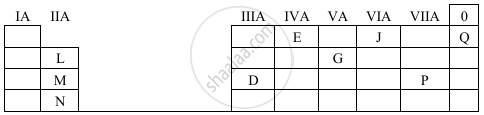
- State the valency of element ‘G’.
- Which element can exhibit catenation?
- Write the formula of the compound formed between ‘M’ and ‘P’.
Given below is a set of elements from the periods. Name the element with the highest ionisation potential in the following set.
Al, Cl, Mg
Given below is a set of elements from the periods. Name the element with the highest ionisation potential in the following set.
Ne, O, F
Viraf J. Dalal solutions for सिंप्लिफाइड केमिस्ट्री [इंग्रजी] इयत्ता १० आयसीएसई 1 Periodic Table – Periodic Properties and Variations of Properties 2. MULTIPLE CHOICE QUESTIONS [MCQ]-Select the correct answer [Page 17]
Assertion (A): Noble gases - Ne, Ar have electron affinity zero.
Reason (R): Greater the value of electron affinity, the more electronegative is the element.
Both A & R are true - and R is the correct explanation of A.
Both A & R are true - but R is not the correct explanation of A.
Ais true - but R is false.
A is false - but R is true.
Assertion (A): Elements with high electronegativity - are usually non-metals.
Reason (R): Non-metallic atoms have - high ionisation potential & tend to gain - electrons.
Both A & R are true - and R is the correct explanation of A.
Both A & R are true - but R is not the correct explanation of A.
A is true - but R is false.
A is false – but R is true.
The oxide of the metallic element - with three valence electrons, in its third shell is:
Basic
Weakly acidic
Amphoteric
Strongly basic
‘ACl’ is the formula of an electrovalent solid. ‘A’ is likely to be in the same group in period-3 as the element given below present in period-2.
Be
Li
C
B
Metallic element ‘X’ in period-3, having valency 2, reacts with a non-metallic element ‘Y’ of the same period also having valency 2. The number of non-metallic atoms in the compound formed between ‘X’ & ‘Y’ is:
3
1
4
2
State the elementwith the lowestelectron affinity-from the elements whose electronic configurations are below:
2, 8, 8
2, 7
2, 8, 6
2, 8, 7
Non-metallic elements have ______.
Large atomic size.
Low electron affinity.
High ionisation potential.
Greatertendency to lose electrons.
The electronic configuration of the element - which has the largest atomic size is ______.
2, 8, 5
2, 8, 1
2, 8, 7
2, 1
Viraf J. Dalal solutions for सिंप्लिफाइड केमिस्ट्री [इंग्रजी] इयत्ता १० आयसीएसई 1 Periodic Table – Periodic Properties and Variations of Properties 3. ADDITIONAL & HIGH ORDER THINKING QUESTIONS [Pages 18 - 19]
Rewrite the - incorrect statements only - by rectifying the incorrect word/s in the statement.
- Periodic table is based on the fundamental property - atomic weight.
- Elements in the periodic table are arranged in - Seven horizontal rows called ‘groups’- which ends with an element having one electron in outermost shell.
- Period numbers i.e. 1, 2, 3 signifies - no. of electron shells of an element e.g. period 3 element ‘Mg’ has 2 shells.
- Across a period from left to right- the no. of electron shells increases by one & the valence electron -remains same.
- Group numbers i.e. 1, 2, 3 signifies - the number of electron shells of an element.
- Down a sub-group - the valence electrons & the number of electron shells - remains same.
Correct the order of elements in period 1 to 3 of the periodic table & state their correct electronic configurations.
| Period | Group 1 | Group 2 | Group 13 | Group 14 | Group 15 | Group 16 | Group 17 | Group 18 (O) |
| 1 | H | He | ||||||
| 2 | Li [2, 1] | C | O | N | B | Be | F | Ne |
| 3 | Na | Al | Si | Mg | S | Cl | P | Ar |
| 4 | K | Ca | Br | Kr |
Give reasons for the following-
Noble gases are considered, unreactive elements.
Give reasons for the following -
In a sub-group - the chemical properties of elements remain similar.
Give reasons for the following -
Halogens in group 17- are strong oxidising agents.
Give reasons for the following -
Atomic radii is considered a periodic property, exhibiting periodicity. [with emphasis on words in italics]
Complete the definition - of the periodic property given below:
Atomic size - the distance between
Complete the definition - of the periodic property given below:
lonization potential - the amount of energy required
Complete the definition - of the periodic property given below:
Electron affinity - the amount of energy released
Complete the definition - of the periodic property given below:
Electronegativity - the tendency of an atom to attract
Complete the definition - of the periodic property given below:
Metallic character - of an element is exhibited when an atom of the element loses
Complete the table of - trends in periodic properties by -
- Filling in the blanks with - ‘decreases’ or ‘increases’ - across a period & down a group.
- The reasons for the - ‘decrease’ or ‘increase’ – based on the criteria given.
| Trend | Reason for trend in periodic property | ||
| Periodic property | Across a period | Down a group | |
| (a) Atomic size | No. of shells • Nuclear charge | ||
| (b) Ionization potential | Increases | Atomic size • Nuclear charge | |
| (c) Electron affinity | Atomic size • Nuclear charge | ||
| (d) Electronegativity | Decreases | Atomic size • Nuclear charge | |
| (e) Metallic character | Atomic size • Ionization potential | ||
State the following -
Physical properties of elements.
State the following -
Nature of hydroxides of elements - which exhibit periodicity.
IDENTIFY THE FOLLOWING - with reference to the elements of the modern periodic table.
The alkali metal - in period 2 & the halogen in period 3.
IDENTIFY THE FOLLOWING - with reference to the elements of the modern periodic table.
The noble gas - having duplet arrangement of electrons.
IDENTIFY THE FOLLOWING - with reference to the elements of the modern periodic table.
The noble gas - having an electronic configuration 2, 8, 8.
IDENTIFY THE FOLLOWING - with reference to the elements of the modern periodic table.
The number - of electron shells in elements of period 3.
IDENTIFY THE FOLLOWING - with reference to the elements of the modern periodic table.
The valency - of elements in group 1[IA].
IDENTIFY THE FOLLOWING - with reference to the elements of the modern periodic table.
The metals - present in period 3.
IDENTIFY THE FOLLOWING - with reference to the elements of the modern periodic table.
The non-metals present in period 2.
IDENTIFY THE FOLLOWING - with reference to the elements of the modern periodic table.
The group - whose elements have zero valency.
IDENTIFY THE FOLLOWING - with reference to the elements of the modern periodic table.
The non-metal - in period 3 having a valency 1.
IDENTIFY THE FOLLOWING - with reference to the elements of the modern periodic table.
The formula - of the hydroxide of the element having electronic configuration 2, 8, 2.
IDENTIFY THE FOLLOWING - with reference to the elements of the modern periodic table.
The formula - of the hydride of the halogen in period 3.
IDENTIFY THE FOLLOWING - with reference to the elements of the modern periodic table.
The formula - of the sulphite of the element in period-3, group 1 [IA].
IDENTIFY THE FOLLOWING - with reference to the elements of the modern periodic table.
The element - in period-3 which does not form an oxide.
IDENTIFY THE FOLLOWING - with reference to the elements of the modern periodic table.
The bonding - [electrovalent or covalent] of the oxide of the element in period-3 group 16 [VIA].
IDENTIFY THE FOLLOWING - with reference to the elements of the modern periodic table.
The character - of the hydroxide of the element in period-3 group 13 [IIIА]
IDENTIFY THE FOLLOWING - with reference to the elements of the modern periodic table.
A light element - in period-3 with a neutron/proton ratio around 1.
IDENTIFY THE FOLLOWING - with reference to the elements of the modern periodic table.
The element - with the least atomic size from carbon, nitrogen, boron and beryllium.
IDENTIFY THE FOLLOWING - with reference to the elements of the modern periodic table.
The element, - from the elements Li, Na, K, having the least number of electron shells
IDENTIFY THE FOLLOWING - with reference to the elements of the modern periodic table.
The element - from the elements C, O, N, F, having the maximum nuclear charge.
IDENTIFY THE FOLLOWING - with reference to the elements of the modern periodic table.
The element - from the elements Be and Mg having a lower nuclear charge.
IDENTIFY THE FOLLOWING - with reference to the elements of the modern periodic table.
The element - from the elements fluorine and neon having a higher electron affinity.
IDENTIFY THE FOLLOWING - with reference to the elements of the modern periodic table.
The period and group - to which the element 'X' with electronic configuration 2, 8, 8, 2 belongs.
IDENTIFY THE FOLLOWING - with reference to the elements of the modern periodic table.
The more - electronegative element from the elements Ar, S, Cl of period- 3.
IDENTIFY THE FOLLOWING - with reference to the elements of the modern periodic table.
The element - with the largest atomic size from the elements of period-1, 2 and 3.
IDENTIFY THE FOLLOWING - with reference to the elements of the modern periodic table.
The element - with the highest ionisation potential from the elements of period 1, 2 and 3.
IDENTIFY THE FOLLOWING - with reference to the elements of the modern periodic table.
The element - from the elements Li, Na, K which has maximum metallic character.
COMPLETE THE FOLLOWING STATEMENTS-by choosing the correct answer from the brackets.
Periods are ______ [5, 6, 7] horizontal rows of elements in the periodic table & an element with three electron shells & two electrons in its valence shell belongs to period ______ [6, 3, 1] and group ______ [3, 6, 2].
Across a period the valence electron ______, while down a subgroup they ______. [remain same/increase by 1].
Across a period, the electropositive character ______, and down a group the electronegative character ______. [increases/decreases]
Elements at the extreme left of the modern periodic table are ______ reactive, while elements on the extreme right [group 18 (O)] are ______ reactive. [least/un/most]
Elements of group 1 [IA] are strong ______ [oxidising/reducing] agents since they are electron ______ [acceptors/donors].
The element in group 17 [VIIA] which is a liquid at room temperature is ______ [F, CI, Br, I].
Periodicity in properties is observed in elements after definite intervals due to similar ______ [electronic configuration, number of valence electrons, atomic numbers] of elements.
Across a period the nature of oxides and hydrides varies from ______ to ______ [acidic/basic] while the strength of oxy-acids ______ [decreases/increases] from left to right.
Nuclear charge of an atom is the ______ [negative/positive] charge on the nucleus of an atom, equivalent to the atomic ______ [number/mass] of an atom.
Atomic size of neon is ______ [more/less] than the atomic size of fluorine.
Atomic size across a period ______ [increases/decreases] with increase in nuclear charge of the element.
With increase in nuclear charge the nuclear attraction for outer electrons ______ [increases/decreases], hence ionisation potential ______ [increases/decreases].
Increase in nuclearcharge of an atom ______ [decreases/increases] the tendency of the atom to lose electrons.
Elements with stable electronic configuration e.g. neon have an electron affinity value of ______ [1, 0, −1].
An atom with a smallatomic radii takes up electrons ______ [less/more] readily than an atom with a large radii.
If combining atoms of a compound have nearly similar electronegativities the bond between them is ______ [electrovalent/covalent].
Elements with low electronegativity are usually ______ [metallic/non-metallic].
An atom is said to be a non-metal if it ______ [gains/loses] one or more electrons.
Atoms with ______ [small/large] atomic radii & ______ [high/low] ionisation potential tend to gain electrons.
Element ‘X’ in period 3 has high electron affinity & electronegativity. It is likely to be a ______ [metal/non-metal].
Element ‘B’ in period 2 is to the right of element ‘A’.
Element ‘B’ is likely to be ______ [more/less] non-metallic in character than element ‘A’.
Element ‘Z’ in sub-group 2[IIA] is below element ‘Y’ in the same sub-group. The element ‘Z’ will bе - expected to have ______ [higher/lower] atomic size an ______ [more/less] metallic character than ‘Y’.
Argon in period 3 is likely to have a ______ [larger/smaller] atomic size than chlorine and its electron affinity value would be ______ [greater/lesser/zero] compared to chlorine.
Across a period - Atomic size & metallic character ______ while I.P., E.A., E.N. & non-metallic character ______ & nuclear charge ______ [increases/decreases]. Down a group - Atomic size & metallic character ______ while I.P., E.A., E.N. & non-metallic character ______ & nuclear charge ______ [increases/decreases].
GIVE REASONS FOR THE FOLLOWING:
In the same period - or subgroup a gradual change – in a particular property may be seen.
GIVE REASONS FOR THE FOLLOWING:
Atomic size - of group 18 [0 group] elements is more than the atomic size of group 17 [VIIA] elements.
GIVE REASONS FOR THE FOLLOWING:
lonisation potential- increases with increase in nuclear charge of the elements.
GIVE REASONS FOR THE FOLLOWING:
Electron affinity - of noble gas elements is zero.
GIVE REASONS FOR THE FOLLOWING:
Phosphorus, sulphur & chlorine - are electronegative elements of the periodic table.
GIVE REASONS FOR THE FOLLOWING:
Sulphur - is placed in group 16, chlorine in group 17 but argon in group 18 [0 group] of the periodic table
GIVE REASONS FOR THE FOLLOWING:
Fluorine- is the most electronegative element of the periodic table.
GIVE REASONS FOR THE FOLLOWING:
Atoms - with large atomic radii & low ionisation potential - are more metallic in nature.
GIVE REASONS FOR THE FOLLOWING:
Decrease in ionisation potential-of an element leads to a decrease in non-metallic characterof the element.
GIVE REASONS FOR THE FOLLOWING:
Atomic size – decreases across a period but increases down a group of the periodic table.
Viraf J. Dalal solutions for सिंप्लिफाइड केमिस्ट्री [इंग्रजी] इयत्ता १० आयसीएसई 1 Periodic Table – Periodic Properties and Variations of Properties 4. TEST - HIGH ORDER & CRITICAL THINKING QUESTIONS [Page 20]
UNIT TEST PAPER 1
In period 2, element ‘A’ is to the right of element ‘B’.
The element ‘A’ would probably have a ______ [smaller/larger] atomic size than ‘B’.
In period 2, element ‘A’ is to the right of element ‘B’.
The element ‘B’ would probably have ______ [lower/higher] ionisation potential than ‘A’.
In period 2, element ‘A’ is to the right of element ‘B’.
The element ‘A’ would have ______ [lesser/higher] electron affinity than ‘B’.
In period 2, element ‘A’ is to the right of element ‘B’.
Nuclear charge of element ‘B’ would be ______ [less/more] than element ‘A’.
In period 2, element ‘A’ is to the right of element ‘B’.
If an element ‘C’ had a low electronegativity and ionisation potential it would have more tendency to ______ [gain/lose] electrons.
With reference to period 3 of the periodic table - State:
The type of bonding of the element with electronic configuration 2, 8, 7.
With reference to period 3 of the periodic table - State:
With metals, it will form ionic bond and with non-metal, it will form covalent bond.
With reference to period 3 of the periodic table - State:
The nature of the oxide of the alkaline earth metal in the period.
With reference to period 3 of the periodic table - State:
The number of electrons in the penultimate shell of the element with valency −1.
With reference to period 3 of the periodic table - State:
The electronic configuration of the element whose hydroxide is a weak base.
With reference to period 3 of the periodic table - State:
The electronic configuration of the element whose hydroxide is a weak base.
With reference to group 1 [IA] of the periodic table - fill in the blanks with the correct word:
The elements are ______ [light/heavy] ______ [metals/non-metals] since their atomic size is ______ [large/small]. The energy binding the atoms is ______ [high/low] and hence the elements have ______ [high/low] melting points. The melting points of the elements ______ [increases/decreases] down the subgroup. The electropositive character ______ [increases/decreases] down the subgroup and the elements are strong ______ [reducing/oxidizing] agents. The element with electronic configuration 2,8,1 will have ______ [higher/lower] electronaffinity and ______ [smaller/larger] atomic size than the element with electronic configuration 2,1.
Match the elements in column ‘X’ with the correct group they belong from column ‘Y’.
| ‘X’ | ‘Y’ |
| 1. Element with atomic number 19 | A: Group 18 [0 group] |
| 2. Element with electronic configuration 2 | B: Group 16 [VIA] |
| 3. Element with a valency of −2 | C: Group 1 [IA] |
| 4. Element ‘P’ which loses 3 electrons to form a cation | D: Group 17 [VIIA] |
| 5. Element ‘Q’ in period-3 which has the highest electron affinity | E: Group 13 [IIA] |
Give reasons for the following:
Occurrence of characteristic properties of elements takes place at definite intervals in the modern periodic table.
Give a reason for the following:
Properties of elements are periodic functions of their atomic numbers and not atomic weights.
Give reasons for the following:
Atomic size of an element depends on the nuclear charge of that element.
Give reasons for the following:
Down a group electronegativity should increase with increase in nuclear charge but it is seen that the electronegativity decreases.
Give reasons for the following:
If combining atoms have nearly similar electronegativities the bond between them is covalent.
Arrange the following elements as per the guidelines in brackets.
Na, Cl, Mg, P [in decreasing order of atomic size]
Arrange the following elements as per the guidelines in brackets.
C, Li, F, N [in increasing order of electronegativity]
Arrange the following elements as per the guidelines in brackets.
Cl, Al, Na, S [in increasing order of ionisation potential]
Arrange the following elements as per the guidelines in brackets.
Li, F, C, O [in increasing order of electron affinity]
Arrange the following as per the instruction given in the brackets:
He, Ar, Ne (Increasing order of the number of electron shells)
Solutions for 1: Periodic Table – Periodic Properties and Variations of Properties
Viraf J. Dalal solutions for सिंप्लिफाइड केमिस्ट्री [इंग्रजी] इयत्ता १० आयसीएसई chapter 1 - Periodic Table – Periodic Properties and Variations of Properties
Shaalaa.com has the CISCE Mathematics सिंप्लिफाइड केमिस्ट्री [इंग्रजी] इयत्ता १० आयसीएसई CISCE solutions in a manner that help students grasp basic concepts better and faster. The detailed, step-by-step solutions will help you understand the concepts better and clarify any confusion. Viraf J. Dalal solutions for Mathematics सिंप्लिफाइड केमिस्ट्री [इंग्रजी] इयत्ता १० आयसीएसई CISCE 1 (Periodic Table – Periodic Properties and Variations of Properties) include all questions with answers and detailed explanations. This will clear students' doubts about questions and improve their application skills while preparing for board exams.
Further, we at Shaalaa.com provide such solutions so students can prepare for written exams. Viraf J. Dalal textbook solutions can be a core help for self-study and provide excellent self-help guidance for students.
Concepts covered in सिंप्लिफाइड केमिस्ट्री [इंग्रजी] इयत्ता १० आयसीएसई chapter 1 Periodic Table – Periodic Properties and Variations of Properties are Metallic Character, Non-metallic Character, Ionisation Potential (Ionisation Energy), Electron Affinity, Electronegativity, Summary Periodic Properties, Atomic Number and Mass Number, Comparison of Alkali Metals and Halogens, Modern Periodic Table, Salient Features of the Modern Periodic Table, Periodicity, Shells and Valency, Periodic Properties, Atomic Size, Other Physical and Chemical Properties, Chemical Reactivity of the Elements.
Using Viraf J. Dalal सिंप्लिफाइड केमिस्ट्री [इंग्रजी] इयत्ता १० आयसीएसई solutions Periodic Table – Periodic Properties and Variations of Properties exercise by students is an easy way to prepare for the exams, as they involve solutions arranged chapter-wise and also page-wise. The questions involved in Viraf J. Dalal Solutions are essential questions that can be asked in the final exam. Maximum CISCE सिंप्लिफाइड केमिस्ट्री [इंग्रजी] इयत्ता १० आयसीएसई students prefer Viraf J. Dalal Textbook Solutions to score more in exams.
Get the free view of Chapter 1, Periodic Table – Periodic Properties and Variations of Properties सिंप्लिफाइड केमिस्ट्री [इंग्रजी] इयत्ता १० आयसीएसई additional questions for Mathematics सिंप्लिफाइड केमिस्ट्री [इंग्रजी] इयत्ता १० आयसीएसई CISCE, and you can use Shaalaa.com to keep it handy for your exam preparation.
