Advertisements
Online Mock Tests
Chapters
1: Bricks, Beads And Bones: The Harappan Civilisation
2: Kings, Farmers And Towns: Early States and Economies
3: Kinship, Caste And Class: Early Societies
4: Thinkers, Beliefs And Buildings: Cultural Developments
Part 2
5: Through The Eyes Of Travellers: Perceptions of Society
6: Bhakti –Sufi Traditions: Changes in Religious Beliefs and Devotional Texts
7: An Imperial Capital: Vijayanagara
▶ 8: Peasants, Zamindars And The State: Agrarian Society and the Mughal Empire
Part 3
9: Colonialism And The Countryside: Exploring Official Archives
10: Rebels And The Raj: 1857 Revolt and its Representations
11: Mahatma Gandhi And The Nationalist Movement: Civil Disobedience and Beyond
12: Framing The Constitution: The Beginning of a New Era
![NCERT solutions for थीम्स इन इंडियन हिस्ट्री पार्ट I, II, अँड III [इंग्रजी] इयत्ता १२ chapter 8 - Peasants, Zamindars And The State: Agrarian Society and the Mughal Empire - Shaalaa.com](/images/themes-in-indian-history-part-i-ii-and-iii-english-class-12_6:81c2d22dfccf437dbdcef1d2cd896e40.jpg "NCERT solutions for थीम्स इन इंडियन हिस्ट्री पार्ट I, II, अँड III [इंग्रजी] इयत्ता १२ chapter 8 - Peasants, Zamindars And The State: Agrarian Society and the Mughal Empire")
Advertisements
Solutions for Chapter 8: Peasants, Zamindars And The State: Agrarian Society and the Mughal Empire
Below listed, you can find solutions for Chapter 8 of CBSE NCERT for थीम्स इन इंडियन हिस्ट्री पार्ट I, II, अँड III [इंग्रजी] इयत्ता १२.
NCERT solutions for थीम्स इन इंडियन हिस्ट्री पार्ट I, II, अँड III [इंग्रजी] इयत्ता १२ 8 Peasants, Zamindars And The State: Agrarian Society and the Mughal Empire Intext Questions [Pages 198 - 219]
|
This was a feature of agrarian society which struck a keen observer like Babur, the first Mughal emperor, forcefully enough for him to write about it in the Babur Nama, his memoirs: In Hindustan hamlets and villages, towns indeed, are depopulated and set up in a moment! If the people of a large town, one inhabited for years even, flee from it, they do it in such a way that not a sign or trace of them remains in a day and a half. On the other hand, if they fix their eyes on a place to settle, they need not dig water courses because their crops are all rain-grown, and as the population of Hindustan is unlimited, it swarms in. They make a tank or a well; they need not build houses or set up walls … khas-grass abounds, wood is unlimited, huts are made, and straightaway there is a village or a town! |
Describe the aspects of agricultural life that struck Babur as particular to regions in northern India.
|
This is an excerpt from the Babur Nama that describes the irrigation devices the emperor observed in northern India: The greater part of Hindustan country is situated on level land. Many though its towns and cultivated lands are, it nowhere has running waters … For … water is not at all a necessity in cultivating crops and orchards. Autumn crops grow by the downpour of the rains themselves; and strange it is that spring crops grow even when no rains fall. (However) to young trees water is made to flow by means of buckets or wheels … In Lahore, Dipalpur (both in present-day Pakistan) and those other parts, people water by means of a wheel. They make two circles of rope long enough to suit the depths of the well, fix strips of wood between them, and on these fasten pitchers. The ropes with the wood and attached pitchers are put over the wheel-well. At one end of the wheel-axle a second wheel is fixed, and close to it another on an upright axle. The last wheel the bullock turns; its teeth catch in the teeth of the second (wheel), and thus the wheel with the pitchers is turned. A trough is set where the water empties from the pitchers and from this the water is conveyed everywhere. In Agra, Chandwar, Bayana (all in present-day Uttar Pradesh) and those parts again, people water with a bucket … At the well-edge they set up a fork of wood, having a roller adjusted between the forks, tie a rope to a large bucket, put the rope over a roller, and tie its other end to the bullock. One person must drive the bullock, another empty the bucket. |
Compare the irrigation devices observed by Babur in Peasants, Zamindars and the State with the irrigation system of Vijayanagara in An Imperial Capital: Vijayanagara. What resources were required for each system? Which system could encourage greater participation of peasants in improving agricultural technology?
Discuss
Identify the technologies and agricultural practices described in this section that appear similar to or different from those described in “Kings, Farmers and Towns.”
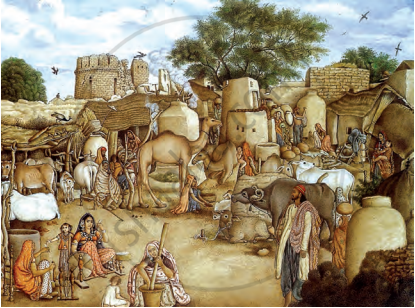
Describe what women and men are shown doing in the illustration as well as the architecture of the village.
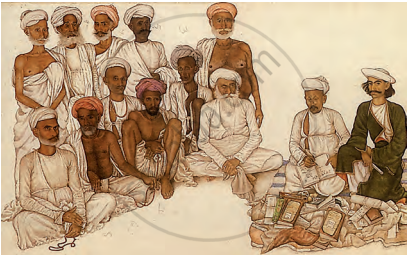
How has the artist differentiated between the village elders and the tax collectors?
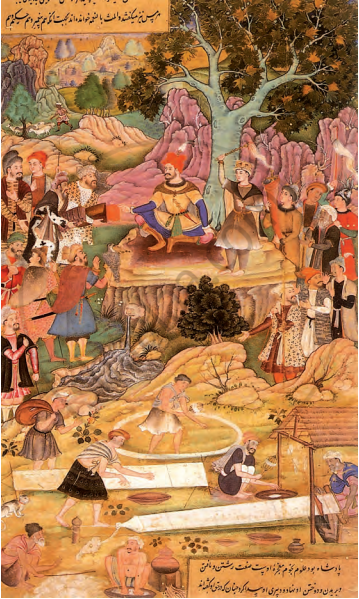
Describe the activities that are shown in the illustration.
Discuss
In what ways do you think the village panchayats described in “Peasants, Zamindars and the State” were similar to or different from present-day gram panchayats?
Are there any differences in the access men and women have to agricultural land in your state?
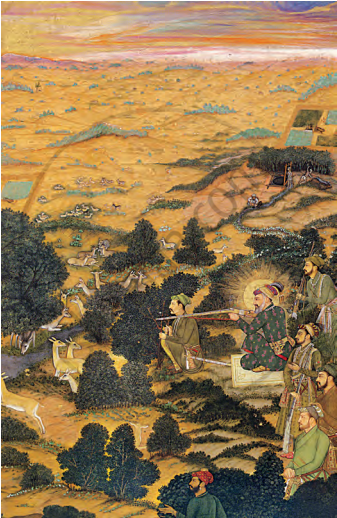
Describe what you see in this painting. What is the symbolic element that helps establish the connection between the hunt and ideal justice?
|
This is an excerpt from a sixteenth-century Bengali poem, Chandimangala, composed by Mukundaram Chakrabarti. The hero of the poem, Kalaketu, set up a kingdom by clearing forests: Hearing the news, outsiders came from various lands. |
What forms of intrusion into the forest does the text evoke? Compare its message with that of the miniature painting in “A Royal Hunt.” Who are the people identified as “foreigners” from the perspective of the forest dwellers?
|
This is how Abu’l Fazl describes the transactions between the hill tribes and the plains in the suba of Awadh (part of present-day Uttar Pradesh): From the northern mountains quantities of goods are carried on the backs of men, of stout ponies and of goats, such as gold, copper, lead, musk, tails of the kutas cow (the yak), honey, chuk (an acid composed of orange juice and lemon boiled together), pomegranate seed, ginger, long pepper, majith (a plant producing a red dye) root, borax, zedoary (a root resembling turmeric), wax, woollen stuffs, wooden ware, hawks, falcons, black falcons, merlins (a kind of bird), and other articles. In exchange they carry back white and coloured cloths, amber, salt, asafoetida, ornaments, glass and earthen ware. |
What are the modes of transport described in this passage? Why do you think they were used? Explain what each of the articles brought from the plains to the hills may have been used for.
Discuss
Find out which areas are currently identified as forest zones in your state. Is life in these areas changing today? Are the factors responsible for these changes different from or identical to those mentioned in “Peasants, Zamindars and the State?”
Why was the zamindari system abolished in India after Independence? Identify the reasons from the section “Zamindars and Their Power” in “Peasants, Zamindars and the State.”
|
The following is a listing of criteria of classification excerpted from the Ain: The Emperor Akbar, in his profound sagacity, classified the lands and fixed a different revenue to be paid by each. Polaj is land which is annually cultivated for each crop in succession and is never allowed to lie fallow. Parauti is land left out of cultivation for a time that it may recover its strength. Chachar is land that has lain fallow for three or four years. Banjar is land uncultivated for five years and more. Of the first two kinds of land, there are three classes, good, middling, and bad. They add together the produce of each sort, and the third of this represents the medium produce, one-third part of which is exacted as the Royal dues. |
What principles did the Mughal state follow while classifying lands in its territories? How was revenue assessed?
What impact do you think the expansion of the empire would have had on land revenue collection?
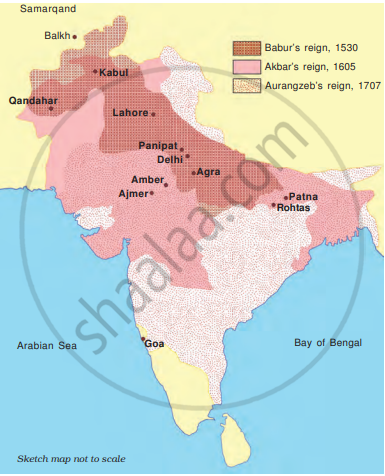
|
The Ain on land revenue collection: Let him (the amil-guzar) not make it a practice of taking only in cash but also in kind. The latter is effected in several ways. First, kankut: in the Hindi language kan signifies grain, and kut, estimates … If any doubts arise, the crops should be cut and estimated in three lots, the good, the middling, and the inferior, and the hesitation removed. Often, too, the land taken by appraisement gives a sufficiently accurate return. Secondly, batai, also called bhaoli, the crops are reaped and stacked and divided by agreement in the presence of the parties. But in this case several intelligent inspectors are required; otherwise, the evil-minded and false are given to deception. Thirdly, khet-batai, when they divide the fields after they are sown. Fourthly, lang batai, after cutting the grain, they form it in heaps and divide it among themselves, and each takes his share home and turns it to profit. |
What difference would each of the systems of assessment and collection of revenue have made to the cultivator?
|
This is an excerpt from Aurangzeb’s order to his revenue official, 1665: He should direct the amins of the parganas that they should discover the actual conditions of cultivation (maujudat), village by village, peasant-wise (asamiwar), and after minute scrutiny, assess the jama, keeping in view the financial interests (kifayat) of the government, and the welfare of the peasantry |
Why do you think the emperor insisted on a detailed survey?
Discuss
Would you consider the land revenue system of the Mughals as a flexible one?
Find out whether there are any taxes on agricultural production at present in your state. Explain the similarities and differences between Mughal fiscal policies and those adopted by present-day state governments.
|
In this extract, Abu’l Fazl gives a vivid account of how and from whom he collected his information: ... to Abu’l Fazl, son of Mubarak … this sublime mandate was given. “Write with the pen of sincerity the account of the glorious events and of our dominion-conquering victories … Assuredly, I spent much labour and research in collecting the records and narratives of His Majesty’s actions, and I was a long time interrogating the servants of the State and the old members of the illustrious family. I examined both prudent, truth-speaking old men and active-minded, right-actioned young ones and reduced their statements to writing. The Royal commands were issued to the provinces, that those who from old service remembered, with certainty or with adminicle of doubt, the events of the past, should copy out the notes and memoranda and transit them to the court. (Then) a second command shone forth from the holy Presence-chamber; to wit – that the materials which had been collected should be ... recited in the royal hearing, and whatever might have to be written down afterwards, should be introduced into the noble volume as a supplement, and that such details as on account of the minuteness of the inquiries and the minutae of affairs, (which) could not then be brought to an end, should be inserted afterwards at my leisure. Being relieved by this royal order – the interpreter of the Divine ordinance – from the secret anxiety of my heart, I proceeded to reduce into writing the rough draughts (drafts)which were void of the grace of arrangement and style. I obtained the chronicle of events beginning at the Nineteenth Year of the Divine Era, when the Record Office was established by the enlightened intellect of His Majesty, and from its rich pages, I gathered the accounts of many events. Great pains too were taken to procure the originals or copies of most of the orders which had been issued to the provinces from the Accession up to the present day… I also took much trouble to incorporate many of the reports which ministers and high officials had submitted, about the affairs of the empire and the events of foreign countries. And my labour-loving soul was satiated by the apparatus of inquiry and research. I also exerted myself energetically to collect the rough notes and memoranda of sagacious and well-informed men. By these means, I constructed a reservoir for irrigating and moistening the rose garden of fortune (the Akbar Nama). |
List all the sources that Abu’l Fazl used to compile his work. Which of these sources would have been most useful for arriving at an understanding of agrarian relations? To what extent do you think his work would have been influenced by his relationship with Akbar?
NCERT solutions for थीम्स इन इंडियन हिस्ट्री पार्ट I, II, अँड III [इंग्रजी] इयत्ता १२ 8 Peasants, Zamindars And The State: Agrarian Society and the Mughal Empire Exercises [Pages 222 - 223]
Answer in100-150 words
What are the problems in using the Ain as a source for reconstructing agrarian history? How do historians deal with this situation?
Answer in 100-150 words
To what extent is it possible to characterise agricultural production in the sixteenth-seventeenth centuries as subsistence agriculture? Give reasons for your answer.
Answer in 100-150 words
Describe the role played by women in agricultural production.
Answer in 100-150 words
Discuss, with examples, the significance of monetary transactions during the period under consideration.
Answer in 100-150 words:
Examine the evidence that suggests that land revenue was important for the Mughal fiscal system.
Write a short essay (about 250-300 words) on the following:
To what extent do you think caste was a factor in influencing social and economic relations in agrarian society?
Write a short essay (about 250-300 words) on the following:
How were the lives of forest dwellers transformed in the sixteenth and seventeenth centuries?
Write a short essay (about 250-300 words) on the following:
Examine the role played by zamindars in Mughal India.
Write a short essay (about 250-300 words) on the following:
Discuss the ways in which panchayats and village headmen regulated rural society.
Map work
On an outline map of the world, mark the areas which had economic links with the Mughal Empire, and trace out possible routes of communication.
Project (choose one)
Visit a neighbouring village. Find out how many people live there, which crops are grown, which animals are raised, which artisanal groups reside there, whether women own land, how the local panchayat functions. Compare this information with what you have learnt about the sixteenth-seventeenth centuries, noting similarities and differences. Explain both the changes and the continuities that you find.
Select a small section of the Ain. Read it carefully and prepare a report on how it can be used by a historian.
Solutions for 8: Peasants, Zamindars And The State: Agrarian Society and the Mughal Empire
NCERT solutions for थीम्स इन इंडियन हिस्ट्री पार्ट I, II, अँड III [इंग्रजी] इयत्ता १२ chapter 8 - Peasants, Zamindars And The State: Agrarian Society and the Mughal Empire
Shaalaa.com has the CBSE Mathematics थीम्स इन इंडियन हिस्ट्री पार्ट I, II, अँड III [इंग्रजी] इयत्ता १२ CBSE solutions in a manner that help students grasp basic concepts better and faster. The detailed, step-by-step solutions will help you understand the concepts better and clarify any confusion. NCERT solutions for Mathematics थीम्स इन इंडियन हिस्ट्री पार्ट I, II, अँड III [इंग्रजी] इयत्ता १२ CBSE 8 (Peasants, Zamindars And The State: Agrarian Society and the Mughal Empire) include all questions with answers and detailed explanations. This will clear students' doubts about questions and improve their application skills while preparing for board exams.
Further, we at Shaalaa.com provide such solutions so students can prepare for written exams. NCERT textbook solutions can be a core help for self-study and provide excellent self-help guidance for students.
Concepts covered in थीम्स इन इंडियन हिस्ट्री पार्ट I, II, अँड III [इंग्रजी] इयत्ता १२ chapter 8 Peasants, Zamindars And The State: Agrarian Society and the Mughal Empire are Peasants and Agricultural Production, The Village Community, Women in Agrarian Society, Forests and Tribes, The Zamindars, Land Revenue System, The Flow of Silver, The Ain-i Akbari of Abu’L Fazl Allami, Overview of Peasants, Zamindars and the State Agrarian Society and the Mughal Empire (c. sixteenth seventeenth centuries), Overview of Peasants, Zamindars and the State Agrarian Society and the Mughal Empire (c. sixteenth seventeenth centuries).
Using NCERT थीम्स इन इंडियन हिस्ट्री पार्ट I, II, अँड III [इंग्रजी] इयत्ता १२ solutions Peasants, Zamindars And The State: Agrarian Society and the Mughal Empire exercise by students is an easy way to prepare for the exams, as they involve solutions arranged chapter-wise and also page-wise. The questions involved in NCERT Solutions are essential questions that can be asked in the final exam. Maximum CBSE थीम्स इन इंडियन हिस्ट्री पार्ट I, II, अँड III [इंग्रजी] इयत्ता १२ students prefer NCERT Textbook Solutions to score more in exams.
Get the free view of Chapter 8, Peasants, Zamindars And The State: Agrarian Society and the Mughal Empire थीम्स इन इंडियन हिस्ट्री पार्ट I, II, अँड III [इंग्रजी] इयत्ता १२ additional questions for Mathematics थीम्स इन इंडियन हिस्ट्री पार्ट I, II, अँड III [इंग्रजी] इयत्ता १२ CBSE, and you can use Shaalaa.com to keep it handy for your exam preparation.
