Advertisements
Online Mock Tests
Chapters
1: Bricks, Beads And Bones: The Harappan Civilisation
2: Kings, Farmers And Towns: Early States and Economies
3: Kinship, Caste And Class: Early Societies
4: Thinkers, Beliefs And Buildings: Cultural Developments
Part 2
5: Through The Eyes Of Travellers: Perceptions of Society
6: Bhakti –Sufi Traditions: Changes in Religious Beliefs and Devotional Texts
7: An Imperial Capital: Vijayanagara
8: Peasants, Zamindars And The State: Agrarian Society and the Mughal Empire
Part 3
9: Colonialism And The Countryside: Exploring Official Archives
10: Rebels And The Raj: 1857 Revolt and its Representations
▶ 11: Mahatma Gandhi And The Nationalist Movement: Civil Disobedience and Beyond
12: Framing The Constitution: The Beginning of a New Era
![NCERT solutions for थीम्स इन इंडियन हिस्ट्री पार्ट I, II, अँड III [इंग्रजी] इयत्ता १२ chapter 11 - Mahatma Gandhi And The Nationalist Movement: Civil Disobedience and Beyond - Shaalaa.com](/images/themes-in-indian-history-part-i-ii-and-iii-english-class-12_6:81c2d22dfccf437dbdcef1d2cd896e40.jpg "NCERT solutions for थीम्स इन इंडियन हिस्ट्री पार्ट I, II, अँड III [इंग्रजी] इयत्ता १२ chapter 11 - Mahatma Gandhi And The Nationalist Movement: Civil Disobedience and Beyond")
Advertisements
Solutions for Chapter 11: Mahatma Gandhi And The Nationalist Movement: Civil Disobedience and Beyond
Below listed, you can find solutions for Chapter 11 of CBSE NCERT for थीम्स इन इंडियन हिस्ट्री पार्ट I, II, अँड III [इंग्रजी] इयत्ता १२.
NCERT solutions for थीम्स इन इंडियन हिस्ट्री पार्ट I, II, अँड III [इंग्रजी] इयत्ता १२ 11 Mahatma Gandhi And The Nationalist Movement: Civil Disobedience and Beyond Intext Questions [Pages 289 - 311]
Discuss
Find out more about the national movement in India before 1915 and see whether Mahatma Gandhi’s comments are justified.
|
Local newspapers in the United Provinces recorded many of the rumours that circulated at that time. There were rumours that every person who wanted to test the power of the Mahatma had been surprised: 1. Sikandar Sahu from a village in Basti said on 15 February that he would believe in the Mahatmaji when the karah (boiling pan) full of sugar cane juice in his karkhana (where gur was produced) split into two. Immediately the karah actually split into two from the middle. 2. A cultivator in Azamgarh said that he would believe in the Mahatmaji’s authenticity if sesamum sprouted on his field planted with wheat. Next day all the wheat in that field became sesamum. There were rumours that those who opposed Mahatma Gandhi invariably met with some tragedy. 1. A gentleman from Gorakhpur city questioned the need to ply the charkha. His house caught fire. 2. In April 1921, some people were gambling in a village of Uttar Pradesh. Someone told them to stop. Only one from amongst the group refused to stop and abused Gandhiji. The next day his goat was bitten by four of his own dogs. 3. In a village in Gorakhpur, the peasants resolved to give up drinking liquor. One person did not keep his promise. As soon as he started for the liquor shop, brickbats started to rain in his path. When he spoke the name of Gandhiji, the brickbats stopped flying. |
You have read about rumours in “Rebels and the Raj” and seen that the circulation of rumours tells us about the structure of the belief of a time: they tell us about the mind of the people who believe in the rumours and the circumstances that make this belief possible. What do you think these rumours about Gandhiji reflect?
Discuss
What was Non-cooperation? Find out about the variety of ways in which different social groups participated in the movement.
|
Why was salt the symbol of protest? This is what Mahatma Gandhi wrote: The volume of information being gained daily shows how wickedly the salt tax has been designed. In order to prevent the use of salt that has not paid the tax, which is at times even fourteen times its value, the Government destroys the salt it cannot sell profitably. Thus it taxes the nation’s vital necessity; it prevents the public from manufacturing it and destroys what nature manufactures without effort. No adjective is strong enough for characterising this wicked dog-in-the-manger policy. From various sources I hear tales of such wanton destruction of the nation’s property in all parts of India. Maunds, if not tons, of salt are said to be destroyed on the Konkan coast. The same tale comes from Dandi. Wherever there is likelihood of natural salt being taken away by the people living in the neighbourhood of such areas for their personal use, salt officers are posted for the sole purpose of carrying on destruction. Thus valuable national property is destroyed at national expense and salt taken out of the mouths of the people. The salt monopoly is thus a fourfold curse. It deprives the people of a valuable, easy village industry, involves wanton destruction of property that nature produces in abundance, the destruction itself means more national expenditure, and fourthly, to crown this folly, an unheard-of tax of more than 1,000 per cent is exacted from a starving people. This tax has remained so long because of the apathy of the general public. Now that it is sufficiently roused, the tax has to go. How soon it will be abolished depends upon the strength the people. THE COLLECTED WORKS OF MAHATMA GANDHI (CWMG), VOL. 49 |
Why was salt destroyed by the colonial government? Why did Mahatma Gandhi consider the salt tax more oppressive than other taxes?
|
On 5 April 1930, Mahatma Gandhi spoke at Dandi: When I left Sabarmati with my companions for this seaside hamlet of Dandi, I was not certain in my mind that we would be allowed to reach this place. Even while I was at Sabarmati, there was a rumour that I might be arrested. I had thought that the Government might perhaps let my party come as far as Dandi, but not me certainly. If someone says that this betrays imperfect faith on my part, I shall not deny the charge. That I have reached here is in no small measure due to the power of peace and non-violence: that power is universally felt. The Government may, if it wishes, congratulate itself on acting as it has done, for it could have arrested every one of us. In saying that it did not have the courage to arrest this army of peace, we praise it. It felt ashamed to arrest such an army. He is a civilised man who feels ashamed to do anything which his neighbours would disapprove. The Government deserves to be congratulated on not arresting us, even if it desisted only from fear of world opinion. Tomorrow we shall break the salt tax law. Whether the Government will tolerate that is a different question. It may not tolerate it, but it deserves congratulations on the patience and forbearance it has displayed in regard to this party. … What if I and all the eminent leaders in Gujarat and in the rest of the country are arrested? This movement is based on the faith that when a whole nation is roused, and on the march, no leader is necessary. CWMG, VOL. 49 |
What does the speech tell us about how Gandhiji saw the colonial state?
Discuss
Read Source “The Problem of Separate Electorates” and “Ambedkar on Separate Electorates.” Write an imaginary dialogue between Dr. B.R. Ambedkar and Mahatma Gandhi on the issue of separate electorates for the Depressed Classes.
|
In the 1920s, Jawaharlal Nehru was increasingly influenced by socialism, and he returned from Europe in 1928 deeply impressed with the Soviet Union. As he began working closely with the socialists (Jayaprakash Narayan, Narendra Dev, N.G. Ranga and others), a rift developed between the socialists and the conservatives within the Congress. After becoming the Congress President in 1936, Nehru spoke passionately against fascism, and upheld the demands of workers and peasants. Worried by Nehru’s socialist rhetoric, the conservatives, led by Rajendra Prasad and Sardar Patel, threatened to resign from the Working Committee, and some prominent industrialists in Bombay issued a statement attacking Nehru. Both Prasad and Nehru turned to Mahatma Gandhi and met him at his ashram at Wardha. The latter acted as the mediator, as he often did, restraining Nehru’s radicalism and persuading Prasad and others to see the significance of Nehru’s leadership. In A Bunch of Old Letters (1958), Nehru reprinted many of the letters that were exchanged at the time. Read the extracts in the following. My dear Jawaharlalji, Wardha, July 1, 1936 Since we parted yesterday, we have had a long conversation with Mahatmaji and a prolonged consultation among ourselves. We understand that you have felt much hurt by the course of action taken by us and particularly the tone of our letter has caused you much pain. It was never our intention either to embarrass you or to hurt you, and if you had suggested or indicated that it hurt you, we would have, without the least hesitation, amended or altered the letter. But we have decided to withdraw it and our resignation on a reconsideration of the whole situation. We have felt that in all your utterances as published in the Press you have been speaking not so much on the general Congress programme as on a topic which has not been accepted by the Congress and in doing so you have been acting more as the mouthpiece of the minority of our colleagues on the Working Committee as also on the Congress than the mouthpiece of the majority which we expected you as Congress President to do. There is regular continuous campaign against us treating us as persons whose time is over, who represent and stand for ideas that are worn out and that have no present value, who are only obstructing the progress of the country and who deserve to be cast out of the positions which they undeservedly hold … we have felt that a great injustice has been and is being done to us by others, and we are not receiving the protection we are entitled from you as our colleague and as our President … Yours sincerely My Dear Bapu, Allahabad, July 5, 1936 I arrived here last night. Ever since I left Wardha, I have been feeling weak in body and troubled in mind. … Since my return from Europe, I found that meetings of the Working Committee exhaust me greatly; they have a devitalising effect on me, and I have almost the feeling of being older in years after every fresh experience … I am grateful to you for all the trouble you took in smoothing over matters and in helping to avoid a crisis. I read again Rajendra Babu’s letter to me (the second one) and his formidable indictment of me ... For however tenderly the fact may be stated, it amounts to this that I am an intolerable nuisance and the very qualities I possess – a measure of ability, energy, earnestness, some personality which has a vague appeal – become dangerous for they are harnessed to the wrong chariot (socialism). The conclusion from all this is obvious. I have written at length, both in my book and subsequently, about my present ideas. There is no lack of material for me to be judged. Those views are not casual. They are part of me, and though I might change them or vary them in future, so long as I hold them I must give expression to them. Because I attached importance to a larger unity, I tried to express them in the mildest way possible and more as an invitation to thought than as fixed conclusions. I saw no conflict in this approach and in anything that the Congress was doing. So far as the elections were concerned, I felt that my approach was a definite asset to us as it enthused the masses. But my approach, mild and vague as it was, is considered dangerous and harmful by my colleagues. I was even told that my laying stress always on the poverty and unemployment in India was unwise, or at any rate the way I did it was wrong … You told me that you intended issuing some kind of a statement. I shall welcome this for I believe in every viewpoint being placed before the country. Yours affectionately Segaon, July 15, 1936 Dear Jawaharlal, Your letter is touching. You feel the most injured party. The fact is that your colleagues have lacked your courage and frankness. The result has been disastrous. I have always pleaded with them to speak to you freely and fearlessly. But having lacked the courage, whenever they have spoken they have done it clumsily, and you have felt irritated. I tell you they have dreaded you, because of your irritability and impatience with them. They have chafed under your rebukes and magisterial manner and above all your arrogation of what has appeared to them your infallibility and superior knowledge. They feel you have treated them with scant courtesy and never defended them from socialist ridicule and even misrepresentation. I have looked at the whole affair as a tragi-comedy. I would therefore like you to look at the whole thing in a lighter vein. I suggested your name for the crown of thorns (Presidentship of the Congress). Keep it on, though the head be bruised. Resume your humour at the committee meetings. That is your most usual role, not that of a care-worn, irritable man ready to burst on the slightest occasion. How I wish you could telegraph me that on finishing my letter you felt as merry as you were on that New Year’s Day in Lahore when you were reported to have danced around the tricolour flag. You must give your throat a chance. Love |
- What do the letters tell us about the way Congress ideals developed over time?
- What do they reveal about the role of Mahatma Gandhi within the national movement?
- Do such letters give us any special insight into the working of the Congress, and into the nature of the national movement?
Can you see any conflict between this image and what was reported in the Fortnightly Reports of the police?
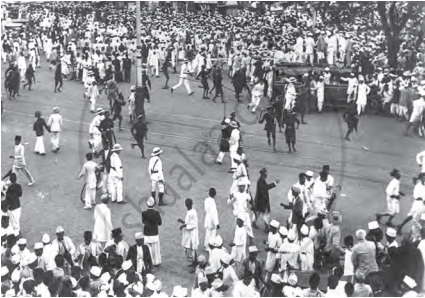
| Fortnightly Reports of the Home Department (Confidential) |
|
FOR THE FIRST HALF OF MARCH 1930 The rapid political developments in Gujarat are being closely watched here. To what extent and in what directions they will affect political condition in this province, it is difficult to surmise at present. The peasantry is for the moment engaged in harvesting a good rabi; students are preoccupied with their impending examinations. Central Provinces and Berar The arrest of Mr. Vallabh Bhai Patel caused little excitement, except in Congress circles, but a meeting organised by the Nagpur Nagar Congress Committee to congratulate Gandhi on the start of his march was attended by a crowd of over 3000 people at Nagpur. Bengal The outstanding event of the past fortnight has been the start of Gandhi’s campaign of civil disobedience. Mr. J.M. Sengupta has formed an All-Bengal Civil Disobedience Council, and the Bengal Provincial Congress Committee has formed an All Bengal Council of Disobedience. But beyond forming councils, no active steps have yet been taken in the matter of civil disobedience in Bengal. The reports from the districts show that the meetings that have been held excite little or no interest and leave no profound impression on the general population. It is noticeable, however, that ladies are attending these meetings in increasing numbers. Bihar and Orissa There is still little to report regarding Congress activity. There is a good deal of talk about a campaign to withhold payment of the chaukidari tax, but no area has yet been selected for experiment. The arrest of Gandhi is being foretold freely, but it seems quite possible that nonfulfilment of the forecast is upsetting plans. Madras The opening of Gandhi’s civil disobedience campaign has completely overshadowed all other issues. General opinion inclines to regard his march as theatrical and his programme as impracticable, but as he is held in such personal reverence by the Hindu public generally, the possibility of arrest which he seems deliberately to be courting and its effect on the political situation are viewed with considerable misgiving. The 12th of March was celebrated as the day of inaugurating the civil disobedience campaign. In Bombay, the celebrations took the form of saluting the national flag in the morning. Bombay Press Kesari indulged in offensive language and in its usual attitude of blowing hot and cold wrote: “If the Government wants to test the power of Satyagraha, both its action and inaction will cause injury to it. If it arrests Gandhi it will incur the discontent of the nation; if it does not do that, the movement of civil disobedience will go on spreading. We therefore say that if the Government punishes Mr. Gandhi the nation will have won a victory, and if it lets him alone it will have won a still greater victory.” On the other hand, the moderate paper Vividh Vritt pointed out the futility of the movement and opined that it could not achieve the end in view. It, however, reminded the government that repression would defeat its purpose. FOR THE SECOND HALF OF MARCH 1930 Bengal Interest has continued to centre round Gandhi’s march to the sea and the arrangements which he is making to initiate a campaign of civil disobedience. The extremist papers report his doings and speeches at great length and make a great display of the various meetings that are being held throughout Bengal and the resolutions passed thereat. But there is little enthusiasm for the form of civil disobedience favoured by Gandhi … Generally people are waiting to see what happens to Gandhi and the probability is that if any action is taken against him, a spark will be set to much inflammable material in Bengal. But the prospect of any serious conflagration is at present slight. Central Provinces and Berar In Nagpur these meetings were well attended, and most of the schools and colleges were deserted on the 12th March to mark the inauguration of Gandhi’s march. The boycott of liquor shops and the infringement of forest laws appear to be the most probable line of attack. Punjab It seems not improbable that organised attempts will be made to break the Salt Law in the Jhelum district; that the agitation relating to the non-payment of the water-tax in Multan will be revived; and that some movement in connection with the National Flag will be started probably at Gujranwala. United Provinces Political activity has undoubtedly intensified during the last fortnight. The Congress party feels that it must do something spectacular to sustain public interest. Enrolment of volunteers, propaganda in villages, preparations for breaking the salt laws on receipt of Mr. Gandhi’s orders are reported from a number of districts. FOR THE FIRST HALF OF APRIL 1930 United Provinces Events have moved rapidly during the fortnight. Apart from political meetings, processions and the enrolment of volunteers, the Salt Act has been openly defied at Agra, Cawnpore, Benaras, Allahabad, Lucknow, Meerut, Rae Bareli, Farukhabad, Etawah, Ballia and Mainpuri. Pt. Jawaharlal Nehru was arrested at Cheoki railway station early on the morning of April 14 as he was proceeding to the Central Provinces to attend a meeting of the Youth League. He was at once taken direct to Naini Central Jail, where he was tried and sentenced to six months’ simple imprisonment. Bihar and Orissa There have been, or are now materialising, spectacular, but small-scale, attempts at illicit salt manufacture in a few places … Central Provinces In Jubbalpore, Seth Govinddass has attempted to manufacture chemical salt at a cost many times in excess of the market price of clean salt. Madras Considerable opposition was shown at Vizagapatam to the Police when they attempted to seize salt made by boiling sea water, but elsewhere resistance to the seizure of illicit salt has been half-hearted. Bengal In the mufassal efforts have been made to manufacture illicit salt, the main operation areas being the districts of 24-Parganas and Midnapore. Very little salt has actually been manufactured, and most of it has been confiscated and the utensils in which it was manufactured destroyed. |
Read the Fortnightly Reports carefully. Remember, they are extracts from confidential reports of the colonial Home Department. These reports did not always accept what the police reported from different localities.
- How do you think the nature of the source affects what is being said in these reports? Write a short note illustrating your argument with quotations from the above text.
- Why do you think the Home Department was continuously reporting on what people thought about the possibility of Mahatma Gandhi’s arrest? Reread what Gandhiji said about the question of arrests in his speech on 5 April 1930 at Dandi.
- Why do you think Mahatma Gandhi was not arrested?
- Why do you think the Home Department continued to say that the march was not evoking any response?
NCERT solutions for थीम्स इन इंडियन हिस्ट्री पार्ट I, II, अँड III [इंग्रजी] इयत्ता १२ 11 Mahatma Gandhi And The Nationalist Movement: Civil Disobedience and Beyond Exercises [Pages 314 - 315]
Answer in 100-150 Words
How Did Mahatma Gandhi Seek to Identify with the Common People?
Answer in 100-150 Words
How Was Mahatma Gandhi Perceived by the Peasants?
Answer in 100-150 Words
Why Did the Salt Laws Become an Important Issue of Struggle?
Answer in 100-150 Words
Why Are Newspapers an Important Source for the Study of the National Movement?
Answer in 100-150 Words
Why Was the Charkha Chosen as a Symbol of Nationalism?
Write a Short Essay (250-300 Words) on the Following:
How Was Non-cooperation a Form of Protest?
Write a Short Essay (250-300 Words) on the Following:
Why Were the Dialogues at the Round Table Conference Inconclusive?
Write a short essay (250-300 words) on the following:
In what way did Mahatma Gandhi transform the
nature of the national movement?
Write a short essay (250-300 words) on the following:
What do private letters and autobiographies tell us about an individual? How are these sources
different from official accounts?
Map work
Find out about the route of the Dandi March. On a map of Gujarat plot the line of the march and mark the major towns and villages that it passed along the route.
Project (choose one)
Read any two autobiographies of nationalist leaders. Look at the different ways in which the authors represent their own life and times, and interpret the national movement. See how their views differ. Write an account based on your studies.
Choose any event that took place during the national movement. Try and read the letters and speeches of the leaders of the time. Some of these are now published. He could be a local leader from the region where you live. Try and see how the local leaders viewed the activities of the national leadership at the top. Write about the movement based on your reading.
Solutions for 11: Mahatma Gandhi And The Nationalist Movement: Civil Disobedience and Beyond
NCERT solutions for थीम्स इन इंडियन हिस्ट्री पार्ट I, II, अँड III [इंग्रजी] इयत्ता १२ chapter 11 - Mahatma Gandhi And The Nationalist Movement: Civil Disobedience and Beyond
Shaalaa.com has the CBSE Mathematics थीम्स इन इंडियन हिस्ट्री पार्ट I, II, अँड III [इंग्रजी] इयत्ता १२ CBSE solutions in a manner that help students grasp basic concepts better and faster. The detailed, step-by-step solutions will help you understand the concepts better and clarify any confusion. NCERT solutions for Mathematics थीम्स इन इंडियन हिस्ट्री पार्ट I, II, अँड III [इंग्रजी] इयत्ता १२ CBSE 11 (Mahatma Gandhi And The Nationalist Movement: Civil Disobedience and Beyond) include all questions with answers and detailed explanations. This will clear students' doubts about questions and improve their application skills while preparing for board exams.
Further, we at Shaalaa.com provide such solutions so students can prepare for written exams. NCERT textbook solutions can be a core help for self-study and provide excellent self-help guidance for students.
Concepts covered in थीम्स इन इंडियन हिस्ट्री पार्ट I, II, अँड III [इंग्रजी] इयत्ता १२ chapter 11 Mahatma Gandhi And The Nationalist Movement: Civil Disobedience and Beyond are The Last Heroic Days, Knowing Gandhi, A Leader Announces Himself, The Making and Unmaking of Non-cooperation, The Salt Satyagraha a Case Study, Quit India, Overview of Mahatma Gandhi and The Nationalist Movement Civil Disobedience and Beyond, Overview of Mahatma Gandhi and The Nationalist Movement Civil Disobedience and Beyond.
Using NCERT थीम्स इन इंडियन हिस्ट्री पार्ट I, II, अँड III [इंग्रजी] इयत्ता १२ solutions Mahatma Gandhi And The Nationalist Movement: Civil Disobedience and Beyond exercise by students is an easy way to prepare for the exams, as they involve solutions arranged chapter-wise and also page-wise. The questions involved in NCERT Solutions are essential questions that can be asked in the final exam. Maximum CBSE थीम्स इन इंडियन हिस्ट्री पार्ट I, II, अँड III [इंग्रजी] इयत्ता १२ students prefer NCERT Textbook Solutions to score more in exams.
Get the free view of Chapter 11, Mahatma Gandhi And The Nationalist Movement: Civil Disobedience and Beyond थीम्स इन इंडियन हिस्ट्री पार्ट I, II, अँड III [इंग्रजी] इयत्ता १२ additional questions for Mathematics थीम्स इन इंडियन हिस्ट्री पार्ट I, II, अँड III [इंग्रजी] इयत्ता १२ CBSE, and you can use Shaalaa.com to keep it handy for your exam preparation.
