Advertisements
Chapters
1: Rational and Irrational Numbers
UNIT-II: COMMERCIAL MATHEMATICS
2: Compound Interest
UNIT-III: ALGEBRA
3: Expansions
4: Factorisation
5: Simultaneous Linear Equations
6: Indices
7: Logarithms
UNIT-IV: GEOMETRY
8: Triangles
9: Inequalities
10: Mid-point Theorem
▶ 11: Pythagoras Theorem
12: Rectilinear Figures (Theorems on Parallelograms and Construction of Polygons)
13: Theorems on Area
14: Circles (Chord and Arc Properties)
UNIT-V: STATISTICS
15: Statistics
16: Graphical Representation of Statistical Data
UNIT-VI: MENSURATION
17: Mensuration
18: Surface Area and Volume of Solids
UNIT-VII: TRIGONOMETRY
19: Trigonometry
20: Simple 2-D Problems in Right Triangle
UNIT-VIII: COORDINATE GEOMETRY
21: Coordinate Geometry
![B Nirmala Shastry solutions for मॅथेमॅटिक्स [इंग्रजी] इयत्ता ९ आयसीएसई chapter 11 - Pythagoras Theorem - Shaalaa.com](/images/mathematics-english-class-9-icse_6:a927b361d63845f4b2afea4ec6bbe35a.jpg "B Nirmala Shastry solutions for मॅथेमॅटिक्स [इंग्रजी] इयत्ता ९ आयसीएसई chapter 11 - Pythagoras Theorem")
Advertisements
Solutions for Chapter 11: Pythagoras Theorem
Below listed, you can find solutions for Chapter 11 of CISCE B Nirmala Shastry for मॅथेमॅटिक्स [इंग्रजी] इयत्ता ९ आयसीएसई.
B Nirmala Shastry solutions for मॅथेमॅटिक्स [इंग्रजी] इयत्ता ९ आयसीएसई 11 Pythagoras Theorem EXERCISE 11 [Pages 124 - 126]
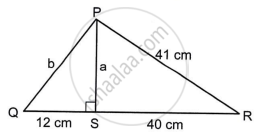
In ΔPQR, PS ⊥ QR. Find the sides marked a and b if PR = 41 cm, QS = 12 cm and SR = 40 cm.
The length of a rectangle is 24 cm and its diagonal is 30 cm. Find its breadth and area.
In the following figure, find the sides marked x and y.
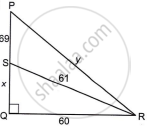
In the following figure, find the sides marked x and y.

In the following figure, find the sides marked x and y.
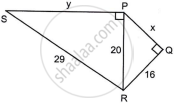
In the following figure, find the sides marked x and y.

In a right-angled triangle, the lengths of sides containing the right angle are 20 cm and 21 cm. What is the radius of the circumcircle of the triangle?
In the given figure, ∠ABC = 90°, AC = 13 cm, CD = 11 cm, AD = 20 cm. Find BC and AB.

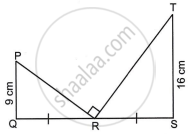
In the given figure, PQ and TS are perpendiculars to QS. R is the mid-point of QS and ∠PRT = 90°. If PQ = 9 cm, QS = 24 cm, TS = 16 cm, find PT.
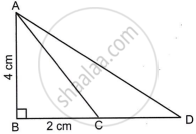
In ΔABD, AB ⊥ BD and AC = BD. If AB = 4 cm, BC = 2 cm, find AD.
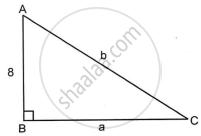
In ΔABC, AB = 8, find a and b if a + b = 32.
In the quadrilateral ABCD, ∠B = ∠D = 90°. Prove that 2AC2 – BC2 = AB2 + AD2 + DC2.
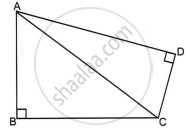
[Hint: LHS = (AC2) + (AC2 – BC2) = (AD2 + CD2) + (AB2) = RHS]
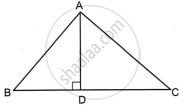
In triangle ABC, AD ⊥ BC. Prove that (AB + AC)(AC – AB) = (CD + BD)(CD – BD).
The diagonals of quadrilateral PQRS intersect at O, at right angles. Prove that PQ2 + SR2 = PS2 + QR2.
In ΔABC, ∠B = 90° and D is the mid-point of BC. Prove that AC2 = AD2 + 3CD2.
In ΔPQR, PS is perpendicular to RQ extended. Prove that PR2 = PQ2 + QR2 + 2QR.SQ.

P is any point inside the rectangle ABCD. Prove that PA2 + PC2 = PB2 + PD2.
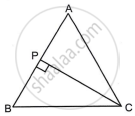
In ΔABC, AB = AC and CP ⊥ AB. Prove that
- 2AB . BP = BC2
- CP2 – BP2 = 2AP . BP
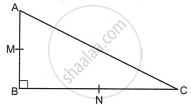
In ΔABC, ∠B = 90°. M and N are mid-points of AB and BC respectively.
Prove that
- CM2 + AN2 = 5MN2
- AN2 + CM2 = AC2 + MN2
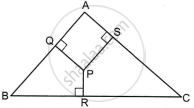
P is any point inside ΔABC and PQ, PR and PS are drawn perpendiculars to sides AB, BC and AC respectively. Prove that AQ2 + BR2 + CS2 = BQ2 + RC2 + AS2.
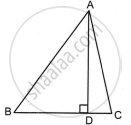
In ΔABC, AD is perpendicular to BC and BD : DC = 3 : 1. Prove that `AB^2 = AC^2 + 1/2 BC^2`.
ABC is an equilateral triangle. Side BC is trisected at D. Prove that 9AD2 = 7AB2.
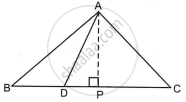
[Hint: Draw AP ⊥ BC. Let BD = 2x.
∴ DC = 4x, BC = 6x = AB and DP = x.]
A man travels 21 m in the west direction and then moves 20 m due north. Find his distance from the first point.
A ladder 25 m long reaches a window at a height of 7 m above the ground. Keeping its foot at the same point, the ladder is turned so that it reaches a window 20 m high across the street. Find the total width of the street.
A ladder is placed in such a way that its foot is a distance of 10 m from the wall. If it reaches a window at a height of 24 m, find the length of the ladder.
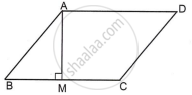
ABCD is a parallelogram, M is the mid-point of BC and AM ⊥ BC. Prove that AD2 = 4(CD2 – AM2).
Two poles are 4 m and 9 m high. They are on the same ground and the distance between them is 12 m. Find the distance between their tops.
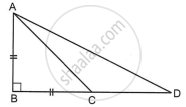
In ΔABC, ∠B = 90°, AB = BC. BC is produced to a point D. Prove that AD2 = 2BC × BD + CD2.
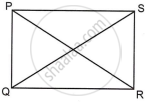
PQRS is a rectangle. Prove that PR2 + QS2 = PQ2 + QR2 + RS2 + PS2.
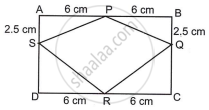
In the rectangle ABCD, AB = 12 cm, BC = 7 cm. P and R are mid-points of AB and CD. AS = BQ = 2.5 cm. Find the perimeter of PQRS.
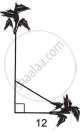
The upper part of a tree is broken by wind and falls to the ground without being detached. If the top of the broken part touches the ground at a distance of 12 feet from the foot of the tree, calculate the height at which it is broken if the original height is 24 feet.
B Nirmala Shastry solutions for मॅथेमॅटिक्स [इंग्रजी] इयत्ता ९ आयसीएसई 11 Pythagoras Theorem MULTIPLE CHOICE QUESTIONS [Pages 127 - 128]
If the sides of a rectangle are 12 cm, 16 cm, then the length of diagonal is ______.
18 cm
20 cm
24 cm
22 cm
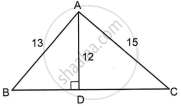
In ΔABC, AD ⊥ BC, AB = 13 cm, AC = 15 cm, AD = 12 cm.
∴ BC is ______.
`sqrt(394)`
9 cm
14 cm
15 cm
In quadrilateral PQRS, ∠Q = 90° = ∠S, SP = 15 cm, PQ = 7 cm, QR = 24 cm.
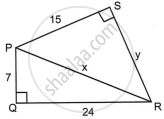
The length of PR is ______.
28 cm
26 cm
25 cm
30 cm
In quadrilateral PQRS, ∠Q = 90° = ∠S, SP = 15 cm, PQ = 7 cm, QR = 24 cm.
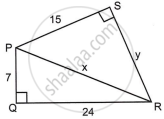
The length of SR is ______.
18 cm
20 cm
16 cm
24 cm
In a rhombus the length of the diagonals are 16 cm, 30 cm.
∴ The length of its side is ______.
34 cm
13 cm
15 cm
17 cm
If the side of a rhombus is 15 cm and one diagonal is 24 cm then the length of the other diagonal is ______.
18 cm
20 cm
26 cm
25 cm
In ΔABC, AD ⊥ BC. AB = 10 cm, BD = 6 cm, DC = 15 cm.
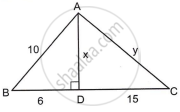
The value of x is ______.
7 cm
8 cm
9 cm
5 cm
In ΔABC, AD ⊥ BC. AB = 10 cm, BD = 6 cm, DC = 15 cm.
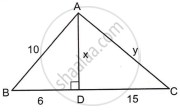
The value of y is ______.
20 cm
25 cm
17 cm
13 cm
In the quadrilateral ABCD, AB = 7 cm, BC = 17 cm, AD = CD = x. ∠B = 90° = ∠D.
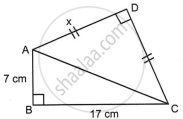
The value of x is ______.
13 cm
15 cm
12 cm
16 cm
Which of the sides can not form a right-angled Δ?
6, 8, 10
4.5, 6, 7.5
9, 12, 15
8, 13, 15
A boy cycles 120 m north and moves 160 m west. How far is he from the starting point?
250 m
200 m
240 m
300 m
In ΔPQR, PS ⊥ QR, PR = 41 cm, SR = 9 cm, QS = 30 cm.
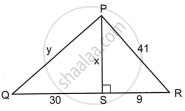
The value of x is ______.
36 cm
35 cm
40 cm
38 cm
In ΔPQR, PS ⊥ QR, PR = 41 cm, SR = 9 cm, QS = 30 cm.
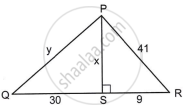
The value of y is ______.
50 cm
55 cm
60 cm
45 cm
The height of pole AB = 8 m. Its shadow on the ground is BC = 6 m.
∴ AC = ______
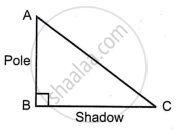
9 m
10 m
11 m
12 m
In ΔABD, AB ⊥ BD and AC = DB. AB = 4 cm, BC = 2 cm.
∴ AD = ______
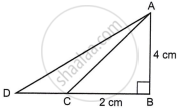
`sqrt(20)` cm
8 cm
7 cm
6 cm
In the quadrilateral ABCD, ∠B = 90°, ∠ACD = 90°, AB = 3 cm, BC = 4 cm, CD = 12 cm, find AD.
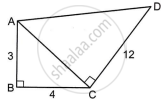
13 cm
15 cm
17 cm
14 cm
In ΔABC, ∠B = 90°, AD = 17 cm, AB = 15 cm, CD = 12 cm, find AC.
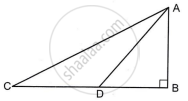
20 cm
24 cm
25 cm
30 cm
In the figure, find x.
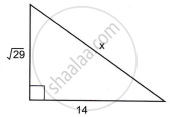
17
16
15
25
In each of the following questions, a statement of assertion (A) is given and a statement of Reason (R) given below it choose the correct option for each question.
Assertion: In the figure, AC = 17 cm, CD = 7 cm and AE = 15 cm, then ED = 15 cm.
Reason: BC = ED.
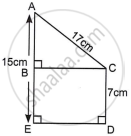
Both A and R are true and R is the correct reason for A.
Both A and R are true but R is the incorrect reason for A.
A is true but R is false.
A is false but R is true.
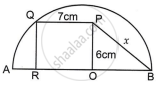
Assertion: In the semi circle, O is the centre. OPQR is a rectangle. OP = 6 cm, PQ = 7 cm. The length of PB = 11 cm.
Reason: The radius OQ = `sqrt(85)` cm.
Both A and R are true and R is the correct reason for A.
Both A and R are true but R is the incorrect reason for A.
A is true but R is false.
A is false but R is true.
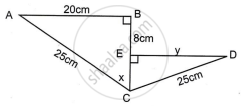
Assertion: In the given figure in ΔABC, ∠B = 90° and DE ⊥ BC. AB = 20 cm, AC = 25 cm = CD. BE = 8 cm, then y = 24 cm.
Reason: BC = 15 cm ∴ x = 7 cm.
Both A and R are true and R is the correct reason for A.
Both A and R are true but R is the incorrect reason for A.
A is true but R is false.
A is false but R is true.
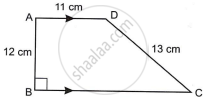
Assertion: In the given figure AB = 12 cm, CD = 13 cm and AD = 11 cm. ∴ AC = 20 cm.
Reason: In ΔABC, if ∠B = 90°, then AB2 + BC2 = AC2.
Both A and R are true and R is the correct reason for A.
Both A and R are true but R is the incorrect reason for A.
A is true but R is false.
A is false but R is true.
B Nirmala Shastry solutions for मॅथेमॅटिक्स [इंग्रजी] इयत्ता ९ आयसीएसई 11 Pythagoras Theorem MISCELLANEOUS EXERCISE [Page 129]
PQRS is a rectangle. PA = 16 cm, AQ = 9 cm and QR = 12 cm.
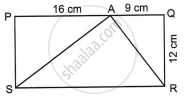
- Find the lengths of AS and AR.
- Prove that ∠SAR = 90°.
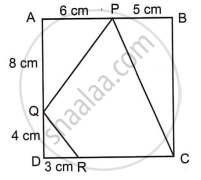
ABCD is a rectangle. AP = 6 cm, PB = 5 cm, AQ = 8 cm, QD = 4 cm, DR = 3 cm. Find PQ, QR and PC.
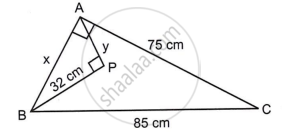
In ΔABC, ∠BAC = 90° = ∠APB. BC = 85 cm, AC = 75 cm and BP = 32 cm. Find x and y.
In ΔABC, AD ⊥ BC. D divides BC in the ratio 2 : 3. Prove that 5AC2 = 5AB2 + BC2.
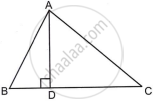
[Hint: Let BD = 2x, AD = y and DC = 3x.]
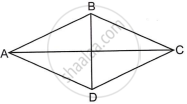
ABCD is a rhombus. Prove that AC2 + BD2 = 4AB2.
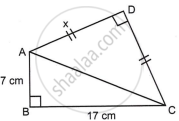
In the quadrilateral ABCD, ∠B = 90° = ∠D, AB = 7 cm, BC = 17 cm and AD = DC = x. Find the value of x.
AB and CD are two buildings of height 30 m and 63 m. If the distance between them is 56 m, calculate the distance between their tops.
For a standard television set, the horizontal length to the height is in the ratio 4 : 3. Find the length of 35 inches television. [The TV measurement indicates its diagonal length].
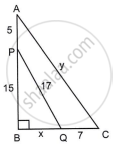
In ΔABC, ∠B = 90°, AP = 5, PB = 15, PQ = 17 and QC = 7. Find the values of x and y.
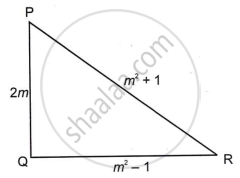
If PQ = 2m, QR = m2 – 1 and PR = m2 + 1, show that PQR is a right-angled triangle. Hence, find the sides of triangle when m = 4, 5, 6.
ABC is a triangle, right angled at B. M is a point on BC. Prove that AM2 + BC2 = AC2 + BM2.

Solutions for 11: Pythagoras Theorem
B Nirmala Shastry solutions for मॅथेमॅटिक्स [इंग्रजी] इयत्ता ९ आयसीएसई chapter 11 - Pythagoras Theorem
Shaalaa.com has the CISCE Mathematics मॅथेमॅटिक्स [इंग्रजी] इयत्ता ९ आयसीएसई CISCE solutions in a manner that help students grasp basic concepts better and faster. The detailed, step-by-step solutions will help you understand the concepts better and clarify any confusion. B Nirmala Shastry solutions for Mathematics मॅथेमॅटिक्स [इंग्रजी] इयत्ता ९ आयसीएसई CISCE 11 (Pythagoras Theorem) include all questions with answers and detailed explanations. This will clear students' doubts about questions and improve their application skills while preparing for board exams.
Further, we at Shaalaa.com provide such solutions so students can prepare for written exams. B Nirmala Shastry textbook solutions can be a core help for self-study and provide excellent self-help guidance for students.
Concepts covered in मॅथेमॅटिक्स [इंग्रजी] इयत्ता ९ आयसीएसई chapter 11 Pythagoras Theorem are .
Using B Nirmala Shastry मॅथेमॅटिक्स [इंग्रजी] इयत्ता ९ आयसीएसई solutions Pythagoras Theorem exercise by students is an easy way to prepare for the exams, as they involve solutions arranged chapter-wise and also page-wise. The questions involved in B Nirmala Shastry Solutions are essential questions that can be asked in the final exam. Maximum CISCE मॅथेमॅटिक्स [इंग्रजी] इयत्ता ९ आयसीएसई students prefer B Nirmala Shastry Textbook Solutions to score more in exams.
Get the free view of Chapter 11, Pythagoras Theorem मॅथेमॅटिक्स [इंग्रजी] इयत्ता ९ आयसीएसई additional questions for Mathematics मॅथेमॅटिक्स [इंग्रजी] इयत्ता ९ आयसीएसई CISCE, and you can use Shaalaa.com to keep it handy for your exam preparation.
