Advertisements
Advertisements
प्रश्न
In ΔABC, AD ⊥ BC. D divides BC in the ratio 2 : 3. Prove that 5AC2 = 5AB2 + BC2.
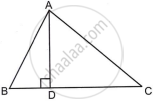
[Hint: Let BD = 2x, AD = y and DC = 3x.]
Advertisements
उत्तर
Given: In ΔABC, AD ⊥ BC.
D divides BC in the ratio 2 : 3, so BD = 2x and DC = 3x.
Let AD be y.
To prove: 5AC2 = 5AB2 + BC2
Proof: Let’s apply the Pythagoras Theorem in the two right-angled triangles:
In ΔABD,
AB2 = AD2 + BD2
= y2 + (2x)2
= y2 + 4x2 ...(1)
In ΔADC,
AC2 = AD2 + DC2
= y2 + (3x)2
= y2 + 9x2 ...(2)
Multiply (1) by 5;
5AB2 = 5(y2 + 4x2)
= 5y2 + 20x2 ...(3)
Now add BC2 to both sides of (3).
Since BC = BD + DC
= 2x + 3x
= 5x
So, BC2 = (5x)2
= 25x2 ...(4)
Add (3) and (4):
5AB2 + BC2 = 5y2 + 20x2 + 25x2
= 5y2 + 45x2 ...(5)
Now multiply (2) by 5.
5AC2 = 5(y2 + 9x2)
= 5y2 + 45x2 ...(6)
Compare (5) and (6):
5AC2 = 5AB2 + BC2
Hence Proved.
