Advertisements
Advertisements
प्रश्न
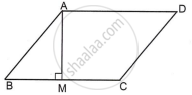
ABCD is a parallelogram, M is the mid-point of BC and AM ⊥ BC. Prove that AD2 = 4(CD2 – AM2).
सिद्धांत
Advertisements
उत्तर
Pythagoras theorem states that in a right-angled triangle, the square of the hypotenuse is equal to the sum of the squares of the other two sides.
Given,
Applying Pythagoras theorem as AM ⊥ BC
BM2 = AB2 − AM2
BM = `(BC)/2` or `(AD)/2`
BC = AD and AB = CD, the opposite sides of a parallelogram are equal.
⇒ BM2 = CD2 − AM2
⇒ `((AD)/2)^2 = CD^2 - AM^2`
⇒ `(AD^2)/4 = CD^2 - AM^2`
⇒ AD2 = 4(CD2 − AM2)
Hence, proved.
shaalaa.com
या प्रश्नात किंवा उत्तरात काही त्रुटी आहे का?
