Advertisements
Chapters
1: Rational and Irrational Numbers
UNIT-II: COMMERCIAL MATHEMATICS
2: Compound Interest
UNIT-III: ALGEBRA
3: Expansions
4: Factorisation
5: Simultaneous Linear Equations
6: Indices
7: Logarithms
UNIT-IV: GEOMETRY
8: Triangles
9: Inequalities
10: Mid-point Theorem
11: Pythagoras Theorem
12: Rectilinear Figures (Theorems on Parallelograms and Construction of Polygons)
▶ 13: Theorems on Area
14: Circles (Chord and Arc Properties)
UNIT-V: STATISTICS
15: Statistics
16: Graphical Representation of Statistical Data
UNIT-VI: MENSURATION
17: Mensuration
18: Surface Area and Volume of Solids
UNIT-VII: TRIGONOMETRY
19: Trigonometry
20: Simple 2-D Problems in Right Triangle
UNIT-VIII: COORDINATE GEOMETRY
21: Coordinate Geometry
![B Nirmala Shastry solutions for मॅथेमॅटिक्स [इंग्रजी] इयत्ता ९ आयसीएसई chapter 13 - Theorems on Area - Shaalaa.com](/images/mathematics-english-class-9-icse_6:a927b361d63845f4b2afea4ec6bbe35a.jpg "B Nirmala Shastry solutions for मॅथेमॅटिक्स [इंग्रजी] इयत्ता ९ आयसीएसई chapter 13 - Theorems on Area")
Advertisements
Solutions for Chapter 13: Theorems on Area
Below listed, you can find solutions for Chapter 13 of CISCE B Nirmala Shastry for मॅथेमॅटिक्स [इंग्रजी] इयत्ता ९ आयसीएसई.
B Nirmala Shastry solutions for मॅथेमॅटिक्स [इंग्रजी] इयत्ता ९ आयसीएसई 13 Theorems on Area EXERCISE 13 [Pages 161 - 163]
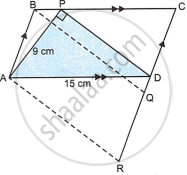
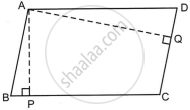
Find the area of parallelogram ABCD, if AD = 15 cm and P is a point on BC such that AP = 9 cm. Also find the area of parallelogram ABQR, where Q and R are points on CD produced.
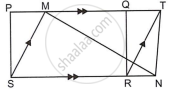
M is a point on side PQ of rectangle PQRS. SR is produced to a point N and MSRT is a parallelogram. PQ = 8.5 cm, PS = 6 cm. Find the area of
- parallelogram MSRT
- ΔMNT
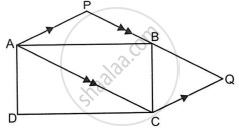
ABCD is a rectangle, AB = 15 cm, AC = 17 cm. Find the area of parallelogram PQCA.
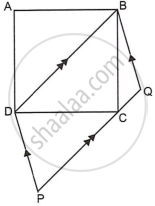
ABCD is a square of side 10 cm. Find the area of parallelogram BDPQ.
The perimeter of parallelogram ABCD is 42 cm. If AP = 3 cm and AQ = 4 cm, calculate the sides of parallelogram ABCD.
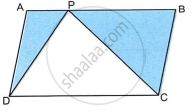
P is any point on the side AB of parallelogram ABCD. Prove that area (ΔAPD) + area (ΔPBC) = `1/2` area (|| gm ABCD).
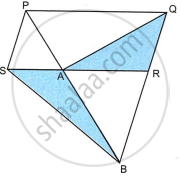
PQRS is a parallelogram. A is any point on SR. PA is produced to meet QR produced at B. Prove that area (ΔQAR) = area (ΔSAB).
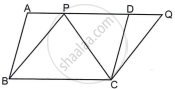
ABCD and PBCQ are parallelograms. Area of ΔPBC = 8 cm2. Calculate the area of parallelograms ABCD, PBCQ and ΔPCQ.
In the given figure, AC || BH and AD || EF. Show area (ΔAHF) = area (pentagon ABCDE). [Hint: Join BC and DE.]
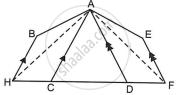
[Hint: Join BC and DE.]
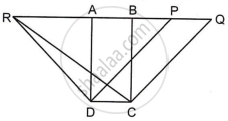
ABCD is a rectangle, AB = 4 cm, BC = 10 cm. Find the area of ΔRDC and || gm PQCD.
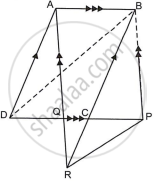
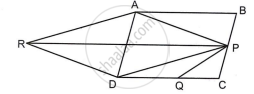
ABCD and ABPQ are two parallelograms. Side AQ and BC are produced to meet at R. Show that area (ΔBCD) = area (ΔBPR).
In the given figure, TQ || SR and PQ || TS. Prove that area (ΔPTS) = area (ΔTRQ).
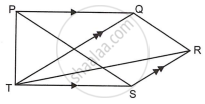
[Hint: Join QS.]
ABCD and APDR are parallelograms. P is the mid-point of BC and Q is on CD such that DQ : QC = 2 : 1. Area (ΔPQC) = 20 cm2. Find the areas of
- ΔPDC
- ΔABP
- || gm APDR
ABCD and BEFG are parallelograms and CE || AG. Prove that Area (|| gm ABCD) = Area (|| gm BEFG)
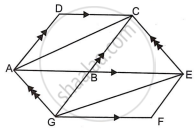
[Hint: Prove Area (ΔABC) = Area (ΔGBE)]
ABCD is a parallelogram, BC is produced to Q so that ∠DQC = 90°. AP ⊥ DC. If AP = 2.5 cm, BC = 4 cm and DQ = 5 cm, find the length of AB.
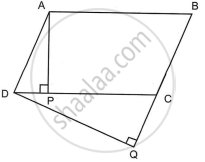
[Hint: Area of || gm = CD × AP = AD × DQ]
ABCD is a parallelogram and AF || DE. Prove that area (|| gm DEFH) = area (|| gm ABCD).
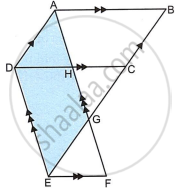
[Hint: Each || gm is equal in area to || gm ADEG]
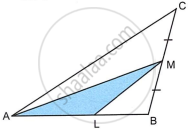
In ΔABC, M is the mid-point of BC, L is a point on AB such that AL = 2LB. Find the area of ΔALM if area of ΔABC = 72 cm2.
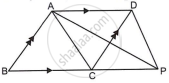
ABCD is a parallelogram, prove that
- Area (ΔABC) = Area (ΔPAD)
- Area (ΔPAB) = Area (quadrilateral ACPD)
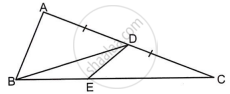
D is the mid-point of AC. E is on BC such that BE = `1/3` BC. Area of ΔABC = 48 cm2. Find the area of ΔADB and ΔBDE.
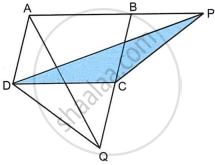
Area of ΔPCD = 10 cm2. Find the area of ΔADQ and parallelogram ABCD.
B Nirmala Shastry solutions for मॅथेमॅटिक्स [इंग्रजी] इयत्ता ९ आयसीएसई 13 Theorems on Area MULTIPLE CHOICE QUESTIONS [Pages 163 - 165]
P is a point on side AB of parallelogram ABCD. Which of the following is true?
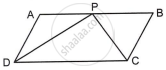
- Area of ΔAPD = `1/4` area || gm ABCD
- Area of ΔPDC = `1/2` area || gm ABCD
- Area of ΔAPD + area of ΔPBC = `1/2` parallelogram ABCD
only A
only B
A and B
B and C
In || gm ABCD, M is a point on AB, ∠DMC = 90°. DM = 15 cm, DC = 17 cm. ∴ Area of || gm ABCD is:
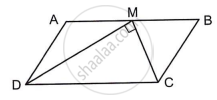
60 cm2
68 cm2
120 cm2
136 cm2
PQRS is a rectangle and AQRB is a || gm, SR = 9 cm, PS = 12 cm
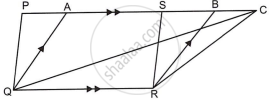
Area of ΔCQR =
108 cm2
72 cm2
54 cm2
42 cm2
PQRS is a rectangle and AQRB is a || gm, SR = 9 cm, PS = 12 cm

Area of || gm AQRB =
2 area of ΔBSR
2 area of ΔPAQ
108 cm2
144 cm2
Area of ΔPMQ = 72 cm2, Area of || gm LMNO =
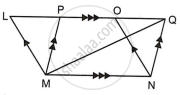
`1/2` area LMNQ
108 cm2
144 cm2
72 cm2
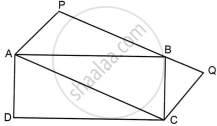
ABCD is a rectangle. PACQ is a || gm. AB = 12 cm, AC = 15 cm. Area of || gm PACQ =
180 cm2
108 cm2
54 cm2
90 cm2
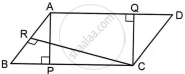
Area of || gm ABCD =
AP × PC
AD × RC
AD × AP
AB × AP
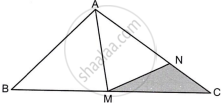
AM is the median of ΔABC. Area of ΔABC = 140 cm2. AN : NC = 3 : 2. Area of ΔMNC =
70 cm2
35 cm2
28 cm2
42 cm2
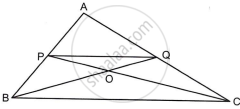
P and Q are mid points of AB and AC of ΔABC. Which of the following is not true?
Area of ΔBQC = Area of ΔBPC
Area of ΔPBQ = Area of ΔPCQ
Area of ΔAPQ = Area of ΔBOC
Area of ΔABQ = Area of ΔBQC
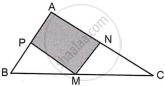
In ΔABC, P, M and N are mid points of sides AB, BC and AC. If area of ΔABC = 120 cm2, Area of || gm APMN =
60 cm2
72 cm2
75 cm2
80 cm2
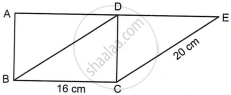
ABCD is a rectangle, DBCE is a || gm. Area of || gm DBCE =
320 cm2
192 cm2
160 cm2
240 cm2
Direction for Questions 11 to 14: In each of the following questions, a statement of assertion (A) is given and a statement of Reason (R) given below it choose the correct option for each question.
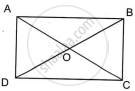
Assertion: If area of ΔAOD = 18 cm2 then area of parallelogram ABCD = 72 cm2.
Reason: The diagonals of a parallelogram bisect each other.
Both A and R are true and R is the correct reason for A.
Both A and R are true but R is the incorrect reason for A.
A is true but R is false.
A is false but R is true.
Assertion: Area of ΔPDC = 160 cm2 and area of parallelogram ABCD = 320 m2.
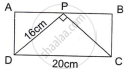
Reason: Area of a right angled Δ = `1/2` product of sides containing right angle.
Both A and R are true and R is the correct reason for A.
Both A and R are true but R is the incorrect reason for A.
A is true but R is false.
A is false but R is true.
Assertion: A median of a triangle divides it into 2 triangles of equal area.
Reason: The two triangles so formed are congruent.
Both A and R are true and R is the correct reason for A.
Both A and R are true but R is the incorrect reason for A.
A is true but R is false.
A is false but R is true.
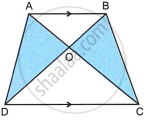
Assertion: AB || DC in the figure. Area of ΔAOD = Area of ΔBOC.
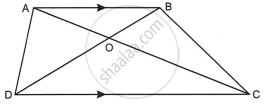
Reason: Two Δs on the same base and between the same parallel lines have equal area.
Both A and R are true and R is the correct reason for A.
Both A and R are true but R is the incorrect reason for A.
A is true but R is false.
A is false but R is true.
B Nirmala Shastry solutions for मॅथेमॅटिक्स [इंग्रजी] इयत्ता ९ आयसीएसई 13 Theorems on Area MISCELLANEOUS EXERCISE [Pages 165 - 166]
ABCD is a trapezium in which AD || BC. M is the mid-point of CD. Through M, PQ is drawn || to AB with P on AD produced and Q on BC.
- Show that ΔDPM ≅ ΔCQM
- Prove that area of ΔABM = `1/2` × area of trapezium ABCD.
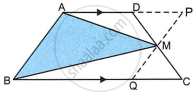
The area of ΔABC = 18 cm2. Find the distance between the || lines AD and BC if BC = 8 cm. Calculate the area of || gm BCDE.
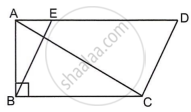
ABCD is a rectangle and BCED is a parallelogram. If BC = 12 cm and CE = 15 cm, find the area of
- Parallelogram BCED
- ΔCDE

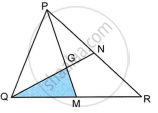
In ΔPQR, PM and QN are medians. Area of ΔGQM = 15 cm2. Find the area of ΔPQR.
ABCD is a trapezium with AB with AB || DC and diagonals AC and BD intersect at O. Prove that area of ΔAOD = area of ΔBOC.
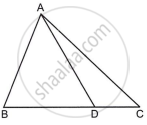
Area of ΔABD = 30 cm2. Find the area of ΔADC, if BD = `5/8` BC.
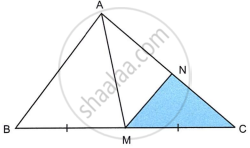
AM is the median of ΔABC. N is on AC such that AN : NC = 3 : 2. If area of ΔMNC = 12 cm2, find the area of ΔABC.
In ΔABC, PQ || BC. Prove that
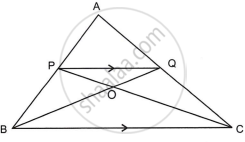
- Area (ΔPBC) = Area (ΔQBC)
- Area (ΔPOB) = Area (ΔQOC)
In adjoining figure, ABCD is a parallelogram, AQ = QB. CB and DQ are produced to meet at P. Prove that

- Area (ΔAQD) = Area (ΔAQP)
- Area (ΔDCP) = Area (|| gm ABCD)
In the given figure, PQRS and PXYZ are parallelograms. Prove that they are of equal area.
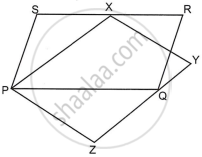
[Hint: Join XQ. Area (ΔXPQ) = `1/2` of each || gm]
In the given figure, PQRS and PXYZ are two parallelograms of equal area. Prove that SX || YR.
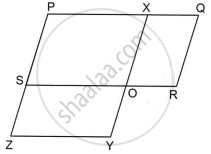
Solutions for 13: Theorems on Area
B Nirmala Shastry solutions for मॅथेमॅटिक्स [इंग्रजी] इयत्ता ९ आयसीएसई chapter 13 - Theorems on Area
Shaalaa.com has the CISCE Mathematics मॅथेमॅटिक्स [इंग्रजी] इयत्ता ९ आयसीएसई CISCE solutions in a manner that help students grasp basic concepts better and faster. The detailed, step-by-step solutions will help you understand the concepts better and clarify any confusion. B Nirmala Shastry solutions for Mathematics मॅथेमॅटिक्स [इंग्रजी] इयत्ता ९ आयसीएसई CISCE 13 (Theorems on Area) include all questions with answers and detailed explanations. This will clear students' doubts about questions and improve their application skills while preparing for board exams.
Further, we at Shaalaa.com provide such solutions so students can prepare for written exams. B Nirmala Shastry textbook solutions can be a core help for self-study and provide excellent self-help guidance for students.
Concepts covered in मॅथेमॅटिक्स [इंग्रजी] इयत्ता ९ आयसीएसई chapter 13 Theorems on Area are .
Using B Nirmala Shastry मॅथेमॅटिक्स [इंग्रजी] इयत्ता ९ आयसीएसई solutions Theorems on Area exercise by students is an easy way to prepare for the exams, as they involve solutions arranged chapter-wise and also page-wise. The questions involved in B Nirmala Shastry Solutions are essential questions that can be asked in the final exam. Maximum CISCE मॅथेमॅटिक्स [इंग्रजी] इयत्ता ९ आयसीएसई students prefer B Nirmala Shastry Textbook Solutions to score more in exams.
Get the free view of Chapter 13, Theorems on Area मॅथेमॅटिक्स [इंग्रजी] इयत्ता ९ आयसीएसई additional questions for Mathematics मॅथेमॅटिक्स [इंग्रजी] इयत्ता ९ आयसीएसई CISCE, and you can use Shaalaa.com to keep it handy for your exam preparation.
