Advertisements
Advertisements
A ball is dropped on a floor from a height of 2.0 m. After the collision it rises up to a height of 1.5 m. Assume that 40% of the mechanical energy lost goes as thermal energy into the ball. Calculate the rise in the temperature of the ball in the collision. Heat capacity of the ball is 800 J K−1.
Concept: undefined >> undefined
A copper cube of mass 200 g slides down on a rough inclined plane of inclination 37° at a constant speed. Assume that any loss in mechanical energy goes into the copper block as thermal energy. Find the increase in the temperature of the block as it slides down through 60 cm. Specific heat capacity of copper = 420 J kg−1 K−1.
Concept: undefined >> undefined
Advertisements
A copper cube of mass 200 g slides down on a rough inclined plane of inclination 37° at a constant speed. Assume that any loss in mechanical energy goes into the copper block as thermal energy. Find the increase in the temperature of the block as it slides down through 60 cm. Specific heat capacity of copper = 420 J kg−1 K−1.
Concept: undefined >> undefined
Two steel rods and an aluminium rod of equal length l0 and equal cross-section are joined rigidly at their ends, as shown in the figure below. All the rods are in a state of zero tension at 0°C. Find the length of the system when the temperature is raised to θ. Coefficient of linear expansion of aluminium and steel are αa and αs, respectively. Young's modulus of aluminium is Ya and of steel is Ys.
| Steel |
| Aluminium |
| Steel |
Concept: undefined >> undefined
Two steel rods and an aluminium rod of equal length l0 and equal cross-section are joined rigidly at their ends, as shown in the figure below. All the rods are in a state of zero tension at 0°C. Find the length of the system when the temperature is raised to θ. Coefficient of linear expansion of aluminium and steel are αa and αs, respectively. Young's modulus of aluminium is Ya and of steel is Ys.
| Steel |
| Aluminium |
| Steel |
Concept: undefined >> undefined
A metal block of density 600 kg m−3 and mass 1.2 kg is suspended through a spring of spring constant 200 N m−1. The spring-block system is dipped in water kept in a vessel. The water has a mass of 260 g and the bloc is at a height 40 cm above the bottom of the vessel. If the support of the spring is broken, what will be the rise in the temperature of the water. Specific heat capacity of the block is 250 J kg−3 K−1 and that of water is 4200 J kg−1 K−1. Heat capacities of the vessel and the spring are negligible.
Concept: undefined >> undefined
A metal block of density 600 kg m−3 and mass 1.2 kg is suspended through a spring of spring constant 200 N m−1. The spring-block system is dipped in water kept in a vessel. The water has a mass of 260 g and the bloc is at a height 40 cm above the bottom of the vessel. If the support of the spring is broken, what will be the rise in the temperature of the water. Specific heat capacity of the block is 250 J kg−3 K−1 and that of water is 4200 J kg−1 K−1. Heat capacities of the vessel and the spring are negligible.
Concept: undefined >> undefined
A torsional pendulum consists of a solid disc connected to a thin wire (α = 2.4 × 10⁻⁵°C–1) at its centre. Find the percentage change in the time period between peak winter (5°C) and peak summer (45°C).
Concept: undefined >> undefined
A torsional pendulum consists of a solid disc connected to a thin wire (α = 2.4 × 10⁻⁵°C–1) at its centre. Find the percentage change in the time period between peak winter (5°C) and peak summer (45°C).
Concept: undefined >> undefined
A circular disc made of iron is rotated about its axis at a constant velocity ω. Calculate the percentage change in the linear speed of a particle of the rim as the disc is slowly heated from 20°C to 50°C, keeping the angular velocity constant. Coefficient of linear expansion of iron = 1.2 × 10⁻⁵ °C–1.
Concept: undefined >> undefined
A circular disc made of iron is rotated about its axis at a constant velocity ω. Calculate the percentage change in the linear speed of a particle of the rim as the disc is slowly heated from 20°C to 50°C, keeping the angular velocity constant. Coefficient of linear expansion of iron = 1.2 × 10⁻⁵ °C–1.
Concept: undefined >> undefined
50 m3 of saturated vapour is cooled down from 30°C to 20°C. Find the mass of the water condensed. The absolute humidity of saturated water vapour is 30 g m−3 at 30°C and 16 g m−3 at 20°C.
Concept: undefined >> undefined
Where will you weigh more: at the centre of the earth or at the surface of the earth?
Concept: undefined >> undefined
A vertical off-shore structure is built to withstand a maximum stress of 109 Pa. Is the structure suitable for putting up on top of an oil well in the ocean? Take the depth of the ocean to be roughly 3 km, and ignore ocean currents.
Concept: undefined >> undefined
Is it possible for a particle to describe a curved path if no force acts on it? Does your answer depend on the frame of reference chosen to view the particle?
Concept: undefined >> undefined
It is sometimes heard that the inertial frame of reference is only an ideal concept and no such inertial frame actually exists. Comment.
Concept: undefined >> undefined
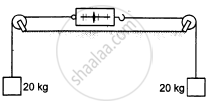
The figure shows a light spring balance connected to two blocks of mass 20 kg each. The graduations in the balance measure the tension in the spring. (a) What is the reading of the balance? (b) Will the reading change if the balance is heavy, say 2.0 kg? (c) What will happen if the spring is light but the blocks have unequal masses?
Concept: undefined >> undefined
The acceleration of a particle is zero, as measured from an inertial frame of reference. Can we conclude that no force acts on the particle?
Concept: undefined >> undefined
Consider a book lying on a table. The weight of the book and the normal force by the table in the book are equal in magnitude and opposite in direction. Is this an example of Newton's third law?
Concept: undefined >> undefined
A plumb bob is hung from the ceiling of a train compartment. If the train moves with an acceleration 'a' along a straight horizontal track , the string supporting the bob makes an angle tan−1 (a/g) with the normal to the ceiling. Suppose the train moves on an inclined straight track with uniform velocity. If the angle of incline is tan−1 (a/g), the string again makes the same angle with the normal to the ceiling. Can a person sitting inside the compartment tell by looking at the plumb line whether the train is accelerating on a horizontal straight track or moving on an incline? If yes, how? If not, then suggest a method to do so.
Concept: undefined >> undefined
