Please select a subject first
Advertisements
Advertisements
How are the colloidal solutions classified on the basis of physical states of the dispersed phase and dispersion medium?
Concept: undefined >> undefined
Why are hydrophobic sols easily coagulated?
Concept: undefined >> undefined
Advertisements
How are colloids classified on the basis of Physical states of components
Concept: undefined >> undefined
How are colloids classified on the basis of the nature of the dispersion medium?
Concept: undefined >> undefined
How are colloids classified on the basis of interaction between the dispersed phase and the dispersion medium?
Concept: undefined >> undefined
Account for the following:
Diazonium salts of aromatic amines are more stable than those of aliphatic amines.
Concept: undefined >> undefined
Show how the following compound can be converted to benzoic acid.
Ethylbenzene
Concept: undefined >> undefined
Show how the following compound can be converted to benzoic acid.
Acetophenone
Concept: undefined >> undefined
Show how the following compound can be converted to benzoic acid.
Bromobenzene
Concept: undefined >> undefined
Show how the following compound can be converted to benzoic acid.
Phenylethene (Styrene)
Concept: undefined >> undefined
Predict the products formed when cyclohexanecarbaldehyde reacts with the following reagent.
Tollens’ reagent
Concept: undefined >> undefined
An organic compound (A) (molecular formula C8H16O2) was hydrolysed with dilute sulphuric acid to give a carboxylic acid (B) and an alcohol (C). Oxidation of (C) with chromic acid produced (B). (C) on dehydration gives but-1-ene. Write equations for the reactions involved.
Concept: undefined >> undefined
How will you prepare the given compound from benzene? You may use any inorganic reagent and any organic reagent having not more than one carbon atom.
Methyl benzoate
Concept: undefined >> undefined
How will you prepare the given compound from benzene? You may use any inorganic reagent and any organic reagent having not more than one carbon atom.
m-Nitrobenzoic acid
Concept: undefined >> undefined
How will you prepare the given compound from benzene? You may use any inorganic reagent and any organic reagent having not more than one carbon atom.
p-Nitrobenzoic acid
Concept: undefined >> undefined
How will you prepare the given compound from benzene? You may use any inorganic reagent and any organic reagent having not more than one carbon atom.
Phenylacetic acid
Concept: undefined >> undefined
How will you bring about the following conversion in not more than two steps?
Benazaldehyde to α-Hydroxyphenylacetic acid
Concept: undefined >> undefined
Complete the synthesis by giving missing starting material, reagent or product.
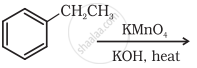
Concept: undefined >> undefined
Comment on the nature of two S−O bonds formed in SO2 molecule. Are the two S−O bonds in this molecule equal?
Concept: undefined >> undefined
How is the presence of SO2 detected?
Concept: undefined >> undefined
