In the figure: ∠PSQ = 90o, PQ = 10 cm, QS = 6 cm and RQ = 9 cm. Calculate the length of PR.

[13] Pythagoras Theorem [Proof and Simple Applications with Converse]
Chapter: [13] Pythagoras Theorem [Proof and Simple Applications with Converse]
Concept: undefined >> undefined
In the given figure, ∠B = 90°, XY || BC, AB = 12 cm, AY = 8cm and AX : XB = 1 : 2 = AY : YC.
Find the lengths of AC and BC.

[13] Pythagoras Theorem [Proof and Simple Applications with Converse]
Chapter: [13] Pythagoras Theorem [Proof and Simple Applications with Converse]
Concept: undefined >> undefined
In the given figure, AB//CD, AB = 7 cm, BD = 25 cm and CD = 17 cm;
find the length of side BC.

[13] Pythagoras Theorem [Proof and Simple Applications with Converse]
Chapter: [13] Pythagoras Theorem [Proof and Simple Applications with Converse]
Concept: undefined >> undefined
The given figure shows a quadrilateral ABCD in which AD = 13 cm, DC = 12 cm, BC = 3 cm and ∠ABD = ∠BCD = 90o. Calculate the length of AB.

[13] Pythagoras Theorem [Proof and Simple Applications with Converse]
Chapter: [13] Pythagoras Theorem [Proof and Simple Applications with Converse]
Concept: undefined >> undefined
Two poles of heights 6 m and 11 m stand vertically on a plane ground. If the distance between their feet is 12 m;
find the distance between their tips.
[13] Pythagoras Theorem [Proof and Simple Applications with Converse]
Chapter: [13] Pythagoras Theorem [Proof and Simple Applications with Converse]
Concept: undefined >> undefined
If the sides of the triangle are in the ratio 1: `sqrt2`: 1, show that is a right-angled triangle.
[13] Pythagoras Theorem [Proof and Simple Applications with Converse]
Chapter: [13] Pythagoras Theorem [Proof and Simple Applications with Converse]
Concept: undefined >> undefined
AD is drawn perpendicular to base BC of an equilateral triangle ABC. Given BC = 10 cm, find the length of AD, correct to 1 place of decimal.
[13] Pythagoras Theorem [Proof and Simple Applications with Converse]
Chapter: [13] Pythagoras Theorem [Proof and Simple Applications with Converse]
Concept: undefined >> undefined
In triangle ABC, AB = AC = x, BC = 10 cm and the area of the triangle is 60 cm2.
Find x.
[13] Pythagoras Theorem [Proof and Simple Applications with Converse]
Chapter: [13] Pythagoras Theorem [Proof and Simple Applications with Converse]
Concept: undefined >> undefined
In triangle ABC, given below, AB = 8 cm, BC = 6 cm and AC = 3 cm. Calculate the length of OC.

[13] Pythagoras Theorem [Proof and Simple Applications with Converse]
Chapter: [13] Pythagoras Theorem [Proof and Simple Applications with Converse]
Concept: undefined >> undefined
In the following figure, AD is perpendicular to BC and D divides BC in the ratio 1: 3.
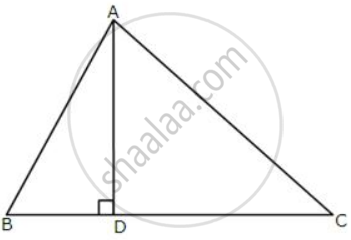
Prove that : 2AC2 = 2AB2 + BC2
[13] Pythagoras Theorem [Proof and Simple Applications with Converse]
Chapter: [13] Pythagoras Theorem [Proof and Simple Applications with Converse]
Concept: undefined >> undefined
In triangle ABC, AB = AC and BD is perpendicular to AC.
Prove that: BD2 − CD2 = 2CD × AD
[13] Pythagoras Theorem [Proof and Simple Applications with Converse]
Chapter: [13] Pythagoras Theorem [Proof and Simple Applications with Converse]
Concept: undefined >> undefined
In the figure, given below, AD ⊥ BC.
Prove that: c2 = a2 + b2 - 2ax.

[13] Pythagoras Theorem [Proof and Simple Applications with Converse]
Chapter: [13] Pythagoras Theorem [Proof and Simple Applications with Converse]
Concept: undefined >> undefined
In triangle ABC, angle A = 90o, CA = AB and D is the point on AB produced.
Prove that DC2 - BD2 = 2AB.AD.

[13] Pythagoras Theorem [Proof and Simple Applications with Converse]
Chapter: [13] Pythagoras Theorem [Proof and Simple Applications with Converse]
Concept: undefined >> undefined
In equilateral Δ ABC, AD ⊥ BC and BC = x cm. Find, in terms of x, the length of AD.
[13] Pythagoras Theorem [Proof and Simple Applications with Converse]
Chapter: [13] Pythagoras Theorem [Proof and Simple Applications with Converse]
Concept: undefined >> undefined
In an isosceles triangle ABC; AB = AC and D is the point on BC produced.
Prove that: AD2 = AC2 + BD.CD.
[13] Pythagoras Theorem [Proof and Simple Applications with Converse]
Chapter: [13] Pythagoras Theorem [Proof and Simple Applications with Converse]
Concept: undefined >> undefined
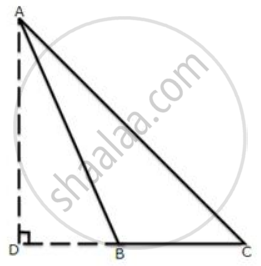
In figure AB = BC and AD is perpendicular to CD.
Prove that: AC2 = 2BC. DC.
[13] Pythagoras Theorem [Proof and Simple Applications with Converse]
Chapter: [13] Pythagoras Theorem [Proof and Simple Applications with Converse]
Concept: undefined >> undefined
ABC is a triangle, right-angled at B. M is a point on BC.
Prove that: AM2 + BC2 = AC2 + BM2
[13] Pythagoras Theorem [Proof and Simple Applications with Converse]
Chapter: [13] Pythagoras Theorem [Proof and Simple Applications with Converse]
Concept: undefined >> undefined
Diagonals of rhombus ABCD intersect each other at point O.
Prove that: OA2 + OC2 = 2AD2 - `"BD"^2/2`
[13] Pythagoras Theorem [Proof and Simple Applications with Converse]
Chapter: [13] Pythagoras Theorem [Proof and Simple Applications with Converse]
Concept: undefined >> undefined
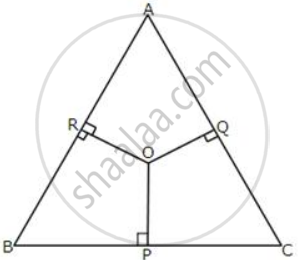
In the following figure, OP, OQ, and OR are drawn perpendiculars to the sides BC, CA and AB respectively of triangle ABC.
Prove that: AR2 + BP2 + CQ2 = AQ2 + CP2 + BR2
[13] Pythagoras Theorem [Proof and Simple Applications with Converse]
Chapter: [13] Pythagoras Theorem [Proof and Simple Applications with Converse]
Concept: undefined >> undefined
O is any point inside a rectangle ABCD.
Prove that: OB2 + OD2 = OC2 + OA2.
[13] Pythagoras Theorem [Proof and Simple Applications with Converse]
Chapter: [13] Pythagoras Theorem [Proof and Simple Applications with Converse]
Concept: undefined >> undefined
