Advertisements
Advertisements
Find the potential difference required to pass a current of 0.2 A in a wire of resistance 20Ω
Concept: undefined >> undefined
What will happen to a compass needle when the compass is placed below a wire with needle parallel to it and a current is made to flow through the wire? Give a reason to justify your answer.
Concept: undefined >> undefined
Advertisements
A given wire of resistance 1 Ω is stretched to double its length. What will be its new resistance?
Concept: undefined >> undefined
When current flows in a wire, it creates ______.
Concept: undefined >> undefined
State two differences between the e.m.f. and terminal voltage of a cell.
Concept: undefined >> undefined
The present of magnetic field at a point can be detected by ______.
Concept: undefined >> undefined
By reversing the direction of current in a wire, the magnetic field produced by it:
Concept: undefined >> undefined
A wire of uniform thickness with a resistance of 27Ω is cut into three equal pieces and they are joined in parallel. Find the equivalent resistance of the parallel combination.
Concept: undefined >> undefined
Calculate the effective resistance between the points A and B in the network shown below in Figure 8.45
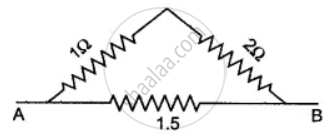
Concept: undefined >> undefined
Calculate the equivalent resistance between A and B in the adjacent diagram.
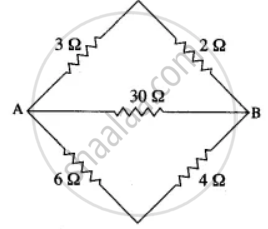
Concept: undefined >> undefined
In the network shown in the following adjacent Figure, calculate the equivalent resistance between the points.
- A and B
- A and C

Concept: undefined >> undefined
Two resistors of 2.0 Ω and 3.0 Ω are connected (a) in series (b) in parallel, with a battery of 6.0 V and negligible internal resistance. For each case draw a circuit diagram and calculate the current through the battery.
Concept: undefined >> undefined
A wire of length 5 m has a resistance of 2.0 Ω calculate:
(a) the resistance of wire of length 1 m
(b) the equivalent resistance if two such wires each of length 2 m are joined in parallel.
(c) the resistance of 1 m length of wire of same material but of half diameter.
Concept: undefined >> undefined
A cell supplies a current of 1.2 A through two 2 Ω resistors connected in parallel. When the resistors are connected in series, it supplies a current of 0.4 A. Calculate:
(i) the internal resistance and (ii) e.m.f. of the cell.
Concept: undefined >> undefined
The following circuit diagram shows three resistors 2 Ω, 4 Ω and R Ω connected to a battery of e.m.f 2V and internal resistance 3 Ω. If the main current of 0.25 A flows through the circuit, find:
- the p.d. across the 4 Ω resistors,
- the p.d. across the internal resistance of the cell,
- the p.d. across the R Ω or 2 Ω resistors, and
- the value of R.
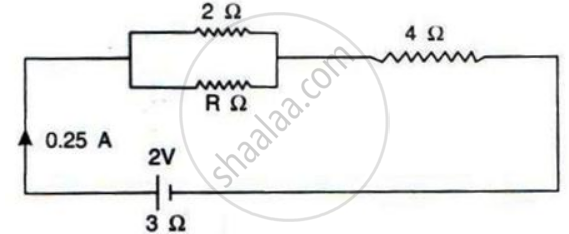
Concept: undefined >> undefined
Show by a diagram, the refraction of two light rays incident parallel to the principal axis on a concave lens by treating it as a combination of a glass block and two triangular glass prisms.
Concept: undefined >> undefined
Write S.I. unit of temperature.
Concept: undefined >> undefined
Give scientific reason for the following:
A man runs in the direction of train while getting down from a moving train.
Concept: undefined >> undefined
Fig shows a thin beam of white light from a source S striking on one face of a prism.

- Complete the diagram to show the effect of the prism on the beam and to show what is seen on the screen.
- If a slit is placed in between the prism and the screen to pass only the light of green colour, what will you then observe on the screen?
- What conclusion do you draw from the observation in part (b) above?
Concept: undefined >> undefined
Concept: undefined >> undefined
