Advertisements
Advertisements
Figure below shows two resistors R1 and R2 connected to a battery having an emf of 40V and negligible internal resistance. A voltmeter having a resistance of. 300 Ω is used to measure the potential difference across R1 Find the reading of the voltmeter.

Concept: undefined >> undefined
Draw a labelled circuit diagram of a potentiometer to compare emfs of two cells. Write the working formula (Derivation not required).
Concept: undefined >> undefined
Advertisements
Three identical cells each of emf 'e' are connected in parallel to form a battery. What is the emf of the battery?
Concept: undefined >> undefined
The Figure below shows a potentiometer circuit in which the driver cell D has an emf of 6 V and internal resistance of 2 Ω. The potentiometer wire AB is 10 m long and has a resistance of 28 Ω. The series resistance RS is of 2 Ω.

- The current Ip flowing in the potentiometer wire AB when the jockey (J) does not touch the wire AB.
- emf of the cell X if the balancing length AC is 4.5 m.
Concept: undefined >> undefined
In a potentiometer, a cell is balanced against 110 cm when the circuit is open. A cell is balanced at 100 cm when short-circuited through a resistance of 10 Ω. Find the internal resistance of the cell.
Concept: undefined >> undefined
Deduce an expression for equivalent capacitance C when three capacitors C1, C2 and C3 connected in parallel.
Concept: undefined >> undefined
Figure 4 below shows a capacitor C, an inductor L and a resistor R, connected in series
to an a.c. supply of 220 V
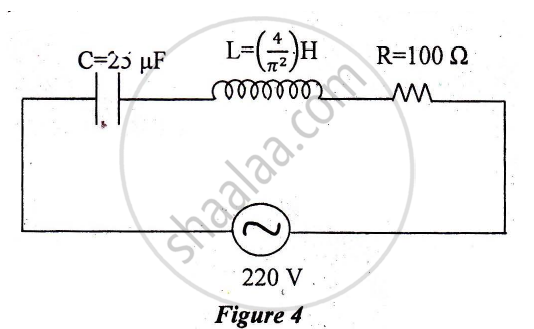
Calculate:
1) The resonant frequency of the given CLR circuit.
2) Current flowing through·the circuit.
3) Average power consumed by the circuit.
Concept: undefined >> undefined
Three capacitors of capacitance `C_1 = 3muf` , `C_2 = 6muf` , `C_3 = 10muf` , are connected to a 10V battery as shown in figure 3 below :
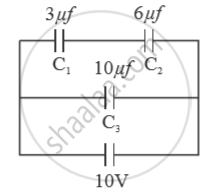
Calculate :
(a) Equivalent capacitance.
(b) Electrostatic potential energy stored in the system
Concept: undefined >> undefined
A wire of resistance ‘R’ is cut into ‘n’ equal parts. These parts are then connected in parallel with each other. The equivalent resistance of the combination is:
Concept: undefined >> undefined
The focal length of a concave lens is 20 cm. The focal length of a convex lens is 25 cm. These two are placed in contact with each other. What is the power of the combination? Is it diverging, converging or undeviating in nature?
Concept: undefined >> undefined
The focal length of a double convex lens is equal to the radius of curvature of either surface. What is the refractive index of its material?
Concept: undefined >> undefined
State any two difference between the primary rainbow and secondary rainbow
Concept: undefined >> undefined
For any prism, prove that :
'n' or `mu = sin((A + delta_m)/2)/sin(A/2)`
where the terms have their usual meaning
Concept: undefined >> undefined
The deviation produced for violet, yellow and red lights for crown glass are 3.75°, 3.25° and 2.86° respectively. Calculate the dispersive power of the crown glass.
Concept: undefined >> undefined
A ray of light is incident on a prism whose refractive index is 1.52 at an angle of 40°. If the angle of emergence is 60°, calculate the angle of the prism.
Concept: undefined >> undefined
In a regular prism, what is the relation between angle of incidence and angle of emergence when it is in the minimum deviation position?
Concept: undefined >> undefined
Calculate dispersive power of a transparent material given : nv = 1.56, nr = 1.54, ny = 1.55.
Concept: undefined >> undefined
A narrow beam of monochromatic light, PQ, is incident normally on one face of an equiangular glass prism of refractive index 1.45. When the prism is immersed in a certain liquid, the ray makes a grazing emergence along the other face (See figure). Find the refractive index of this liquid. 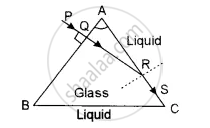
Concept: undefined >> undefined
What is meant by the dispersive power of transparent material?
Concept: undefined >> undefined
Define angular dispersion.
Concept: undefined >> undefined
