Advertisements
Advertisements
प्रश्न
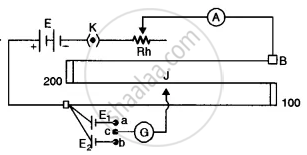
Draw a labelled circuit diagram of a potentiometer to compare emfs of two cells. Write the working formula (Derivation not required).
Advertisements
उत्तर
The required circuit diagram is given alongside.
Working formula `"E"_1/"E"_2 = l_1/l_2`
APPEARS IN
संबंधित प्रश्न
Write two factors by which current sensitivity of a potentiometer can be increased.
State the advantages of potentiometer over voltmeter.
In a potentiometer experiment, balancing length is found to be 120 cm for a cell E1 of emf 2V. What will be the balancing length for another cell E2 of emf 1.5V? (No other changes are made in the experiment.)
A potentiometer wire of length 1 m has a resistance of 5 Ω. It is connected to a 8 V battery in series with a resistance of 15 Ω. Determine the emf of the primary cell which gives a balance point at 60 cm.
State the uses of a potentiometer.
A potentiometer wire of length 100 cm and resistance 3 `Omega` is connected in series with resistance of 8 `Omega` and an accumulator of 4 volt whose internal resistance is 1 `Omega`.
It is observed in a potentiometer experiment that no current passes through the galvanometer when the terminals of the cell are connected across a certain length of the potentiometer wire. On shunting the cell by a 2 Ω resistance, the balancing length is reduced to half. The internal resistance of the cell is ______.
In the experiment of potentiometer, at balance point, there is no current in the ______.
Consider a simple circuit shown in figure  stands for a variable resistance R′. R′ can vary from R0 to infinity. r is internal resistance of the battery (r << R << R0).

- Potential drop across AB is nearly constant as R ′ is varied.
- Current through R′ is nearly a constant as R ′ is varied.
- Current I depends sensitively on R′.
- `I ≥ V/(r + R)` always.
The emf of the cell of internal resistance 1.275 Ω balances against a length of 217 cm of a potentiometer wire. Find the balancing length when the cell is shunted by a resistance of 15 Ω.
