Advertisements
Advertisements
प्रश्न
A potentiometer wire of length 1 m has a resistance of 5 Ω. It is connected to a 8 V battery in series with a resistance of 15 Ω. Determine the emf of the primary cell which gives a balance point at 60 cm.
Advertisements
उत्तर
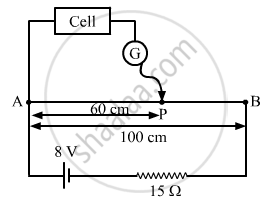
From the figure:
Total resistance of the circuit, R = (RAB + 15) Ω = 20 Ω
Current in the circuit ,
\[i = \frac{V}{R} = \frac{8}{20} A\]
∴ Voltage across AB, VAB = i.RAB = 2 V
The emf of the cell connected as above is given by: \[e = \frac{l}{L} V_0\]
Here:
l = 60 cm (balance point)
AB = L = 1 m = 100 cm (total length of the wire)
\[\therefore e = \frac{60}{100}\left( 2 \right) = 1 . 2 V\]
APPEARS IN
संबंधित प्रश्न
Figure shows a potentiometer with a cell of 2.0 V and internal resistance 0.40 Ω maintaining a potential drop across the resistor wire AB. A standard cell which maintains a constant emf of 1.02 V (for very moderate currents up to a few mA) gives a balance point at 67.3 cm length of the wire. To ensure very low currents drawn from the standard cell, very high resistance of 600 kΩ is put in series with it, which is shorted close to the balance point. The standard cell is then replaced by a cell of unknown emf ε and the balance point found similarly, turns out to be at 82.3 cm length of the wire.

(a) What is the value ε?
(b) What purpose does the high resistance of 600 kΩ have?
(c) Is the balance point affected by this high resistance?
(d) Is the balance point affected by the internal resistance of the driver cell?
(e) Would the method work in the above situation if the driver cell of the potentiometer had an emf of 1.0 V instead of 2.0 V?
(f) Would the circuit work well for determining an extremely small emf, say of the order of a few mV (such as the typical emf of a thermo-couple)? If not, how will you modify the circuit?
(i) State the principle on which a potentiometer works. How can a given potentiometer be made more sensitive?

Two students ‘X’ and ‘Y’ perform an experiment on potentiometer separately using the circuit given below:

Keeping other parameters unchanged, how will the position of the null point be affected if
(i) ‘X’ increases the value of resistance R in the set-up by keeping the key K1 closed and the Key K2 opens?
(ii) ‘Y’ decreases the value of resistance S in the set-up, while the key K2 remains open and they K1 closed?
Justify.
When a resistor of 5Ω is connected across the cell, its terminal potential difference is balanced by 150 cm of potentiometer wire and when a resistance of 10 Ω is connected across the cell, the terminal potential difference is balanced by 175 cm same potentiometer wire. Find the balancing length when the cell is in open circuit and the internal resistance of the cell.
A potentiometer wire has a length of 1.5 m and a resistance of 10 Ω. It is connected in series with the cell of emf 4 Volt and internal resistance 5 Ω. Calculate the potential drop per centimeter of the wire.
A potential drop per unit length along a wire is 5 × 10⁻³ V/m. If the emf of a cell balances against length 216 cm of this potentiometer wire, find the emf of the cell.
The sensitivity of the potentiometer can be increased by ______.
AB is a potentiometer wire (Figure). If the value of R is increased, in which direction will the balance point J shift?

The Figure below shows a potentiometer circuit in which the driver cell D has an emf of 6 V and internal resistance of 2 Ω. The potentiometer wire AB is 10 m long and has a resistance of 28 Ω. The series resistance RS is of 2 Ω.

- The current Ip flowing in the potentiometer wire AB when the jockey (J) does not touch the wire AB.
- emf of the cell X if the balancing length AC is 4.5 m.
