Advertisements
Advertisements
ABC is an isosceles triangle with AB = AC and D is a point on BC such that AD ⊥ BC (Figure). To prove that ∠BAD = ∠CAD, a student proceeded as follows:
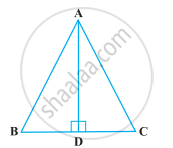
In ∆ABD and ∆ACD,
AB = AC (Given)
∠B = ∠C (Because AB = AC)
and ∠ADB = ∠ADC
Therefore, ∆ABD ≅ ∆ACD (AAS)
So, ∠BAD = ∠CAD (CPCT)
What is the defect in the above arguments?
[Hint: Recall how ∠B = ∠C is proved when AB = AC].
Concept: undefined >> undefined
Show that in a quadrilateral ABCD, AB + BC + CD + DA < 2(BD + AC)
Concept: undefined >> undefined
Advertisements
Show that in a quadrilateral ABCD, AB + BC + CD + DA > AC + BD
Concept: undefined >> undefined
In a triangle ABC, D is the mid-point of side AC such that BD = `1/2` AC. Show that ∠ABC is a right angle.
Concept: undefined >> undefined
ABCD is a cyclic quadrilateral such that AB is a diameter of the circle circumscribing it and ∠ADC = 140º, then ∠BAC is equal to ______.
Concept: undefined >> undefined
ABCD is a cyclic quadrilateral such that ∠A = 90°, ∠B = 70°, ∠C = 95° and ∠D = 105°.
Concept: undefined >> undefined
If a line is drawn parallel to the base of an isosceles triangle to intersect its equal sides, prove that the quadrilateral so formed is cyclic.
Concept: undefined >> undefined
If a pair of opposite sides of a cyclic quadrilateral are equal, prove that its diagonals are also equal.
Concept: undefined >> undefined
In the following figure, AOB is a diameter of the circle and C, D, E are any three points on the semi-circle. Find the value of ∠ACD + ∠BED.

Concept: undefined >> undefined
If non-parallel sides of a trapezium are equal, prove that it is cyclic.
Concept: undefined >> undefined
If P, Q and R are the mid-points of the sides BC, CA and AB of a triangle and AD is the perpendicular from A on BC, prove that P, Q, R and D are concyclic.
Concept: undefined >> undefined
ABCD is a parallelogram. A circle through A, B is so drawn that it intersects AD at P and BC at Q. Prove that P, Q, C and D are concyclic.
Concept: undefined >> undefined
If bisectors of opposite angles of a cyclic quadrilateral ABCD intersect the circle, circumscribing it at the points P and Q, prove that PQ is a diameter of the circle.
Concept: undefined >> undefined
Find the surface area of a sphere of radius 10.5 cm.
`["Assume "pi=22/7]`
Concept: undefined >> undefined
Find the surface area of a sphere of radius 5.6 cm.
`["Assume "pi=22/7]`
Concept: undefined >> undefined
Find the surface area of a sphere of radius 14 cm.
`["Assume "pi=22/7]`
Concept: undefined >> undefined
Find the surface area of a sphere of diameter 14 cm.
`["Assume "pi=22/7]`
Concept: undefined >> undefined
Find the surface area of a sphere of diameter 21 cm.
`["Assume "pi=22/7]`
Concept: undefined >> undefined
Find the surface area of a sphere of diameter 3.5 m.
`["Assume "pi=22/7]`
Concept: undefined >> undefined
Find the total surface area of a hemisphere of radius 10 cm. [Use π = 3.14]
Concept: undefined >> undefined
