Advertisements
Advertisements
During a nuclear fission reaction,
Concept: undefined >> undefined
A uniform magnetic field B exist in a region. An electron projected perpendicular to the field goes in a circle. Assuming Bohr's quantization rule for angular momentum, calculate (a) the smallest possible radius of the electron (b) the radius of the nth orbit and (c) the minimum possible speed of the electron.
Concept: undefined >> undefined
Advertisements
Show that the minimum energy needed to separate a proton from a nucleus with Zprotons and N neutrons is `ΔE = (M_(Z-1,N) + M_B - M_(Z,N))c^2`
where MZ,N = mass of an atom with Z protons and N neutrons in the nucleus and MB = mass of a hydrogen atom. This energy is known as proton-separation energy.
Concept: undefined >> undefined
Consider the fusion in helium plasma. Find the temperature at which the average thermal energy 1.5 kT equals the Coulomb potential energy at 2 fm.
Concept: undefined >> undefined
Calculate the Q-values of the following fusion reactions :-
(a) `""_1^2H + ""_1^2H → ""_1^3H + ""_1^1H`
(b) `""_1^2H + ""_1^2H → ""_2^3H + n`
(c) `""_1^2H + ""_1^3H → _2^4H + n`.
Atomic masses are `m(""_1^2H) = 2.014102 "u", m(""_1^3H) = 3.016049 "u", m(""_2^3He) = 3.016029 "u", m(""_2^4He) = 4.002603 "u".`
(Use Mass of proton mp = 1.007276 u, Mass of `""_1^1"H"` atom = 1.007825 u, Mass of neutron mn = 1.008665 u, Mass of electron = 0.0005486 u ≈ 511 keV/c2,1 u = 931 MeV/c2.)
Concept: undefined >> undefined
Answer the following question.
State Bohr's quantization condition of angular momentum. Calculate the shortest wavelength of the Bracket series and state to which part of the electromagnetic spectrum it belongs.
Concept: undefined >> undefined
Plot a graph showing the variation of de Broglie wavelength (X) associated with a charged a particle of mass m, versus `1/sqrtV` where V is the potential difference through which the particle is accelerated. How does this graph give us information regarding the magnitude of the charge of the particle?
Concept: undefined >> undefined
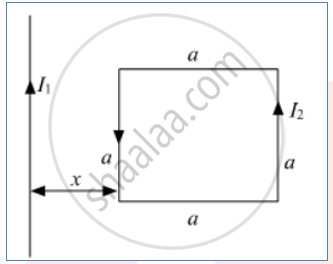
A square loop of side 'a' carrying a current I2 is kept at distance x from an infinitely long straight wire carrying a current I1 as shown in the figure. Obtain the expression for the resultant force acting on the loop.
Concept: undefined >> undefined
Answer the following question.
Write three points of differences between para-, dia- and ferromagnetic materials, giving one example for each.
Concept: undefined >> undefined
Answer the following question.
When an inductor is connected to a 200 V dc voltage, a current at 1A flows through it. When the same inductor is connected to a 200 V, 50 Hz ac source, only 0.5 A current flows. Explain, why? Also, calculate the self-inductance of the inductor.
Concept: undefined >> undefined
Identify the following magnetic materials :
Concept: undefined >> undefined
A planar loop of rectangular shape is moved within the region of a uniform magnetic field acting perpendicular to its plane. What is the direction and magnitude of the current induced in it?
Concept: undefined >> undefined
Use the above relation to obtain the condition on the position of the object and the radius of curvature in terms of n1and n2 when the real image is formed.
Concept: undefined >> undefined
In a single slit diffraction experiment, the width of the slit is increased. How will the
- size and
- intensity
of central bright band be affected? Justify your answer.
Concept: undefined >> undefined
Define the term ‘focal length of a mirror’.
Concept: undefined >> undefined
The earth’s field departs from its dipole shape substantially at large distances (greater than about 30,000 km). What agencies may be responsible for this distortion?
Concept: undefined >> undefined
A short bar magnet has a magnetic moment of 0.48 J T−1. Give the direction and magnitude of the magnetic field produced by the magnet at a distance of 10 cm from the centre of the magnet on
- the axis,
- the equatorial lines (normal bisector) of the magnet.
Concept: undefined >> undefined
A uniform magnetic field of 3000 G is established along the positive z-direction. A rectangular loop of sides 10 cm and 5 cm carries a current of 12 A. What is the torque on the loop in the different cases shown in fig.? What is the force on each case? Which case corresponds to stable equilibrium?

Concept: undefined >> undefined
Why does a paramagnetic sample display greater magnetisation (for the same magnetising field) when cooled?
Concept: undefined >> undefined
Why is diamagnetism, in contrast, almost independent of temperature?
Concept: undefined >> undefined
