Advertisements
Advertisements
Find the maximum angular speed of the electron of a hydrogen atom in a stationary orbit.
Concept: undefined >> undefined
Suppose, in certain conditions only those transitions are allowed to hydrogen atoms in which the principal quantum number n changes by 2. (a) Find the smallest wavelength emitted by hydrogen. (b) List the wavelength emitted by hydrogen in the visible range (380 nm to 780 nm).
Concept: undefined >> undefined
Advertisements
Find the mutual inductance between the straight wire and the square loop of figure.
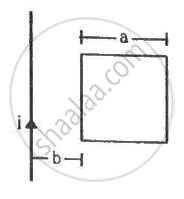
Concept: undefined >> undefined
Find the mutual inductance between the circular coil and the loop shown in figure.
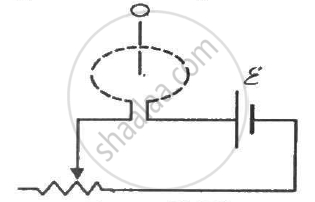
Concept: undefined >> undefined
The current in a long solenoid of radius R and having n turns per unit length is given by i= i0 sin ωt. A coil having N turns is wound around it near the centre. Find (a) the induced emf in the coil and (b) the mutual inductance between the solenoid ant the coil.
Concept: undefined >> undefined
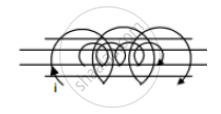
A solenoid of length 20 cm, area of cross-section 4.0 cm2 and having 4000 turns is placed inside another solenoid of 2000 turns having a cross-sectional area 8.0 cm2 and length 10 cm. Find the mutual inductance between the solenoids.
Concept: undefined >> undefined
The average kinetic energy of molecules in a gas at temperature T is 1.5 kT. Find the temperature at which the average kinetic energy of the molecules of hydrogen equals the binding energy of its atoms. Will hydrogen remain in molecular from at this temperature? Take k = 8.62 × 10⁻⁵ eV K−1.
Concept: undefined >> undefined
Find the temperature at which the average thermal kinetic energy is equal to the energy needed to take a hydrogen atom from its ground state to n = 3 state. Hydrogen can now emit red light of wavelength 653.1 nm. Because of Maxwellian distribution of speeds, a hydrogen sample emits red light at temperatures much lower than that obtained from this problem. Assume that hydrogen molecules dissociate into atoms.
Concept: undefined >> undefined
Average lifetime of a hydrogen atom excited to n = 2 state is 10−8 s. Find the number of revolutions made by the electron on the average before it jumps to the ground state.
Concept: undefined >> undefined
Show that the ratio of the magnetic dipole moment to the angular momentum (l = mvr) is a universal constant for hydrogen-like atoms and ions. Find its value.
Concept: undefined >> undefined
In a typical fission reaction, the nucleus is split into two middle-weight nuclei of unequal masses. Which of the two (heavier or lighter) has greater kinetic energy? Which one has greater liner momentum?
Concept: undefined >> undefined
If three helium nuclei combine to form a carbon nucleus, energy is liberated. Why can't helium nuclei combine on their own and minimise the energy?
Concept: undefined >> undefined
The mass of a neutral carbon atom in ground state is
Concept: undefined >> undefined
As compared to 12C atom, 14C atom has
Concept: undefined >> undefined
A hydrogen atom in ground state absorbs a photon of ultraviolet radiation of wavelength 50 nm. Assuming that the entire photon energy is taken up by the electron with what kinetic energy will the electron be ejected?
Concept: undefined >> undefined
Electrons are emitted from an electron gun at almost zero velocity and are accelerated by an electric field E through a distance of 1.0 m. The electrons are now scattered by an atomic hydrogen sample in ground state. What should be the minimum value of E so that red light of wavelength 656.3 nm may be emitted by the hydrogen?
Concept: undefined >> undefined
A hydrogen atom moving at speed υ collides with another hydrogen atom kept at rest. Find the minimum value of υ for which one of the atoms may get ionized.
The mass of a hydrogen atom = 1.67 × 10⁻²⁷ kg.
Concept: undefined >> undefined
The heavier nuclei tend to have larger N/Z ratio because
(a) a neutron is heavier than a proton
(b) a neutron is an unstable particle
(c) a neutron does not exert electric repulsion
(d) Coulomb forces have longer range compared to the nuclear forces.
Concept: undefined >> undefined
A person travelling in a fast spaceship measures the distance between the earth and the moon. Is it the same, smaller or larger than the value quoted in this book?
Concept: undefined >> undefined
As the mass number A increases, which of the following quantities related to a nucleus do not change?
Concept: undefined >> undefined
