Please select a subject first
Advertisements
Advertisements
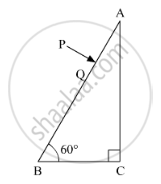
A ray PQ incident normally on the refracting face BA is refracted in the prism BAC made of material of refractive index 1.5. Complete the path of ray through the prism. From which face will the ray emerge? Justify your answer.
Concept: undefined >> undefined
Define mobility of a charge carrier
Concept: undefined >> undefined
Advertisements
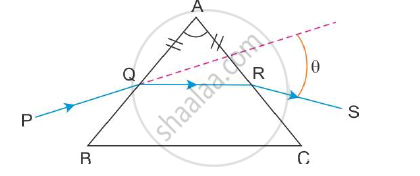
A ray PQ incident on the refracting face BA is refracted in the prism BAC as shown in the figure and emerges from the other refracting face AC as RS such that AQ = AR. If the angle of prism A = 60° and refractive index of material of prism is `sqrt3 `. Calculate angle θ.
Concept: undefined >> undefined
Write the important characteristic features by which the interference can be distinguished from the observed diffraction pattern.
Concept: undefined >> undefined
A ray PQ incident on the face AB of a prism ABC, as shown in the figure, emerges from the face AC such that AQ = AR.
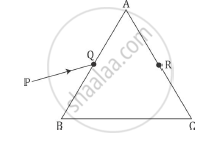
Draw the ray diagram showing the passage of the ray through the prism. If the angle of the prism is 60° and refractive index of the material of prism is `sqrt3` , determine the values of angle of incidence and angle of deviation
Concept: undefined >> undefined
A ray of light passes through an equilateral glass prism such that the angle of incidence is equal to the angle of emergence and each of these angles is equal to 3/4 of angle of prism. Find the angle of deviation.
Concept: undefined >> undefined
Write the necessary conditions to obtain sustained interference fringes.
Concept: undefined >> undefined
Show variation of resistivity of copper as a function of temperature in a graph.
Concept: undefined >> undefined
Two charged spherical conductors of radii R1 and R2 when connected by a conducting wire acquire charges q1 and q2 respectively. Find the ratio of their surface charge densities in terms of their radii.
Concept: undefined >> undefined
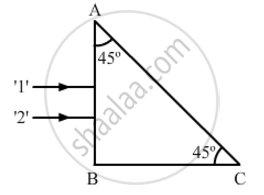
Two monochromatic rays of light are incident normally on the face AB of an isosceles right-angled prism ABC. The refractive indices of the glass prism for the two rays '1' and '2' are respectively 1.38 and 1.52. Trace the path of these rays after entering through the prism.
Concept: undefined >> undefined
In the previous question, obtaining the frequency of revolution of the electron in its circular orbit. Does the answer depend on the speed of the electron? Explain.
Concept: undefined >> undefined
What is a dispersion of light
Concept: undefined >> undefined
What is the cause of dispersion of light
Concept: undefined >> undefined
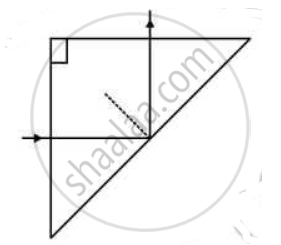
A ray of light incident normally on one face of a right isosceles prism is totally reflected, as shown in fig. What must be the minimum value of refractive index of glass? Give relevant calculations.
Concept: undefined >> undefined
Define the term 'conductivity' of a metallic wire. Write its SI unit.
Concept: undefined >> undefined
Using the concept of free electrons in a conductor, derive the expression for the conductivity of a wire in terms of number density and relaxation time. Hence obtain the relation between current density and the applied electric field E.
Concept: undefined >> undefined
Draw the ray diagram showing refraction of light through a glass prism and hence obtain the relation between the refractive index μ of the prism, angle of prism and angle of minimum deviation.
Concept: undefined >> undefined
Describe an activity to show that the colours of white light splitted by a glass prism can be recombined to get white light by another identical glass prism. Also, draw a ray diagram to show the recombination of the spectrum of white light.
Concept: undefined >> undefined
Define the term 'electrical conductivity' of a metallic wire. Write its S.I. unit.
Concept: undefined >> undefined
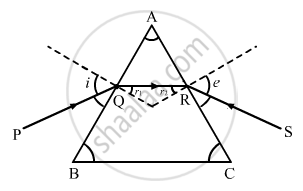
Figure shows a ray of light passing through a prism. If the refracted ray QR is parallel to the base BC, show that (i) r1 = r2 = A/2 and (ii) angle of minimum deviation, Dm = 2i − A.
Concept: undefined >> undefined
