मराठी

Science (English Medium) इयत्ता १२ - CBSE Question Bank Solutions

Advertisements
[object Object]
[object Object]
विषय
मुख्य विषय
अध्याय

Please select a subject first

Advertisements
Advertisements
< prev  22581 to 22600 of 25884  next > 

In Young's double-slit experiment, the two slits are separated by a distance of 1.5 mm, and the screen is placed 1 m away from the plane of the slits. A beam of light consisting of two wavelengths of 650 nm and 520 nm is used to obtain interference fringes.
Find the least distance from the central maximum where the bright fringes due to both the wavelengths coincide.

[10] Wave Optics
Chapter: [10] Wave Optics
Concept: undefined >> undefined

Two parallel uniformly charged infinite plane sheets, '1' and '2', have charge densities + `sigma and -2sigma `respectively. Give the magnitude and direction of the net electric field at a point.
(i) in between the two sheets and
(ii) outside near the sheet '1'.

[2] Electrostatic Potential and Capacitance
Chapter: [2] Electrostatic Potential and Capacitance
Concept: undefined >> undefined

Advertisements

The wavelength and intensity of light emitted by a LED depend upon ______.

[14] Semiconductor Electronics - Materials, Devices and Simple Circuits
Chapter: [14] Semiconductor Electronics - Materials, Devices and Simple Circuits
Concept: undefined >> undefined

What is a solar cell?

[14] Semiconductor Electronics - Materials, Devices and Simple Circuits
Chapter: [14] Semiconductor Electronics - Materials, Devices and Simple Circuits
Concept: undefined >> undefined

Explain the three processes involved in the working of a solar cell.

[14] Semiconductor Electronics - Materials, Devices and Simple Circuits
Chapter: [14] Semiconductor Electronics - Materials, Devices and Simple Circuits
Concept: undefined >> undefined

A uniform magnetic field of 1.5 T exists in a cylindrical region of radius 10.0 cm, its direction parallel to the axis along east to west. A wire carrying current of 7.0 A in the north to south direction passes through this region. What is the magnitude and direction of the force on the wire if,

(a) the wire intersects the axis,

(b) the wire is turned from N-S to northeast-northwest direction,

(c) the wire in the N-S direction is lowered from the axis by a distance of 6.0 cm?

[4] Moving Charges and Magnetism
Chapter: [4] Moving Charges and Magnetism
Concept: undefined >> undefined
The maximum electric field that a dielectric medium can withstand without break-down is called its ______.
[2] Electrostatic Potential and Capacitance
Chapter: [2] Electrostatic Potential and Capacitance
Concept: undefined >> undefined
If in a parallel plate capacitor, which is connected to a battery, we fill dielectrics in whole space of its plates, then which of the following increases?
[2] Electrostatic Potential and Capacitance
Chapter: [2] Electrostatic Potential and Capacitance
Concept: undefined >> undefined
Two parallel circular coils of equal radii having equal number of turns placed coaxially and separated by a distance equal to the radii of the coils carrying equal currents in same direction are known as ______.
[4] Moving Charges and Magnetism
Chapter: [4] Moving Charges and Magnetism
Concept: undefined >> undefined
A charged particle moves through a magnetic field in a direction perpendicular to it. Then the ______.
[4] Moving Charges and Magnetism
Chapter: [4] Moving Charges and Magnetism
Concept: undefined >> undefined

A parallel plate air capacitor is charged to a potential difference of V volts. After disconnecting the charging battery the distance between the plates of the capacitor is increased using an insulating handle. As a result the potential difference between the plates ______.

[2] Electrostatic Potential and Capacitance
Chapter: [2] Electrostatic Potential and Capacitance
Concept: undefined >> undefined

Current flows through uniform, square frames as shown in the figure. In which case is the magnetic field at the centre of the frame not zero?

[4] Moving Charges and Magnetism
Chapter: [4] Moving Charges and Magnetism
Concept: undefined >> undefined

Capacitor plates are charged by a battery with ‘V’ volts. After charging the battery is disconnected and a dielectric slab with dielectric constant ‘K’ is inserted between its plates, the potential across the plates of a capacitor will become ____________.

[2] Electrostatic Potential and Capacitance
Chapter: [2] Electrostatic Potential and Capacitance
Concept: undefined >> undefined

A free electron and a free proton are placed between two oppositely charged parallel plates. Both are closer to the positive plate than the negative plate.
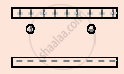
Which of the following statements is true?

  1. The force on the proton is greater than the force on the electron.
  2. The potential energy of the proton is greater than that of the electron.
  3. The potential energy of the proton and the electron is the same.
[2] Electrostatic Potential and Capacitance
Chapter: [2] Electrostatic Potential and Capacitance
Concept: undefined >> undefined

Name the device which converts the change in intensity of illumination to change in electric current flowing through it. Plot I-V characteristics of this device for different intensities. State any two applications of this device.

[14] Semiconductor Electronics - Materials, Devices and Simple Circuits
Chapter: [14] Semiconductor Electronics - Materials, Devices and Simple Circuits
Concept: undefined >> undefined

In Figure, assuming the diodes to be ideal ______.

[14] Semiconductor Electronics - Materials, Devices and Simple Circuits
Chapter: [14] Semiconductor Electronics - Materials, Devices and Simple Circuits
Concept: undefined >> undefined

The amplifiers X, Y and Z are connected in series. If the voltage gains of X, Y and Z are 10, 20 and 30, respectively and the input signal is 1 mV peak value, then what is the output signal voltage (peak value)

  1. if dc supply voltage is 10V?
  2. if dc supply voltage is 5V?
[14] Semiconductor Electronics - Materials, Devices and Simple Circuits
Chapter: [14] Semiconductor Electronics - Materials, Devices and Simple Circuits
Concept: undefined >> undefined

If the resistance R1 is increased (Figure), how will the readings of the ammeter and voltmeter change?

[14] Semiconductor Electronics - Materials, Devices and Simple Circuits
Chapter: [14] Semiconductor Electronics - Materials, Devices and Simple Circuits
Concept: undefined >> undefined

Read the following paragraph and answer the questions.

LED is a heavily doped P-N junction which under forward bias emits spontaneous radiation. When it is forward-biased, due to recombination of holes and electrons at the junction, energy is released in the form of photons. In the case of Si and Ge diode, the energy released in recombination lies in the infrared region. LEDs that can emit red, yellow, orange, green and blue light are commercially available. The semiconductor used for fabrication of visible LEDs must at least have a band gap of 1.8 eV. The compound semiconductor Gallium Arsenide – Phosphide is used for making LEDs of different colours.


LEDs of different kinds

  1. Why are LEDs made of compound semiconductor and not of elemental semiconductors?
  2. What should be the order of bandgap of an LED, if it is required to emit light in the visible range?
  3. A student connects the blue coloured LED as shown in the figure. The LED did not glow when switch S is closed. Explain why?

    OR
    iii. Draw V-I characteristic of a p-n junction diode in
    (i) forward bias and (ii) reverse bias
[14] Semiconductor Electronics - Materials, Devices and Simple Circuits
Chapter: [14] Semiconductor Electronics - Materials, Devices and Simple Circuits
Concept: undefined >> undefined

Why a photo-diode is operated in reverse bias whereas the current in the forward bias is much larger than that in the reverse bias? Explain. Mention its two uses.

[14] Semiconductor Electronics - Materials, Devices and Simple Circuits
Chapter: [14] Semiconductor Electronics - Materials, Devices and Simple Circuits
Concept: undefined >> undefined
< prev  22581 to 22600 of 25884  next > 
Advertisements
Advertisements
CBSE Science (English Medium) इयत्ता १२ Question Bank Solutions
Question Bank Solutions for CBSE Science (English Medium) इयत्ता १२ Biology
Question Bank Solutions for CBSE Science (English Medium) इयत्ता १२ Chemistry
Question Bank Solutions for CBSE Science (English Medium) इयत्ता १२ Computer Science (C++)
Question Bank Solutions for CBSE Science (English Medium) इयत्ता १२ Computer Science (Python)
Question Bank Solutions for CBSE Science (English Medium) इयत्ता १२ English Core
Question Bank Solutions for CBSE Science (English Medium) इयत्ता १२ English Elective - NCERT
Question Bank Solutions for CBSE Science (English Medium) इयत्ता १२ Entrepreneurship
Question Bank Solutions for CBSE Science (English Medium) इयत्ता १२ Geography
Question Bank Solutions for CBSE Science (English Medium) इयत्ता १२ Hindi (Core)
Question Bank Solutions for CBSE Science (English Medium) इयत्ता १२ Hindi (Elective)
Question Bank Solutions for CBSE Science (English Medium) इयत्ता १२ History
Question Bank Solutions for CBSE Science (English Medium) इयत्ता १२ Informatics Practices
Question Bank Solutions for CBSE Science (English Medium) इयत्ता १२ Mathematics
Question Bank Solutions for CBSE Science (English Medium) इयत्ता १२ Physical Education
Question Bank Solutions for CBSE Science (English Medium) इयत्ता १२ Physics
Question Bank Solutions for CBSE Science (English Medium) इयत्ता १२ Political Science
Question Bank Solutions for CBSE Science (English Medium) इयत्ता १२ Psychology
Question Bank Solutions for CBSE Science (English Medium) इयत्ता १२ Sanskrit (Core)
Question Bank Solutions for CBSE Science (English Medium) इयत्ता १२ Sanskrit (Elective)
Question Bank Solutions for CBSE Science (English Medium) इयत्ता १२ Sociology
Share
Notifications

Englishहिंदीमराठी


      Forgot password?
Use app×