Please select a subject first
Advertisements
Advertisements
Distinguish between polarized and unpolarized light. Does the intensity of polarized light emitted by a polaroid depend on its orientation? Explain briefly.
The vibration in a beam of polarized light make an angle of 60° with the axis of the polaroid sheet. What percentage of light is transmitted through the sheet?
Concept: undefined >> undefined
Describe the working principle of a solar cell. Mention three basic processes involved in the generation of emf.
Concept: undefined >> undefined
Advertisements
Why are Si and GaAs preferred materials for solar cells?
Concept: undefined >> undefined
Gautam went for a vacation to the village where his grandmother lived. His grandmother took him to watch 'nautanki' one evening. They noticed a blackbox connected to the mike lying nearby. Gautam's grandmother did not know what that box was. When she asked this question to Gautam, he explained to her that it was an amplifier.
(i) Which values were displayed by the grandmother? How can inculcation of these values in students be promoted?
(ii) What is the function of an amplifier?
(iii) Which basic electronic device is used in the amplifier?
Concept: undefined >> undefined
Why is potentiometer preferred over a voltmeter for comparison of emf. of cells?
Concept: undefined >> undefined
A small conducting sphere of radius 'r' carrying a charge +q is surrounded by a large concentric conducting shell of radius Ron which a charge +Q is placed. Using Gauss's law, derive the expressions for the electric field at a point 'x'
(i) between the sphere and the shell (r < x < R),
(ii) outside the spherical shell.
Concept: undefined >> undefined
A circuit is set up by connecting inductance L = 100 mH, resistor R = 100 Ω and a capacitor of reactance 200 Ω in series. An alternating emf of \[150\sqrt{2}\] V, 500/π Hz is applies across this series combination. Calculate the power dissipated in the resistor.
Concept: undefined >> undefined
Distinguish between unpolarised and linearly polarised light.
Concept: undefined >> undefined
A partially plane polarised beam of light is passed through a polaroid. Show graphically the variation of the transmitted light intensity with angle of rotation of the polaroid ?
Concept: undefined >> undefined
Explain with the help of a diagram how sunlight is polarised by scattering through atmospheric particles ?
Concept: undefined >> undefined
Explain briefly how sunlight is polarised by scattering through atmospheric particles.
Concept: undefined >> undefined
The emf of a cell is always greater than its terminal voltage. Why? Give reason.
Concept: undefined >> undefined
Using Gauss’ law deduce the expression for the electric field due to a uniformly charged spherical conducting shell of radius R at a point
(i) outside and (ii) inside the shell.
Plot a graph showing variation of electric field as a function of r > R and r < R.
(r being the distance from the centre of the shell)
Concept: undefined >> undefined
Using Gauss’s law, prove that the electric field at a point due to a uniformly charged infinite plane sheet is independent of the distance from it.
Concept: undefined >> undefined
How is the field directed if (i) the sheet is positively charged, (ii) negatively charged?
Concept: undefined >> undefined
Figure shows a block diagram of a transmitter identify the boxes ‘X’ and ‘Y’ and write their functions.
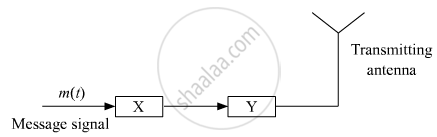
Concept: undefined >> undefined
Figure shows a block diagram of a detector for amplitude modulated signal. Identify the boxes ‘X’ and ‘Y’ and write their functions.

Concept: undefined >> undefined
What is an unpolarized light? Explain with the help of suitable ray diagram how an unpolarized light can be polarized by reflection from a transparent medium. Write the expression for Brewster angle in terms of the refractive index of denser medium.
Concept: undefined >> undefined
If the angle between the pass axis of polarizer and the analyser is 45º, write the ratio of the intensities of original light and the transmitted light after passing through the analyser.
Concept: undefined >> undefined
A charge Q is uniformly distributed on a spherical shell. What is the field at the centre of the shell? If a point charge is brought close to the shell, will the field at the centre change? Does your answer depend on whether the shell is conducting or non-conducting?
Concept: undefined >> undefined
