Advertisements
Advertisements
प्रश्न
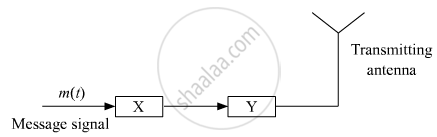
Figure shows a block diagram of a transmitter identify the boxes ‘X’ and ‘Y’ and write their functions.
Advertisements
उत्तर
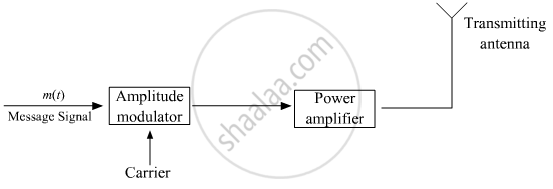
Modulator: Since the frequency range of signal is quiet low and it is associated with very small amount of energy, it dies out very soon if transmitted as such. So, it is modulated by mixing with very high frequency waves called carrier waves. This is done by modulator power. Amplifier: Since the signal gets weaken after travelling through long distances it cannot be transmitted as such. Thus, we use a power amplifier to provide it necessary power before feeding the signal to the transmitting antenna.
APPEARS IN
संबंधित प्रश्न
For a CE-transistor amplifier, the audio signal voltage across the collector resistance of 2 kΩ is 2 V. Suppose the current amplification factor of the transistor is 100, find the input signal voltage and base current if the base resistance is 1 kΩ.
Draw a circuit diagram of a p-n-p transistor and explain how it works as a transistor amplifier
Define the terms : Input resistance How are these determined using typical input and output characteristics?
Under what condition does the transistor act as an amplifier?
Draw a labelled diagram of a common emitter amplifier, showing waveforms of the signal voltage and output voltage.
Figure shows a block diagram of a detector for amplitude modulated signal. Identify the boxes ‘X’ and ‘Y’ and write their functions.

Consider an amplifier circuit using a transistor. The output power is several times greater than the input power. Where does the extra power come from?
Draw a circuit diagram for the common emitter transistor amplifier. What is meant by phase reversal?
In common emitter amplifier, the current gain is 62. The collector resistance and input resistance are 5 kΩ and 500 Ω respectively. If the input voltage is 0.01 V, the output voltage is:
When a junction transistor is used as an amplifier in CE-mode,
