Please select a subject first
Advertisements
Advertisements
An object is placed at a distance u from a simple microscope of focal length f. The angular magnification obtained depends
Concept: undefined >> undefined
A man is looking at a small object placed at his near point. Without altering the position of his eye or the object, he puts a simple microscope of magnifying power 5 X before his eyes. The angular magnification achieved is
Concept: undefined >> undefined
Advertisements
In which of the following the final image is erect?
(a) Simple microscope
(b) Compound microscope
(c) Astronomical telescope
(d) Galilean telescope
Concept: undefined >> undefined
The focal length of the objective of a compound microscope if fo and its distance from the eyepiece is L. The object is placed at a distance u from the objective. For proper working of the instrument,
(a) L < u
(b) L > u
(c) fo < L < 2fo
(d) L > 2fo
Concept: undefined >> undefined
A compound microscope forms an inverted image of an object. In which of the following cases it it likely to create difficulties?
Concept: undefined >> undefined
An object is to be seen through a simple microscope of focal length 12 cm. Where should the object be placed so as to produce maximum angular magnification? The least distance for clear vision is 25 cm.
Concept: undefined >> undefined
A simple microscope is rated 5 X for a normal relaxed eye. What will be its magnifying power for a relaxed farsighted eye whose near point is 40 cm?
Concept: undefined >> undefined
Consider the following two statements :-
(A) Line spectra contain information about atoms.
(B) Band spectra contain information about molecules.
Concept: undefined >> undefined
Can the image formed by a simple microscope be projected on a screen without using any additional lens or mirror?
Concept: undefined >> undefined
A simple microscope using a single lens often shows coloured image of a white source. Why?
Concept: undefined >> undefined
The magnifying power of a converging lens used as a simple microscope is `(1+D/f).` A compound microscope is a combination of two such converging lenses. Why don't we have magnifying power `(1+D/f_0)(1+D/f_0)`?In other words, why can the objective not be treated as a simple microscope but the eyepiece can?
Concept: undefined >> undefined
The separation between the objective and the eyepiece of a compound microscope can be adjusted between 9.8 cm to 11.8 cm. If the focal lengths of the objective and the eyepiece are 1.0 cm and 6 cm respectively, find the range of the magnifying power if the image is always needed at 24 cm from the eye
Concept: undefined >> undefined
An eye can distinguish between two points of an object if they are separated by more than 0.22 mm when the object is placed at 25 cm from the eye. The object is now seen by a compound microscope having a 20 D objective and 10 D eyepiece separated by a distance of 20 cm. The final image is formed at 25 cm from the eye. What is the minimum separation between two points of the object which can now be distinguished?
Concept: undefined >> undefined
A compound microscope consists of an objective of focal length 1 cm and an eyepiece of focal length 5 cm. An object is placed at a distance of 0.5 cm from the objective. What should be the separation between the lenses so that the microscope projects an inverted real image of the object on a screen 30 cm behind the eyepiece?
Concept: undefined >> undefined
A lady uses + 1.5 D glasses to have normal vision from 25 cm onwards. She uses a 20 D lens as a simple microscope to see an object. Find the maximum magnifying power if she uses the microscope (a) together with her glass (b) without the glass. Do the answers suggest that an object can be more clearly seen through a microscope without using the correcting glasses?
Concept: undefined >> undefined
An electric dipole is placed in a uniform electric field. The net electric force on the dipole
Concept: undefined >> undefined
Can the potential difference across a battery be greater than its emf?
Concept: undefined >> undefined
Two non-ideal batteries are connected in series. Consider the following statements:-
(A) The equivalent emf is larger than either of the two emfs.
(B) The equivalent internal resistance is smaller than either of the two internal resistances.
Concept: undefined >> undefined
Two non-ideal batteries are connected in parallel. Consider the following statements:-
(A) The equivalent emf is smaller than either of the two emfs.
(B) The equivalent internal resistance is smaller than either of the two internal resistances.
Concept: undefined >> undefined
The following figure shows an arrangement to measure the emf ε and internal resistance r of a battery. The voltmeter has a very high resistance and the ammeter also has some resistance. The voltmeter reads 1.52 V when the switch S is open. When the switch is closed, the voltmeter reading drops to 1.45 V and the ammeter reads 1.0 A. Find the emf and the internal resistance of the battery.
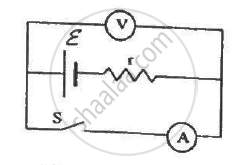
Concept: undefined >> undefined
