Advertisements
Advertisements
A hockey player is moving northward and suddenly turns westward with the same speed to avoid an opponent. The force that acts on the player is ______.
Concept: undefined >> undefined
A body of mass 2 kg travels according to the law x(t) = pt + qt2 + rt3 where p = 3 ms−1, q = 4 ms−2 and r = 5 ms−3. The force acting on the body at t = 2 seconds is ______.
Concept: undefined >> undefined
Advertisements
The motion of a particle of mass m is given by x = 0 for t < 0 s, x(t) = A sin 4 pt for 0 < t < (1/4) s (A > o), and x = 0 for t > (1/4) s. Which of the following statements is true?
- The force at t = (1/8) s on the particle is – 16π2 Am.
- The particle is acted upon by on impulse of magnitude 4π2 A m at t = 0 s and t = (1/4) s.
- The particle is not acted upon by any force.
- The particle is not acted upon by a constant force.
- There is no impulse acting on the particle.
Concept: undefined >> undefined
The position time graph of a body of mass 2 kg is as given in figure. What is the impulse on the body at t = 0 s and t = 4 s.
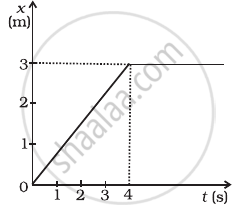
Concept: undefined >> undefined
Why does a child feel more pain when she falls down on a hard cement floor, than when she falls on the soft muddy ground in the garden?
Concept: undefined >> undefined
A woman throws an object of mass 500 g with a speed of 25 ms1.
- What is the impulse imparted to the object?
- If the object hits a wall and rebounds with half the original speed, what is the change in momentum of the object?
Concept: undefined >> undefined
Figure shows (x, t), (y, t ) diagram of a particle moving in 2-dimensions.
|
|
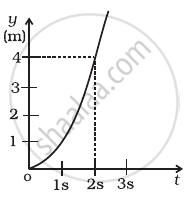 (b) |
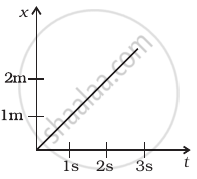
If the particle has a mass of 500 g, find the force (direction and magnitude) acting on the particle.
Concept: undefined >> undefined
A bicyclist comes to a skidding stop in 10 m. During this process, the force on the bicycle due to the road is 200 N and is directly opposed to the motion. The work done by the cycle on the road is ______.
Concept: undefined >> undefined
A body of mass 0.5 kg travels in a straight line with velocity v = a x3/2 where a = 5 m–1/2s–1. The work done by the net force during its displacement from x = 0 to x = 2 m is ______.
Concept: undefined >> undefined
A body is moving unidirectionally under the influence of a source of constant power supplying energy. Which of the diagrams shown in figure correctly shows the displacement-time curve for its motion?
Concept: undefined >> undefined
A body is being raised to a height h from the surface of earth. What is the sign of work done by applied force?
Concept: undefined >> undefined
A body is being raised to a height h from the surface of earth. What is the sign of work done by gravitational force?
Concept: undefined >> undefined
A graph of potential energy V(x) verses x is shown in figure. A particle of energy E0 is executing motion in it. Draw graph of velocity and kinetic energy versus x for one complete cycle AFA.
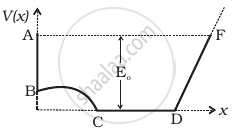
Concept: undefined >> undefined
A block of mass 1 kg is pushed up a surface inclined to horizontal at an angle of 30° by a force of 10 N parallel to the inclined surface (Figure). The coefficient of friction between block and the incline is 0.1. If the block is pushed up by 10 m along the incline, calulate
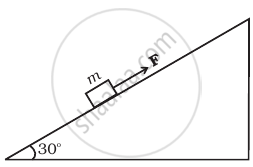
- work done against gravity
- work done against force of friction
- increase in potential energy
- increase in kinetic energy
- work done by applied force.
Concept: undefined >> undefined
The earth is an approximate sphere. If the interior contained matter which is not of the same density everywhere, then on the surface of the earth, the acceleration due to gravity ______.
Concept: undefined >> undefined
Which of the following options are correct?
- Acceleration due to gravity decreases with increasing altitude.
- Acceleration due to gravity increases with increasing depth (assume the earth to be a sphere of uniform density).
- Acceleration due to gravity increases with increasing latitude.
- Acceleration due to gravity is independent of the mass of the earth.
Concept: undefined >> undefined
The stress-strain graphs for two materials are shown in figure (assume same scale).
 Material (i) |
 Material (i) |
- Material (ii) is more elastic than material (i) and hence material (ii) is more brittle.
- Material (i) and (ii) have the same elasticity and the same brittleness.
- Material (ii) is elastic over a larger region of strain as compared to (i).
- Material (ii) is more brittle than material (i).
Concept: undefined >> undefined
The stress-strain graphs for two materials are shown in figure (assume same scale).
Material (i) |
Material (i) |
- Material (ii) is more elastic than material (i) and hence material (ii) is more brittle.
- Material (i) and (ii) have the same elasticity and the same brittleness.
- Material (ii) is elastic over a larger region of strain as compared to (i).
- Material (ii) is more brittle than material (i).
Concept: undefined >> undefined
Pressure decreases as one ascends the atmosphere. If the density of air is ρ, what is the change in pressure dp over a differential height dh?
Concept: undefined >> undefined
Considering the pressure p to be proportional to the density, find the pressure p at a height h if the pressure on the surface of the earth is p0.
Concept: undefined >> undefined
