Please select a subject first
Advertisements
Advertisements
Why should the objective of a telescope have large focal length and large aperture? Justify your answer.
Concept: Optical Instruments >> Telescope
When are two objects just resolved? Explain.
Concept: Optical Instruments >> Simple Microscope or a Reading Glass
How can the resolving power of a compound microscope be increased? Use relevant formula to support your answer.
Concept: Optical Instruments >> Simple Microscope or a Reading Glass
Draw a ray diagram depicting the formation of the image by an astronomical telescope in normal adjustment.
Concept: Optical Instruments >> Telescope
You are given the following three lenses. Which two lenses will you use as an eyepiece and as an objective to construct an astronomical telescope ? Give reason
| Lenses | Power (D) | Aperture (cm) |
| L1 | 3 | 8 |
| L2 | 6 | 1 |
| L3 | 10 | 1 |
Concept: Optical Instruments >> Telescope
Draw a ray diagram to show the working of a compound microscope. Deduce an expression for the total magnification when the final image is formed at the near point.
In a compound microscope, an object is placed at a distance of 1.5 cm from the objective of focal length 1.25 cm. If the eye piece has a focal length of 5 cm and the final image is formed at the near point, estimate the magnifying power of the microscope.
Concept: Optical Instruments >> Simple Microscope or a Reading Glass
What type of wavefront will emerge from a (i) point source, and (ii) distance light source?
Concept: Refraction at a Spherical Surface and Lenses >> Refraction at Spherical Surfaces
Trace the rays of light showing the formation of an image due to a point object placed on the axis of a spherical surface separating the two media of refractive indices n1 and n2. Establish the relation between the distances of the object, the image and the radius of curvature from the central point of the spherical surface.
Hence derive the expression of the lens maker’s formula.
Concept: Thin Lens Formula
Draw the labelled ray diagram for the formation of image by a compound microscope.
Derive the expression for the total magnification of a compound microscope. Explain why both the objective and the eyepiece of a compound microscope must have short focal lengths.
Concept: Optical Instruments >> Simple Microscope or a Reading Glass
Consider a plane wave front incident on a thin convex lens. Draw a proper diagram to show how the incident wave front traverses through the lens and after refraction focusses on the focal point of the lens, giving the shape of the emergent wave front.
Concept: Huygens' Principle
What is an unpolarized light? Explain with the help of suitable ray diagram how an unpolarized light can be polarized by reflection from a transparent medium. Write the expression for Brewster angle in terms of the refractive index of denser medium.
Concept: Plane Polarised Light
State Huygens’s principle. Show, with the help of a suitable diagram, how this principle is used to obtain the diffraction pattern by a single slit.
Draw a plot of intensity distribution and explain clearly why the secondary maxima becomes weaker with increasing order (n) of the secondary maxima.
Concept: Huygens' Principle
You are given following three lenses. Which two lenses will you use as an eyepiece and as an objective to construct an astronomical telescope?
|
Lens |
Power (P) |
Aperture (A) |
|
L1 |
3D |
8 cm |
|
L2 |
6D |
1 cm |
|
L3 |
10D |
1 cm |
Concept: Diffraction of Light >> Resolving Power of Microscope and Astronomical Telescope
If the angle between the pass axis of polarizer and the analyser is 45º, write the ratio of the intensities of original light and the transmitted light after passing through the analyser.
Concept: Plane Polarised Light
In a single slit diffraction experiment, when tiny circular obstacle is placed in path of light from a distance source, a bright spot is seen at the centre of the shadow of the obstacle. Explain why?
Concept: Diffraction of Light >> The Single Slit
The following graph shows the variation of photocurrent for a photosensitive metal :
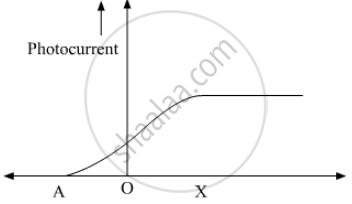
(a) Identify the variable X on the horizontal axis.
(b) What does the point A on the horizontal axis represent?
(c) Draw this graph for three different values of frequencies of incident radiation v1, v2 and v3 (v1 > v2 > v3) for same intensity.
(d) Draw this graph for three different values of intensities of incident radiation I1, I2 and I3 (I1 > I2 > I3) having same frequency.
Concept: Experimental Study of Photoelectric Effect
The work function of the following metals is given : Na 2.75 ev, K = 2.3 eV, Mo = 4.17 eV and Ni = 5.15 eV. Which of these metals will not cause photoelectric emission for radiation of wavelength 3300 Å from a laser source placed 1 m away from these metals? What happens if the laser source is brought nearer and placed 50 cm away?
Concept: Electron Emission
A electron of mass me revolves around a nucleus of charge +Ze. Show that it behaves like a tiny magnetic dipole. Hence prove that the magnetic moment associated wit it is expressed as `vecμ =−e/(2 m_e)vecL `, where `vec L` is the orbital angular momentum of the electron. Give the significance of negative sign.
Concept: Wave Nature of Matter
An α-particle and a proton are accelerated through the same potential difference. Find the ratio of their de Broglie wavelength.
Concept: de-Broglie Relation
Radiation of frequency 1015 Hz is incident on two photosensitive surface P and Q. There is no photoemission from surface P. Photoemission occurs from surface Q but photoelectrons have zero kinetic energy. Explain these observations and find the value of work function for surface Q.
Concept: Einstein’s Equation - Particle Nature of Light
