Advertisements
Advertisements
प्रश्न
Draw a ray diagram to show the working of a compound microscope. Deduce an expression for the total magnification when the final image is formed at the near point.
In a compound microscope, an object is placed at a distance of 1.5 cm from the objective of focal length 1.25 cm. If the eye piece has a focal length of 5 cm and the final image is formed at the near point, estimate the magnifying power of the microscope.
Advertisements
उत्तर
Ray diagram for a compound microscope
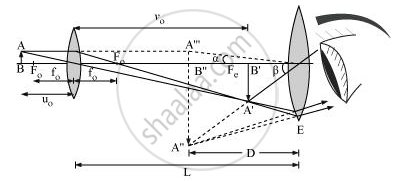
Total angular magnification, `m = beta/alpha`
β → Angle subtended by the image
α → Angle subtended by the object
Since α and β are small,
`tan alpha ≈ alpha and tan beta ≈ beta`
`m= (tanbeta)/(tanalpha)`
`tan alpha = (AB)/D`
And
`tan beta = (A''B'')/D`
`m = (tanbeta)/(tanalpha) = (A''B'')/D xx D/(AB) = (A''B'')/(AB)`
On multiplying the numerator and the denominator with A′B′, we obtain
`m = (A''B'' xx A'B')/(A'B' xx AB)`
Now, magnification produced by objective, `m_0 = (A'B')/(AB)`
Magnification produced by eyepiece, `m_e = (A''B'')/(AB)`
Therefore,
Total magnification, (m) = m0 me
`m_0 = ( V_0) / (u_0) =(\text { Image distance for image produced by objective lens})/(\text { Object distance for the objective lens})`
`m_e = (1+D/(f_e))`
fe → Focal length of eyepiece
`m = m_0m_e`
`= V_0/u_0(1+D/f_e)`
`V_0 ≈ L`(Separation between the lenses)
`u_0 ≈ -f_0`
`therefore m = (-L)/(f_0) (1 +D/f_e)`
`u_0 = -1.5 cm`
`f_0 = +1.5cm`
`1/f_0 = 1/v_0 - 1/u_0`
`1/1.25 =1/v_0 + 1/1.5`
`1/v_0=1/1.25 - 1/1.5`
`= 100/125 - 10/15`
`= (1500 -1250)/1875`
`1/v_0 = 250/1875`
`v_0 = + 7.5 cm`
`f_e = + 5cm`
`m =v_0/u_0 (1+D/f_e)`
`= 7.5 / - 1.5 (1+25/5)`
`= - 7.5/1.5 xx 6`
`m =-30`
APPEARS IN
संबंधित प्रश्न
A giant refracting telescope has an objective lens of focal length 15 m. If an eye piece of focal length 1.0 cm is used, what is the angular magnification of the telescope ?
Draw a labelled ray diagram showing the formation of a final image by a compound microscope at least distance of distinct vision
How can the resolving power of a compound microscope be increased? Use relevant formula to support your answer.
A simple microscope using a single lens often shows coloured image of a white source. Why?
The separation between the objective and the eyepiece of a compound microscope can be adjusted between 9.8 cm to 11.8 cm. If the focal lengths of the objective and the eyepiece are 1.0 cm and 6 cm respectively, find the range of the magnifying power if the image is always needed at 24 cm from the eye
The near vision of an average person is 25 cm. To view an object with an angular magnification of 10, what should be the power of the microscope?
| A compound microscope consists of two converging lenses. One of them, of smaller aperture and smaller focal length, is called objective and the other of slightly larger aperture and slightly larger focal length is called eye-piece. Both lenses are fitted in a tube with an arrangement to vary the distance between them. A tiny object is placed in front of the objective at a distance slightly greater than its focal length. The objective produces the image of the object which acts as an object for the eye-piece. The eye-piece, in turn, produces the final magnified image. |
In a compound microscope, the images formed by the objective and the eye-piece are respectively.
| A compound microscope consists of two converging lenses. One of them, of smaller aperture and smaller focal length, is called objective and the other of slightly larger aperture and slightly larger focal length is called eye-piece. Both lenses are fitted in a tube with an arrangement to vary the distance between them. A tiny object is placed in front of the objective at a distance slightly greater than its focal length. The objective produces the image of the object which acts as an object for the eye-piece. The eye-piece, in turn, produces the final magnified image. |
Which of the following is not correct in the context of a compound microscope?
| A compound microscope consists of two converging lenses. One of them, of smaller aperture and smaller focal length, is called objective and the other of slightly larger aperture and slightly larger focal length is called eye-piece. Both lenses are fitted in a tube with an arrangement to vary the distance between them. A tiny object is placed in front of the objective at a distance slightly greater than its focal length. The objective produces the image of the object which acts as an object for the eye-piece. The eye-piece, in turn, produces the final magnified image. |
A compound microscope consists of an objective of 10X and an eye-piece of 20X. The magnification due to the microscope would be:
What is meant by a microscope in normal use?
