Advertisements
Advertisements
प्रश्न
Draw a ray diagram to show the working of a compound microscope. Deduce an expression for the total magnification when the final image is formed at the near point.
In a compound microscope, an object is placed at a distance of 1.5 cm from the objective of focal length 1.25 cm. If the eye piece has a focal length of 5 cm and the final image is formed at the near point, estimate the magnifying power of the microscope.
Advertisements
उत्तर
Ray diagram for a compound microscope
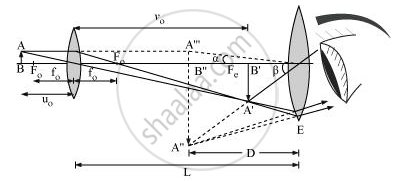
Total angular magnification, `m = beta/alpha`
β → Angle subtended by the image
α → Angle subtended by the object
Since α and β are small,
`tan alpha ≈ alpha and tan beta ≈ beta`
`m= (tanbeta)/(tanalpha)`
`tan alpha = (AB)/D`
And
`tan beta = (A''B'')/D`
`m = (tanbeta)/(tanalpha) = (A''B'')/D xx D/(AB) = (A''B'')/(AB)`
On multiplying the numerator and the denominator with A′B′, we obtain
`m = (A''B'' xx A'B')/(A'B' xx AB)`
Now, magnification produced by objective, `m_0 = (A'B')/(AB)`
Magnification produced by eyepiece, `m_e = (A''B'')/(AB)`
Therefore,
Total magnification, (m) = m0 me
`m_0 = ( V_0) / (u_0) =(\text { Image distance for image produced by objective lens})/(\text { Object distance for the objective lens})`
`m_e = (1+D/(f_e))`
fe → Focal length of eyepiece
`m = m_0m_e`
`= V_0/u_0(1+D/f_e)`
`V_0 ≈ L`(Separation between the lenses)
`u_0 ≈ -f_0`
`therefore m = (-L)/(f_0) (1 +D/f_e)`
`u_0 = -1.5 cm`
`f_0 = +1.5cm`
`1/f_0 = 1/v_0 - 1/u_0`
`1/1.25 =1/v_0 + 1/1.5`
`1/v_0=1/1.25 - 1/1.5`
`= 100/125 - 10/15`
`= (1500 -1250)/1875`
`1/v_0 = 250/1875`
`v_0 = + 7.5 cm`
`f_e = + 5cm`
`m =v_0/u_0 (1+D/f_e)`
`= 7.5 / - 1.5 (1+25/5)`
`= - 7.5/1.5 xx 6`
`m =-30`
APPEARS IN
संबंधित प्रश्न
If this telescope is used to view the moon, what is the diameter of the image of the moon formed by the objective lens ? the diameter of the moon is 3.48 × 10⁶ m and the radius of lunar orbit is 3.8 × 10⁸m.
When viewing through a compound microscope, our eyes should be positioned not on the eyepiece but a short distance away from it for best viewing. Why? How much should be that short distance between the eye and eyepiece?
An angular magnification (magnifying power) of 30X is desired using an objective of focal length 1.25 cm and an eyepiece of focal length 5 cm. How will you set up the compound microscope?
A compound microscope has an objective of focal length 1.25 cm and eyepiece of focal length 5 cm. A small object is kept at 2.5 cm from the objective. If the final image formed is at infinity, find the distance between the objective and the eyepiece ?
An object is placed at a distance u from a simple microscope of focal length f. The angular magnification obtained depends
Can the image formed by a simple microscope be projected on a screen without using any additional lens or mirror?
The magnifying power of a converging lens used as a simple microscope is `(1+D/f).` A compound microscope is a combination of two such converging lenses. Why don't we have magnifying power `(1+D/f_0)(1+D/f_0)`?In other words, why can the objective not be treated as a simple microscope but the eyepiece can?
In the case of a regular prism, in minimum deviation position, the angle made by the refracted ray (inside the prism) with the normal drawn to the refracting surface is ______.
With the help of a ray diagram, show how a compound microscope forms a magnified image of a tiny object, at least distance of distinct vision. Hence derive an expression for the magnification produced by it.
| A compound microscope consists of two converging lenses. One of them, of smaller aperture and smaller focal length, is called objective and the other of slightly larger aperture and slightly larger focal length is called eye-piece. Both lenses are fitted in a tube with an arrangement to vary the distance between them. A tiny object is placed in front of the objective at a distance slightly greater than its focal length. The objective produces the image of the object which acts as an object for the eye-piece. The eye-piece, in turn, produces the final magnified image. |
In a compound microscope, the images formed by the objective and the eye-piece are respectively.
