Please select a subject first
Advertisements
Advertisements
A long straight wire of a circular cross-section of radius ‘a’ carries a steady current ‘I’. The current is uniformly distributed across the cross-section. Apply Ampere’s circuital law to calculate the magnetic field at a point ‘r’ in the region for (i) r < a and (ii) r > a.
Concept: Ampere’s Circuital Law
State the underlying principle of working of a moving coil galvanometer. Write two reasons why a galvanometer can not be used as such to measure current in a given circuit. Name any two factors on which the current sensitivity of a galvanometer depends.
Concept: Moving Coil Galvanometer
Magnetic field lines can be entirely confined within the core of a toroid, but not within a straight solenoid. Why?
Concept: Solenoid and the Toroid - the Toroid
Derive the expression for force per unit length between two long straight parallel current carrying conductors. Hence define one ampere.
Concept: Force Between Two Parallel Currents, the Ampere
Explain the principle and working of a cyclotron with the help of a schematic diagram. Write the expression for cyclotron frequency.
Concept: Cyclotron
Predict the polarity of the capacitor in the situation described below :
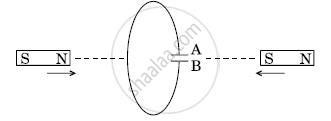
Concept: The Bar Magnet
Why should the material used for making permanent magnets have high coercivity?
Concept: Permanent Magnet
What is the direction of induced currents in metal rings 1 and 2 when current I in the wire is increasing steadily?
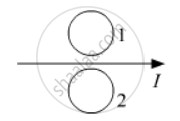
Concept: Lenz’s Law and Conservation of Energy
Show diagrammatically how an alternating emf is generated by a loop of wire rotating in a magnetic field. Write the expression for the instantaneous value of the emf induced in the rotating loop.
Concept: Electromagnetic Induction
Define self inductance. Write its S.I. units.
Concept: Inductance >> Self Inductance
Derive an expression for self inductance of a long solenoid of length l, cross-sectional area A having N number of turns.
Concept: Inductance >> Self Inductance
Why does current in a steady state not flow in a capacitor connected across a battery? However momentary current does flow during charging or discharging of the capacitor. Explain.
Concept: Different Types of AC Circuits: AC Voltage Applied to a Series LCR Circuit
A series LCR circuit is connected to a source having voltage v = vm sin ωt. Derive the expression for the instantaneous current I and its phase relationship to the applied voltage.
Obtain the condition for resonance to occur. Define ‘power factor’. State the conditions under which it is (i) maximum and (ii) minimum.
Concept: Different Types of AC Circuits: AC Voltage Applied to a Series LCR Circuit
Derive an expression for the average power consumed in a series LCR circuit connected to a.c. source in which the phase difference between the voltage and the current in the circuit is Φ.
Concept: Different Types of AC Circuits: AC Voltage Applied to a Series LCR Circuit
Describe briefly, with the help of labelled diagram, working of a step-up transformer.
A step-up transformer converts a low voltage into high voltage. Does it not violate the principle of conservation of energy? Explain.
Concept: Transformers
You are given the following three lenses. Which two lenses will you use as an eyepiece and as an objective to construct a compound microscope?
| Lenses | Power (D) | Aperture (cm) |
| L1 | 3 | 8 |
| L2 | 6 | 1 |
| L3 | 10 | 1 |
Concept: Optical Instruments >> Simple Microscope or a Reading Glass
Define resolving power of a microscope and write one factor on which it depends
Concept: Optical Instruments >> Simple Microscope or a Reading Glass
Define the magnifying power of a compound microscope when the final image is formed at infinity. Why must both the objective and the eyepiece of a compound microscope has short focal lengths? Explain.
Concept: Optical Instruments >> Simple Microscope or a Reading Glass
Why should the objective of a telescope have large focal length and large aperture? Justify your answer.
Concept: Optical Instruments >> Telescope
When are two objects just resolved? Explain.
Concept: Optical Instruments >> Simple Microscope or a Reading Glass
