Advertisements
Advertisements
Name one electrical device which works on Faraday's law of electromagnetic induction principle.
Concept: Transformers
If the strength of the current flowing through a wire is increased, the strength of the magnetic field produced by it ______.
Concept: Force on a Current-Carrying Conductor Placed in a Uniform Magnetic Field
A copper conductor is placed over two stretched copper wires whose ends ate connected to a D.C. supply as shown in the diagram.
- What should be the magnetic poles at the points A and B lying on either side of the conductor to experience the force in the upward direction?
- Name the law used to find these polarities.

Concept: Force on a Current-Carrying Conductor Placed in a Uniform Magnetic Field
State two factors affecting the coil's rotation speed in a D.C. motor.
Concept: Simple D.C. Motor
State one factor that affects the magnitude of induced current in an AC generator.
Concept: Alternating-Current Generator
|
Given below is a circuit to study the magnetic effect of electric current. ABCD is a cardboard kept perpendicular to the conductor XY. A magnetic compass is placed at the point P of the cardboard. P1 and P2 are the positions of the magnetic compass, before and after passing a current through XY respectively.
|

- Name the rule that is used to predict the direction of deflection of the magnetic compass.
- State the direction of current in the conductor (X to Y or Y to X) when the circuit is complete.
- If resistance R is increased, then what will be the effect on the magnetic lines of force around the conductor?
Concept: Right-hand Thumb Rule
Current is flowing through a coil as shown in the figure. Which one of the given figures will correctly depict the magnetic polarity and the direction of the lines of force along the axis of the coil?
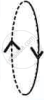
Concept: Applications of Ampere’s Circuital Law > Magnetic Field of a Long Straight Solenoid
Name the principle of AC generator.
Concept: Faraday's Laws of Electromagnetic Induction
State the use of the principle of electromagnetic induction.
Concept: Faraday's Laws of Electromagnetic Induction
|
The graph (fig A) illustrates the correlation between the number of protons (x-axis) and the number of neutrons (y-axis) for elements A, B, C, D, and E in the periodic table. These elements are denoted by the letters rather than their conventional symbols. When the element C, depicted in the graph, undergoes radioactive decay, it releases radioactive rays. When these rays are directed into the plane of the paper in the presence of a magnetic field, as indicated in the fig B, they experience deflection, causing them to move upwards.
|
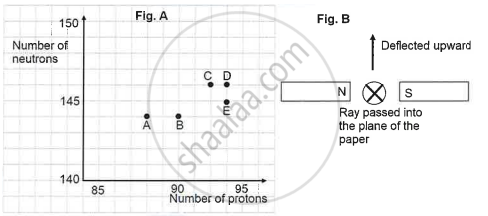
Name the law used to identify the radioactive radiation emitted by the element.
Concept: Force on a Current-Carrying Conductor Placed in a Uniform Magnetic Field
Define heat capacity and state its SI unit.
Concept: Specific Heat Capacity
A solid of mass 50 g at 150 °C is placed in 100 g of water at 11 °C when the final temperature recorded is 20 °C. Find the specific heat capacity of the solid. (specific heat capacity of water = 4.2 J/g °C)
Concept: Specific Heat Capacity
You have a choice of three metals A, B, and C, of specific heat capacities 900 Jkg-1 °C-1, 380 Jkg-1 °C-1 and 460 Jkg-1 °C-1 respectively, to make a calorimeter. Which material will you select? Justify your answer.
Concept: Specific Heat Capacity
Calculate the mass of ice needed to cool 150 g of water contained in a calorimeter of mass 50 g at 32 °C such that the final temperature is 5 °C. Specific heat capacity of calorimeter = 0.4 J g-1 °C-1, Specific heat capacity of water = 4.2 J g-1°C-1, latent heat capacity of ice = 330 J g-1.
Concept: Specific Heat Capacity
Calculate the mass of ice required to lower the temperature of 300 g of water 40°C to water at 0°C.
(Specific latent heat of ice = 336 J/g, the Specific heat capacity of water = 4.2J/g°C)
Concept: Specific Heat Capacity
What do you understand by the following statements:
The heat capacity of the body is 60JK-1.
Concept: Specific Heat Capacity
What do you understand by the following statements:
The specific heat capacity of lead is 130 Jkg-1K-1.
Concept: Specific Heat Capacity
State two factors upon which the heat absorbed by a body depends
Concept: Specific Heat Capacity
A copper vessel of mass 100 g contains 150 g of water at 50°C. How much ice is needed to cool it to 5°C?
Given: Specific heat capacity of copper = 0.4 Jg-1 °C-1
The Specific heat capacity of water = 4.2 Jg-1 °C-1
The Specific latent heat of fusion ice = 336 Jg-1
Concept: Specific Heat Capacity
What property of water makes it an effective coolant?
Concept: Specific Heat Capacity
