Advertisements
Advertisements
Answer briefly.
Give two uses of radio waves.
Concept: Electromagnetic Spectrum
Arrange the following electromagnetic radiation in the ascending order of their frequencies:
X-rays, microwaves, gamma rays, radio waves
Concept: Electromagnetic Spectrum
Write two uses of the following radiation.
Gamma rays
Concept: Electromagnetic Spectrum
State the condition under which a large magnification can be achieved in an astronomical telescope.
Concept: Introduction to Optical Instruments >> Telescope
Write the necessary conditions for the phenomenon of total internal reflection to
occur ?
Concept: Total Internal Reflection
Write the relation between the refractive index and critical angle for a given pair of optical media?
Concept: Total Internal Reflection
One day Chetan’s mother developed a severe stomach ache all of a sudden. She was rushed to the doctor who suggested for an immediate endoscopy test and gave an estimate of expenditure for the same. Chetan immediately contacted his class teacher and shared the information with her. The class teacher arranged for the money and rushed to the hospital. On realizing that Chetan belonged to a below average income group family, even the doctor offered concession for the test fee. The test was conducted successfully.
Answer the following questions based on the above information:
(a) Which principle in optics is made use of in endoscopy?
(b) Briefly explain the values reflected in the action taken by the teacher.
(c) In what way do you appreciate the response of the doctor on the given situation?
Concept: Total Internal Reflection
Define magnifying power of a telescope. Write its expression.
Concept: Introduction to Optical Instruments >> Telescope
A small telescope has an objective lens of focal length 150 cm and an eye piece of focal length 5 cm. If this telescope is used to view a 100 m high tower 3 km away, find the height of the final image when it is formed 25 cm away from the eye piece.
Concept: Introduction to Optical Instruments >> Telescope
How is the working of a telescope different from that of a microscope?
Concept: Introduction to Optical Instruments >> Telescope
The focal lengths of the objective and eyepiece of a microscope are 1.25 cm and 5 cm respectively. Find the position of the object relative to the objective in order to obtain an angular magnification of 30 in normal adjustment.
Concept: Introduction to Optical Instruments >> Telescope
A ray of light passes through a prism of refractive index `sqrt2` as shown in the figure. Find:
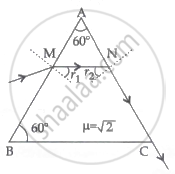
- The angle of incidence (∠r2) at face AC.
- The angle of minimum deviation for this prism.
Concept: Total Internal Reflection
With the help of a ray diagram explain the working of a reflecting telescope.
Concept: Introduction to Optical Instruments >> Telescope
A point object is placed at O in front of a glass sphere as shown in figure.

Show the formation of the image by the sphere.
Concept: Power of a Lens
A concave mirror of focal length 12 cm forms three times the magnified virtual image of an object. Find the distance of the object from the mirror.
Concept: Reflection of Light by Spherical Mirrors
Draw a labelled ray diagram showing the image formation by a refracting telescope. Define its magnifying power.
Concept: Introduction to Optical Instruments >> Telescope
Draw a ray diagram for the formation of image of an object by an astronomical telescope, in normal adjustment. Obtain the expression for its magnifying power.
Concept: Introduction to Optical Instruments >> Telescope
The magnifying power of an astronomical telescope in normal adjustment is 2.9 and the objective and the eyepiece are separated by a distance of 150 cm. Find the focal lengths of the two lenses.
Concept: Introduction to Optical Instruments >> Telescope
Using Huygens's construction of secondary wavelets explain how a diffraction pattern is obtained on a screen due to a narrow slit on which a monochromatic beam of light is incident normally.
Concept: Huygens Principle
In Young's double slit experiment, using monochromatic light of wavelength λ, the intensity of light at a point on the screen where path difference is λ, is K units. Find out the intensity of light at a point where path difference is `λ/3`.
Concept: Interference of Light Waves and Young’s Experiment
