Advertisements
Advertisements
Two identical cells of emf 1.5 V each joined in parallel, supply energy to an external circuit consisting of two resistances of 7 Ω each joined in parallel. A very high resistance voltmeter reads the terminal voltage of cells to be 1.4 V. Calculate the internal resistance of each cell.
Concept: Cells, EMF, and Internal Resistance
Estimate the average drift speed of conduction electrons in a copper wire of cross-sectional area 2.5 × 10⁻⁷ m2 carrying a current of 1.8 A. Assume the density of conduction electrons to be 9 × 1028 m−3.
Concept: Drift of Electrons and the Origin of Resistivity
Estimate the average drift speed of conduction electrons in a copper wire of cross-sectional area 1.0 × 10⁻⁷ m2 carrying a current of 1.5 A. Assume the density of conduction electrons to be 9 × 1028 m−3
Concept: Drift of Electrons and the Origin of Resistivity
Estimate the average drift speed of conduction electrons in a copper wire of cross-sectional area 2·5 × 10−7 m2 carrying a current of 2·7 A. Assume the density of conduction electrons to be 9 × 1028 m−3
Concept: Drift of Electrons and the Origin of Resistivity
A heating element using nichrome connected to a 230 V supply draws an initial current of 3.2 A which settles after a few seconds to a steady value of 2.8 A. What is the steady temperature of the heating element if the room temperature is 27.0°C? The temperature coefficient of resistance of nichrome averaged over the temperature range involved is 1.70 × 10⁻⁴ °C−1.
Concept: Temperature Dependence of Resistivity
In a potentiometer arrangement, a cell of emf 1.25 V gives a balance point at 35.0 cm length of the wire. If the cell is replaced by another cell and the balance point shifts to 63.0 cm, what is the emf of the second cell?
Concept: Cells, EMF, and Internal Resistance
How does drift velocity of electrons in a metallic conductor vary with increase in temperature? Explain.
Concept: Drift of Electrons and the Origin of Resistivity
Plot a graph showing variation of voltage vs the current drawn from the cell. How can one get information from this plot about the emf of the cell and its internal resistance?
Concept: Cells, EMF, and Internal Resistance
State Kirchhoff's rules and explain on what basis they are justified.
Concept: Kirchhoff’s Laws
Given the resistances of 1 Ω, 2 Ω, 3 Ω, how will be combine them to get an equivalent resistance of (11/3) Ω?
Concept: Kirchhoff’s Laws
Given the resistances of 1 Ω, 2 Ω, 3 Ω, how will be combine them to get an equivalent resistance of (11/5) Ω?
Concept: Kirchhoff’s Laws
Show variation of resistivity of Si with temperature in a graph ?
Concept: Temperature Dependence of Resistivity
A potentiometer wire of length 1.0 m has a resistance of 15 Ω. It is connected to a 5 V battery in series with a resistance of 5 Ω. Determine the emf of the primary cell which gives a balance point at 60 cm.
Concept: Cells, EMF, and Internal Resistance
In the circuit shown in the figure, find the total resistance of the circuit and the current in the arm AD.
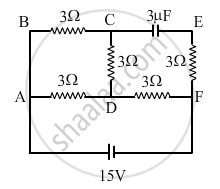
Concept: Ohm's Law
A cell of emf ‘E’ and internal resistance ‘r’ draws a current ‘I’. Write the relation between terminal voltage ‘V’ in terms of E, I and r ?
Concept: Cells, EMF, and Internal Resistance
A heating element is marked 210 V, 630 W. What is the value of the current drawn by the element when connected to a 210 V dc source?
Concept: Resistivity of Various Materials
A heating element is marked 210 V, 630 W. Find the resistance of the element when connected to a 210 V dc source.
Concept: Resistivity of Various Materials
Calculate the value of the resistance R in the circuit shown in the figure so that the current in the circuit is 0.2 A. What would b the potential difference between points B and E?

Concept: Kirchhoff’s Laws
Calculate the value of the resistance R in the circuit shown in the figure so that the current in the circuit is 0.2 A. What would b the potential difference between points A and B?

Concept: Kirchhoff’s Laws
In the given circuit, assuming point A to be at zero potential, use Kirchhoff’s rules to determine the potential at point B.

Concept: Kirchhoff’s Laws
